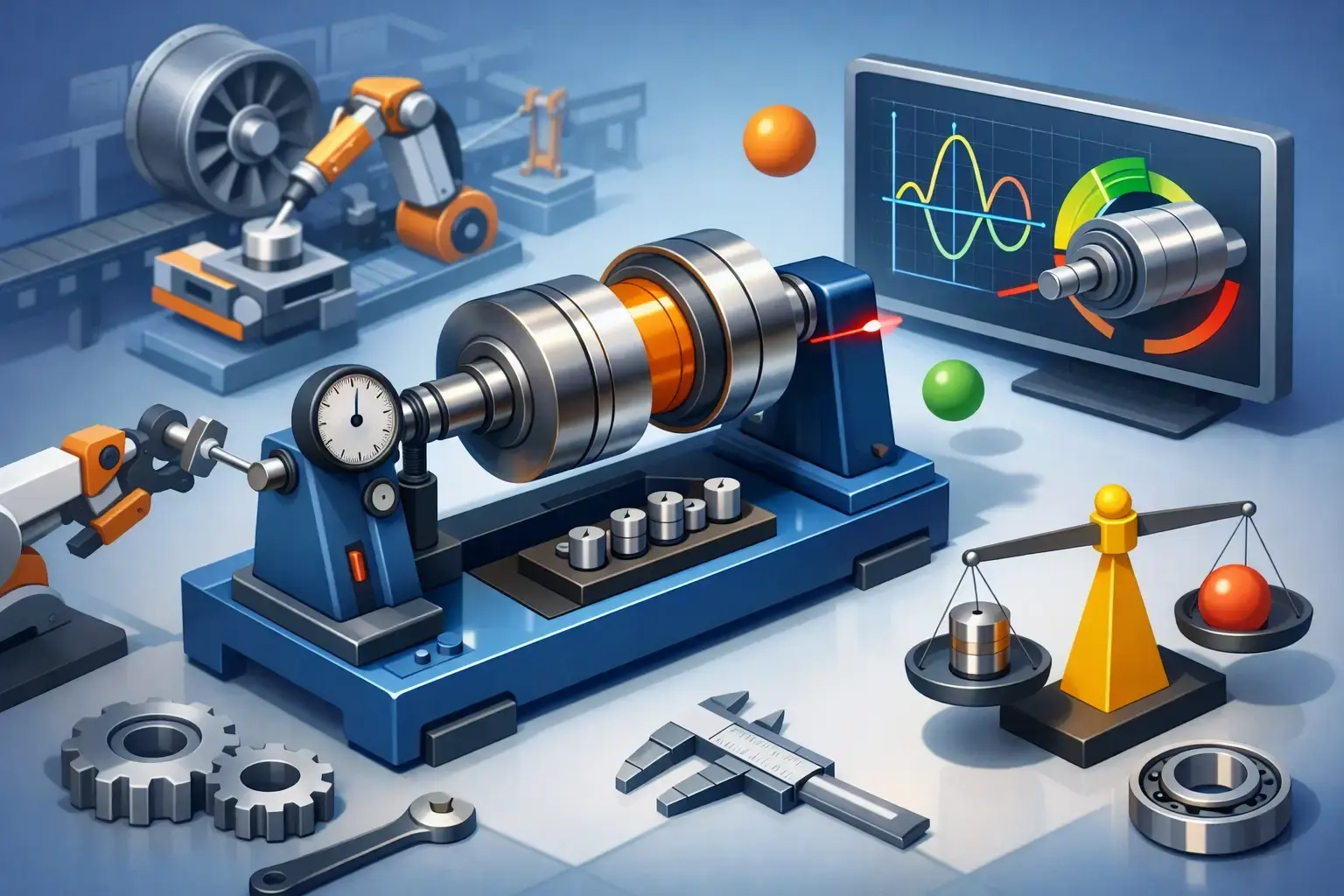
Frequent replacement of the same bearing on a production line, recurring vibration alarms on a test bench, or rotors rejected during final inspection before shipment often point to a single root cause: imbalance. Therefore, the question of why balancing is important in production directly concerns not only quality control but also maintenance, production planning, and cost management. Balancing controls the mass distribution of a rotating part around its axis and enables the machine to operate more stably, safely, and efficiently under actual operating conditions.
The technical meaning of why balancing is important in production
Balancing is the measurement of mass inequality in a rotating part and its reduction to an acceptable level. Even if parts such as rotors, fans, shafts, drums, electric motor armatures, turbine components, or pump impellers appear to have nominally identical geometry, they may develop imbalance due to manufacturing tolerances, differences in material density, machining errors, and assembly deviations.
As rotational speed increases, this imbalance returns to the system as centrifugal force. The result is not limited to vibration. Bearing loads increase, bearing life decreases, the risk of shaft deflection rises, fasteners loosen, and the machine's overall operating stability deteriorates. Especially in high-speed applications, even a small imbalance can turn into serious field problems.
This is where the importance of balancing begins: it is not a process applied only after a problem occurs, but a production discipline that determines product performance and process reliability from the outset.
Its effect on vibration control and equipment life
In rotating equipment, vibration is often the first visible symptom. However, vibration is not a fault in itself; it is the output of an underlying mechanical problem. Imbalance is one of the most common of these problems. When balancing is not performed, the system places additional load on structural components with every revolution.
At the first stage, the operator may notice this as increased noise or abnormal surface movement. At the second stage, bearing heating, coupling strain, and bearing wear come into play. At the third stage, unplanned downtime begins. From a production perspective, the main cost is not the replacement of the part but the spread of downtime across the entire line.
A correctly balanced rotor keeps vibration levels under control. This makes maintenance intervals more predictable. The same result is not obtained in every piece of equipment because operating speed, rotor geometry, tolerance class, and conditions of use vary. Nevertheless, the fundamental fact remains unchanged: balancing is one of the most critical processes for extending mechanical life.
Why is product quality directly affected?
Balancing is often regarded as a maintenance issue. Yet it is directly related to production quality. Particularly for electric motors, fans, pump groups, turbo components, grinding spindles, and precision rotating parts, the balance level determines the performance of the final product.
Even if an unbalanced part passes the testing stage, it may cause problems for the customer under field conditions. Noise levels may rise, energy consumption may increase, and precision may be lost. This increases warranty costs and customer dissatisfaction. From the manufacturer's perspective, the problem is not only technical but also a commercial risk.
The effect of balancing on quality becomes especially visible in mass production. When small deviations accumulate on the same line, batch-based quality fluctuations occur. Such fluctuations return as high rejection rates at final inspection or recurring fault records in the field. Correctly integrating the balancing process into the production flow significantly reduces this variability.
Balancing in terms of energy efficiency and process stability
Unbalanced rotating parts create more mechanical resistance and vibration. This means direct energy loss. The motor, fan, or pump operates under additional load to perform its nominal task. Especially in continuously operating systems, although this loss may appear small, it creates a significant annual cost.
Process stability is also affected. For example, in fan and pump applications requiring precise flow control, imbalance disrupts not only the equipment but also system performance. Similarly, in grinding, machining, or high-speed testing processes, imbalance may affect measurement accuracy and surface quality.
Energy savings are not at the same level in every application. The effect may be more limited in low-speed equipment with broad tolerances. However, in high-speed, continuously operating, or tightly toleranced systems, neglecting balancing generally returns as higher operating costs.
How does it reduce unplanned downtime on the production line?
One of the most expensive problems in industry is unplanned downtime. This is because not only the faulty equipment stops; the processes connected to it are also affected. Failures caused by imbalance often develop slowly but have a sudden impact. Bearing damage, coupling problems, loosened connections, or bearing deformation may grow unnoticed for a long time.
Balancing breaks this chain at an early stage. Pre-production rotor verification, rebalancing after overhaul, or corrective balancing applications supported by vibration analysis under field conditions prevent major failures. This approach helps the maintenance team move from firefighting mode to a planned maintenance discipline.
Especially in facilities operating multiple shifts, making balancing part of the preventive maintenance strategy provides a significant advantage. The objective here is not merely to eliminate the fault but to prevent it from disrupting the production schedule.
In which sectors is its impact more critical?
Balancing is critically important in every sector involving rotating parts. However, the tolerance range is much narrower in some applications. Examples include electric motors and fan groups in automotive, high-precision rotors in aerospace, generator and turbine components in the energy sector, motor systems expected to operate quietly in white goods, reliable rotating equipment in rail systems, and mechanisms requiring continuous performance in the defense industry.
In heavy-duty conditions such as mining, construction, and marine applications, the importance of balancing comes to the fore from a different perspective. Because environmental loads and operating severity are high in these fields, imbalance accelerates equipment wear much more rapidly. In other words, balancing becomes critical for quality in precision sectors and for durability and continuity in heavy industry.
Is a machine alone sufficient for correct balancing?
No. A balancing machine is a critical element, but it is not sufficient on its own. For accurate results, the rotor type, weight, operating speed, support method, tolerance standard, and correction method must be evaluated together. Horizontal and vertical balancing machines address different needs. Automatic systems offer advantages in terms of cycle time and repeatability, especially in high-volume production.
Calibration, operator experience, and software accuracy also directly affect the result. Due to incorrect referencing, improper mounting, or an unsuitable correction method, the balancing process may appear to have been completed even though actual field performance does not reach the expected level.
For this reason, a good balancing infrastructure means more than equipment. Measurement accuracy, technical service support, maintenance continuity, spare-parts access, and the capacity for on-site intervention when required must be evaluated together. Solution partners focused on this field, such as MDBALANS, make a difference precisely at this point because the need is not only machine supply but securing the entire process.
When should balancing be performed?
There is no single answer to this question. Balancing may be required in new production, after overhaul, following part replacement, when an increase in vibration is observed, at specified maintenance intervals, or as part of a risk analysis before a field failure. A periodic verification approach is safer for critical equipment. In more standard applications, balancing performed during end-of-production quality control may be sufficient.
The correct decision depends on the equipment's operating conditions and the cost of failure. If downtime costs are very high, delaying balancing is generally an expensive choice. If the product requires high precision, balancing should be treated not as a final inspection but as an in-process quality step.
Balancing in production should be seen as a control tool, not a cost
Balancing is sometimes perceived as an additional operation. In reality, it is a control mechanism that reduces production losses. It provides lower vibration, longer equipment life, less downtime, more stable quality, and a more predictable maintenance plan. Each of these is directly reflected in production efficiency.
The real issue is not whether balancing is performed, but how accurately and how promptly it is performed. Imbalance is often an invisible problem whose cost grows rapidly. If continuity on the production line, reliable field performance, and customer perception of quality are the goals, balancing is not an option but a fundamental engineering requirement.
Instead of waiting for seemingly minor vibrations in production to turn into major losses, making balancing a natural part of process discipline is always the better step.