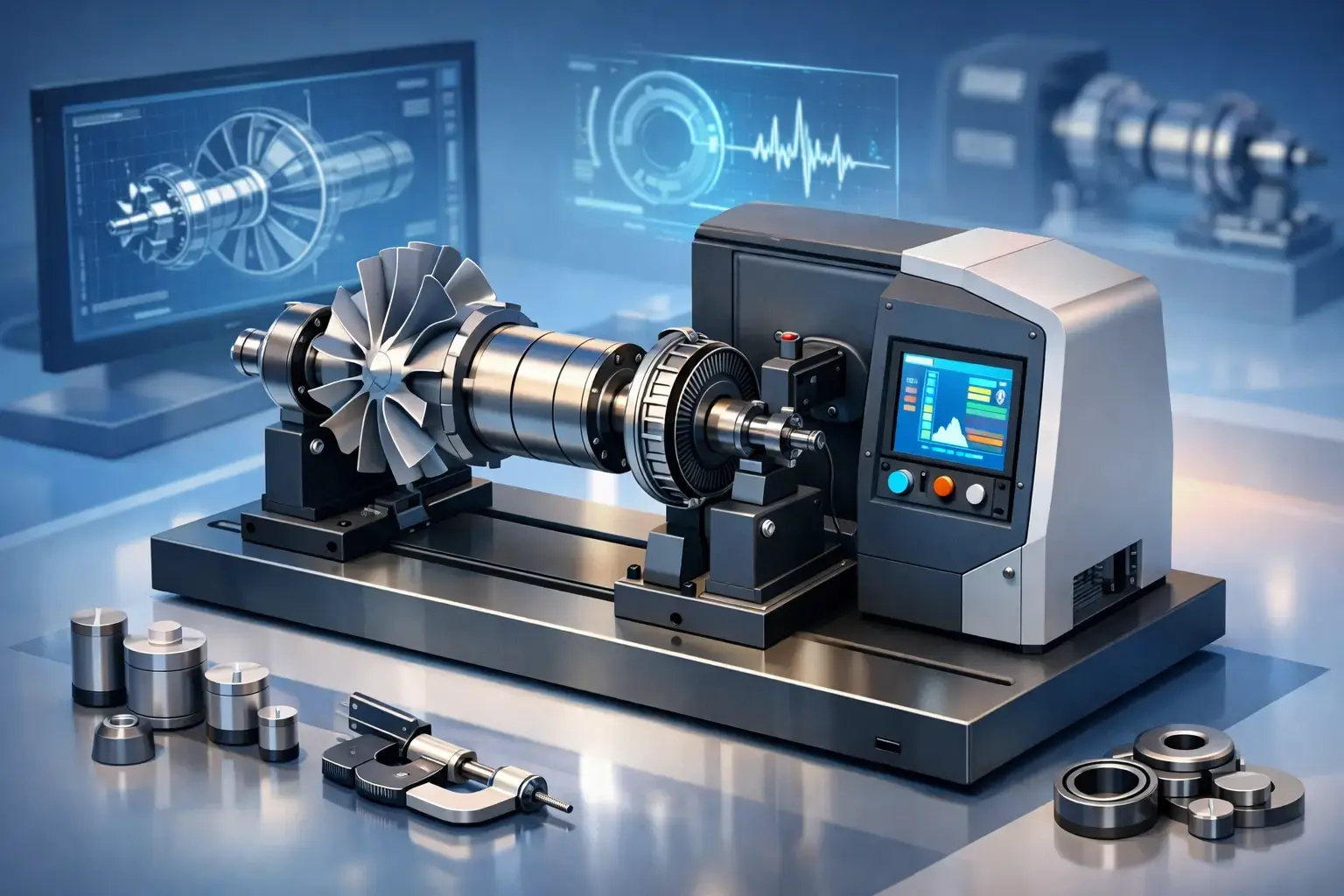
In production lines where millimetric imbalances turn into bearing failures, quality loss, and unplanned downtime by the end of a shift, a high-precision balancing machine is not an option but an essential part of process reliability. Especially in rotor assemblies operating with tight tolerances, balancing quality directly affects not only vibration levels but also product lifespan, energy consumption, and end-user satisfaction. Therefore, the issue is not simply a machine investment, but establishing the right balance between measurement accuracy and production continuity.
Why Does a High-Precision Balancing Machine Become Critical?
Standard balancing applications may be sufficient for many production lines. However, as rotor diameters become smaller, rotational speeds increase, or application requirements become more demanding, tolerances narrow significantly. In applications such as electric motors, fans, turbine components, automotive parts, aerospace equipment, and precision spindle assemblies, even a minor imbalance can lead to significant field failures.
The advantage of a high-precision solution is not merely its ability to detect imbalance. Its real value lies in accurately identifying low-mass correction requirements, delivering consistent results across repeated measurements, and minimizing operator influence. If the measurement system is unstable, the mechanical structure lacks rigidity, or the software generates inconsistent correction recommendations, theoretical precision cannot be achieved in practice.
At this point, one of the most common mistakes decision-makers make is evaluating precision solely based on display resolution. In reality, true precision is the combined performance of sensor quality, spindle construction, bearing system, calibration accuracy, resistance to environmental vibrations, and software algorithms.
The Impact of Precision Balancing on Production
A properly balanced rotor primarily reduces vibration. However, its benefits extend much further. Bearing loads decrease, stress on the shaft and housing is reduced, and sealing components operate with a longer service life. Lower vibration results in quieter operation while also contributing to a more stable production process.
From a manufacturing perspective, this means less scrap, more predictable quality, and lower service costs. From a maintenance perspective, it reduces the need for unplanned maintenance. Especially in mass production environments, even minor improvements in balancing quality can make a significant difference in overall equipment effectiveness.
In some industries, the issue directly concerns safety. The unstable operation of high-speed rotors can cause not only equipment damage but also put operator safety at risk in test stands, production lines, and field applications. For this reason, a high-precision balancing machine is much more than just a quality control device.
Which Applications Require a High-Precision Balancing Machine?
There is no single correct answer. The requirement depends on rotor geometry, weight, operating speed, and quality expectations. While horizontal balancing machines are ideal for long shaft-type rotors, vertical balancing machines may provide greater efficiency for disc-shaped components, flywheels, fan impellers, and compact rotating parts.
If your production line processes different rotor types, flexibility becomes increasingly important. Automatic systems offer advantages in cycle time for high-volume production of identical parts, whereas operator-controlled, high-resolution systems may be a better investment for low-volume but highly critical components.
For electric motor manufacturers, rotor repeatability is essential, while maintenance teams may prioritize the ability to reliably balance components with varying geometries and conditions received from the field. Therefore, machine selection should be based not only on catalog specifications but also on actual application requirements.
Which Technical Criteria Are Most Important When Selecting the Right Machine?
The first consideration is the rotor range. Selecting a machine without clearly defining the minimum and maximum part weight, diameter, length, bearing locations, and operating speed often results in investments that are either unnecessarily expensive or become insufficient within a short period.
The second consideration is measurement precision. Here, it is important to evaluate not only the theoretical minimum residual imbalance but also how consistently this value can be achieved under actual production conditions. Evaluations that ignore workshop floor conditions, surrounding equipment vibrations, and operator variability remain incomplete.
The third consideration is the correction method. In some processes, providing the operator with only the correction angle and amount is sufficient. In others, integration with milling, drilling, welding, or weight addition processes is required. This level of integration directly affects both the software infrastructure and the machine's ergonomics.
The fourth consideration is calibration and service sustainability. Purchasing a high-precision balancing machine alone is not enough. To maintain its precision over time, periodic inspections, proper calibration, and fast technical support are essential. Otherwise, the accuracy achieved during initial installation may become inconsistent within just a few months.
Precision Alone Is Not Enough—Repeatability Matters
One of the most common issues encountered in practice is obtaining a good result during the first measurement but a different result during the second. The cause is often more complex than a simple sensor failure. Fixture errors, inconsistent part positioning by the operator, variations in the drive system, or mechanical wear of the machine can all contribute to inconsistent measurements.
For this reason, a high-quality system does more than simply provide precise measurements. It consistently delivers reliable results when the same part is measured repeatedly under similar conditions. For production engineers, this is one of the fundamental requirements of process capability. For purchasing teams, it means maintaining control over service and quality costs.
Why Are Software, Operator Experience, and Reporting Important?
Balancing operations are often performed under significant time pressure. Systems in which operators struggle to navigate menus, confuse correction directions, or cannot generate traceable reports may reduce production efficiency, even if they are technically advanced.
A well-designed software interface should clearly guide users through rotor identification, tolerance selection, measurement steps, correction instructions, and result verification. In addition, measurement history, user-based operation tracking, and reporting capabilities have become essential requirements for quality documentation in many manufacturing facilities.
Especially in automotive, defense, aerospace, and export-oriented manufacturing, traceability requirements are much higher. Therefore, software capabilities are just as strategically important as the machine's mechanical quality.
Common Mistakes Made During the Investment Decision
The most common mistake is focusing solely on the initial purchase cost. A lower-priced system may appear advantageous in the short term. However, poor repeatability, slower cycle times, limited service support, or inadequate spare parts availability can quickly increase the total cost of ownership.
The second mistake is failing to consider future production capacity. A machine purchased today for a specific rotor family may require replacement within six months if it cannot accommodate a different product group. A certain level of flexibility offers a significant advantage, particularly for growing manufacturing operations.
The third mistake is overlooking the importance of service infrastructure. A balancing machine is a long-term production asset. Regular overhaul, calibration, sensor inspection, mechanical maintenance, and software support are essential. Fast service response is often just as valuable as the machine's technical specifications.
How Is the Right Solution Determined?
The correct approach begins by defining the part and the production process. Rotor dimensions, weight, operating speed, required balancing quality grade, correction method, target cycle time, and operator profile should all be clearly identified. Only then should the machine be evaluated not only for today's requirements but also for its suitability to your medium-term production and maintenance plans.
At this stage, the manufacturer's engineering approach becomes a decisive factor. There is a significant difference between selling a standard machine and developing an application-specific solution. Especially for tight-tolerance applications, fixtures, drive systems, sensor selection, and software parameters should be optimized according to the application. For this reason, companies such as MDBALANS, which provide both machine manufacturing and technical service expertise, are preferred not only for their equipment but also for ensuring long-term process reliability.
The best investment in a high-precision balancing machine is not necessarily the system with the highest technical specifications on paper. The key is finding the solution that best matches your rotor, tolerance requirements, production speed, and service expectations. A properly configured system does more than eliminate imbalance—it makes your production process more stable, predictable, and reliable.