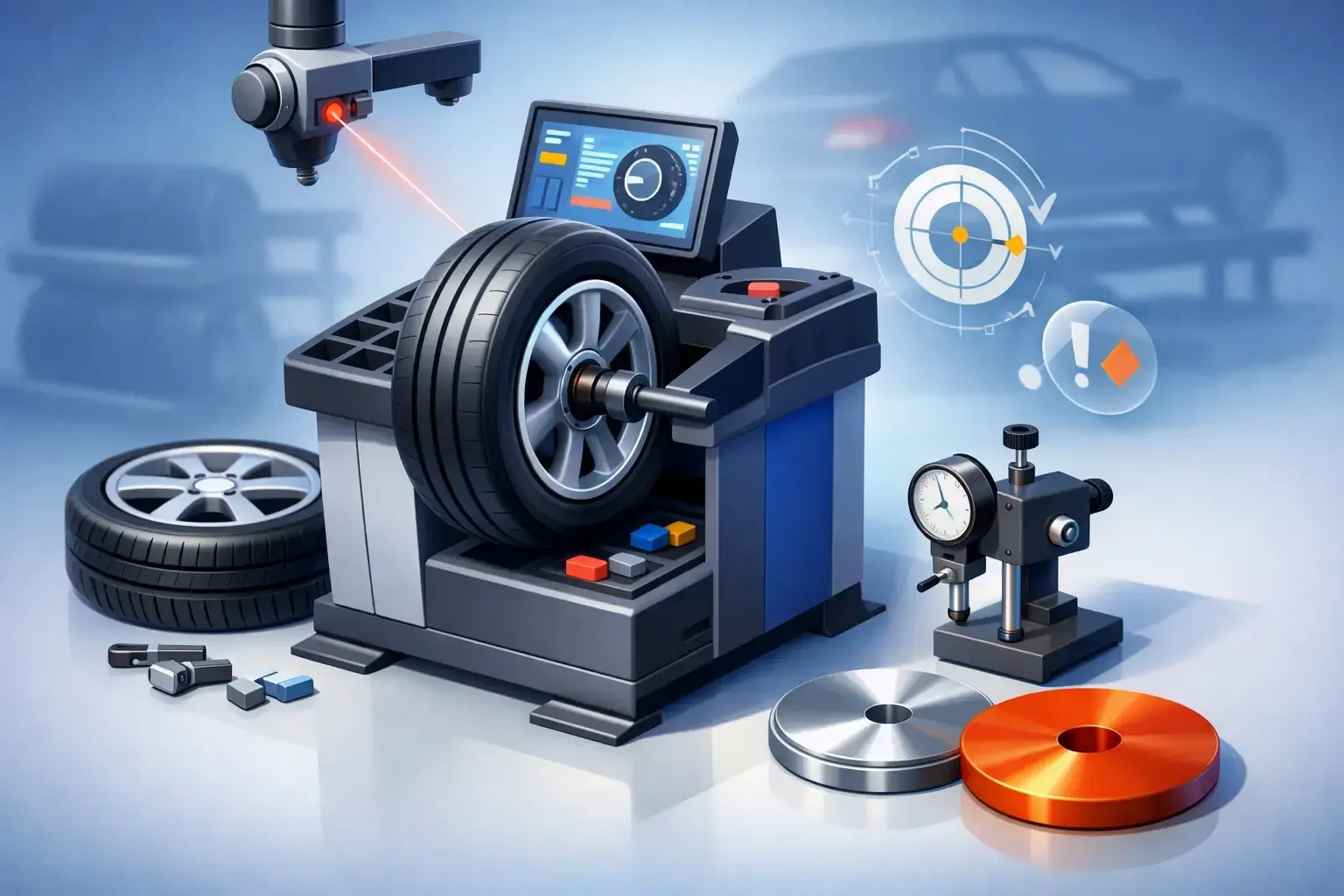
Rotor balancing is usually brought into focus on the shop floor when vibration increases, bearing life decreases, or quality issues become visible. However, in many cases the problem does not originate from the part itself, but from the measurement infrastructure. This is why balancing machine calibration is not just a maintenance task, but a technical necessity that directly determines measurement reliability.
An improperly calibrated balancing machine may produce results that appear reliable to the operator but are actually incorrect. This does not only reduce balancing quality; it also leads to rework, unnecessary weight addition or removal, extended production time, and customer complaints. In industries with tight tolerances, neglecting calibration is not an acceptable risk.
What does balancing machine calibration guarantee?
The main purpose of calibration is to verify that the machine’s measurement output is aligned with known references. The issue is not simply whether the machine is running, but whether it correctly reads imbalance magnitude and angular position.
Measurement accuracy depends on the combined performance of sensors, electronic processing units, mechanical rigidity, bearing condition, drive components, and software parameters. Any deviation in this chain affects the final result. Calibration makes these deviations visible and restores the system to an acceptable accuracy range.
In practice, this means that the same rotor, tolerance target, and operator should always produce consistent results. If results are not repeatable, production reliability is compromised.
How can incorrect calibration be detected in the field?
Some symptoms are immediately noticeable, while others appear as hidden costs over time. Frequent changes in correction values, inconsistent results when reinstalling the same rotor, or higher-than-expected residual imbalance after correction are early indicators.
Additionally, excessive trial attempts by operators, deviations in reference parts, insufficient vibration reduction after final checks, and increasing scrap or rework rates should be carefully evaluated. However, the issue is not always calibration alone; mechanical wear, incorrect fixtures, rotor geometry, or operator errors may also contribute. Still, calibration is one of the first elements that should be checked.
On long-running machines, it is important not to assume that measurement output equals measurement accuracy. In industrial systems, errors often progress silently.
What factors affect balancing machine calibration?
In industrial environments, measurement systems do not operate under stable conditions. Sensor characteristics may drift over time, connections may loosen, electronic components may degrade, and mechanical structures may wear. Transport, impact, heavy usage cycles, or lack of maintenance also affect accuracy.
Environmental conditions also play a major role. Floor stability, ambient temperature, electrical interference, and surrounding vibration sources can degrade measurement quality. Calibration therefore must consider real production conditions, not just internal parameters.
For refurbished or second-hand machines, this becomes even more critical. Even if mechanical restoration is completed, electronic and software alignment must be verified separately. Calibration is an essential part of commissioning.
How should calibration intervals be determined?
There is no single correct interval. Usage intensity, rotor types, tolerance requirements, and industry standards all vary. High-precision, continuously operating facilities require shorter intervals, while low-intensity systems may allow longer periods.
Calibration should not be treated as a corrective action after failure. It must be part of a preventive maintenance schedule and properly documented. In quality-managed systems, calibration history is a key traceability factor.
If sensors are replaced, electronics are serviced, mechanical modifications are made, software is updated, or the machine is relocated, calibration should be performed immediately without waiting for the scheduled period.
What is checked during calibration?
A proper calibration process does not end with attaching a test rotor and reading the screen. First, the overall mechanical condition is evaluated, including bearings, drive systems, connections, protection elements, and frame structure.
Then sensors and measurement channels are tested. The machine response is verified using reference weights, angular position accuracy is checked, and system parameters are adjusted if necessary. On the software side, rotor configuration, plane settings, and operational parameters are reviewed.
A good service approach does not only correct values but also identifies operator-related mistakes that may affect measurement accuracy.
Calibration and maintenance are not the same
Maintenance and calibration serve different purposes. Maintenance ensures the machine operates properly, while calibration verifies measurement accuracy.
A machine may have new bearings, a replaced belt, and a clean system, yet still produce inaccurate measurements. Therefore, these two processes cannot replace each other.
Which industries carry higher risk?
Industries producing electric motors, fans, pumps, turbo components, spindles, defense parts, aerospace components, and high-speed rotors operate under very low tolerance margins.
For maintenance teams, the goal is often to reduce vibration quickly and reliably.
In-house check or external service?
Basic internal checks are useful, but full calibration performed by an expert service provides more reliable results. Experienced teams can identify the root cause of deviations and apply necessary corrections.
Calibration is not a cost, it is process assurance
Calibration is not an optional expense but a fundamental part of production reliability. Incorrect measurement affects the entire production chain.
The most critical factor for accurate balancing is regular, traceable, and professionally executed calibration.