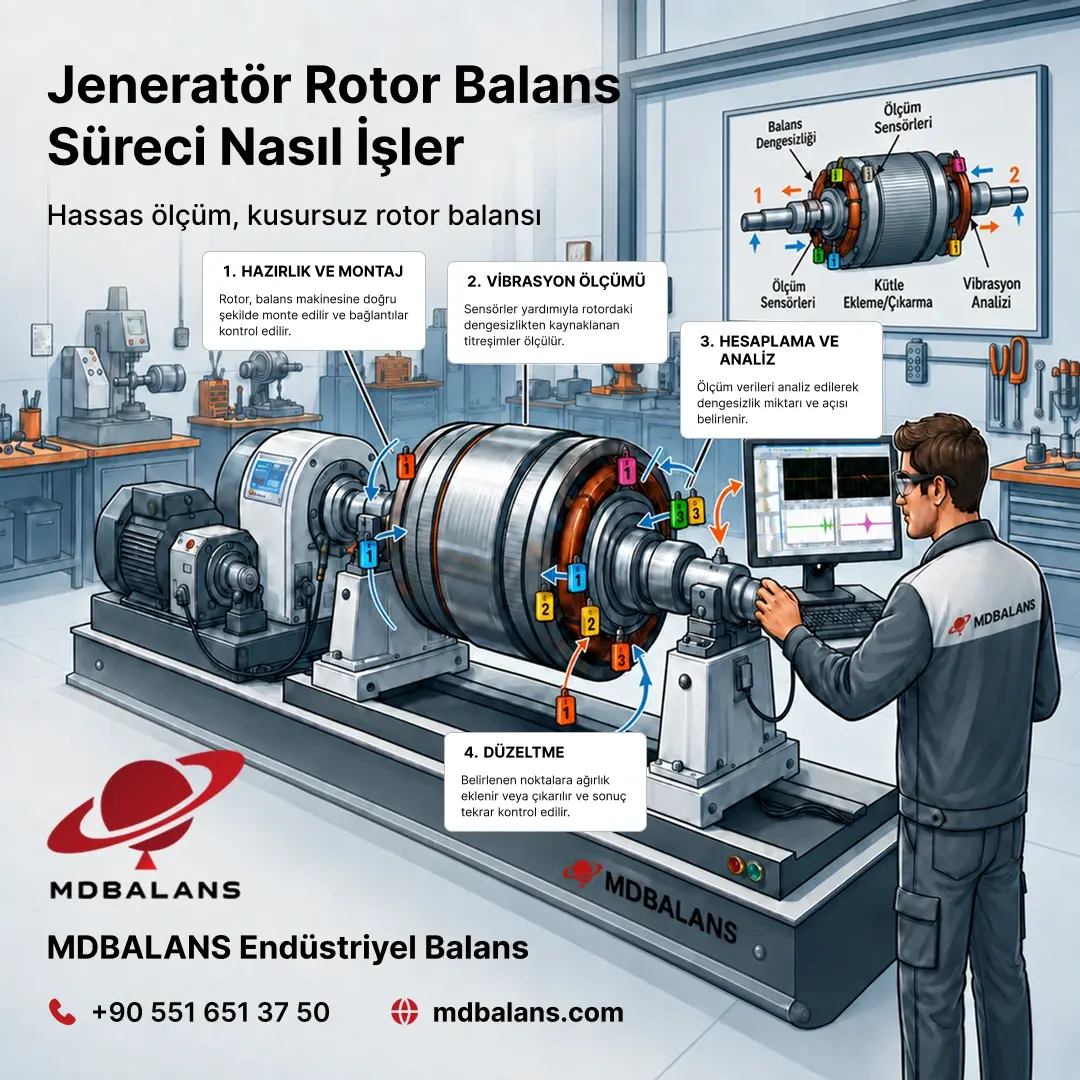
If the rotor is balanced after removal, the machine is put back into operation, and the problem is assumed to be solved, this is exactly where one of the most costly mistakes in the field begins. Generator rotor balancing is not simply a matter of measuring imbalance and adding weight. When performed correctly, it reduces bearing loads, lowers vibration levels, limits stress on the coupling and housing, and extends the generator's reliable operating life.
The need for balancing in generator rotors is often not caused by a single factor. Manufacturing tolerances, geometric changes after repair, winding and insulation processes, fan structure, key effects, dirt accumulation, and thermal differences that occur during operation collectively determine the result. Therefore, rotor balancing is not only a measurement process but also a process of accurate diagnosis.
Why is generator rotor balancing critical?
Imbalance in a generator rotor initially appears as vibration. However, from an operational perspective, the main problem is not the vibration itself but the chain of effects it causes. Increased bearing loads, rising bearing temperatures, reduced coupling life, loosening of connection elements, and fatigue damage in auxiliary equipment are typical links in this chain.
Especially in power generation, heavy industry, and continuously operating facilities, rotor balancing quality directly affects availability. The cost of unplanned downtime is often much higher than the cost of the balancing process. Therefore, the process should not be treated as a secondary task within the maintenance plan but as one of the fundamental steps of reliability management.
Another critical point is that an incorrect balancing application may appear to have been performed correctly. If measurement points are incorrect, the reference is taken incorrectly, or the rotor is rotated in a setup that does not represent actual operating conditions, a seemingly acceptable result may produce vibration again in the field. This causes teams to intervene in the same problem twice.
The first stage of the process: proper preliminary assessment
A successful balancing process begins before the rotor is mounted on the machine. The first step is to clearly determine the rotor type, dimensions, weight, operating speed, bearing arrangement, and application area. The balancing approach for a two-pole high-speed generator rotor is not the same as that for a different low-speed rotor.
At this stage, the mechanical condition of the rotor should also be checked. If there is bending, shaft surface damage, loose components, fan deformation, a missing key, mass changes after welding, or localized material loss, proceeding directly to balancing will not provide accurate results. This is because a balancing machine does not eliminate mechanical defects. It only measures the existing mass distribution.
Cleaning should not be overlooked either. Dirt, oil, resin, or particles accumulated on the rotor can directly affect the measurement result. Especially in rotors requiring precise tolerances, even a few grams of uneven accumulation can mislead the balancing correction.
Static or dynamic?
The most fundamental decision here is whether the rotor requires static or dynamic balancing. Static balancing may be sufficient for narrow and disc-type structures. However, a significant portion of generator rotors have a structure extending along the shaft and may exhibit imbalance in two planes. In this case, dynamic balancing is required.
One of the common mistakes made in the field is evaluating a rotor that exhibits dynamic behavior using a single-plane approach. As a result, improvement may be observed at one end while vibration continues at the other. Therefore, rotor geometry and operating speed are determining factors in the selection of balancing planes.
How is measurement performed during generator rotor balancing?
During the measurement stage, the rotor is mounted on a balancing machine with suitable capacity and rotated in a controlled manner. Sensors collect vibration amplitude and phase information. This data indicates the magnitude and angular position of the imbalance. Although technically simple in appearance, the reliability of the process depends on machine calibration, fixture accuracy, and operator interpretation.
Proper mounting of the rotor is critical. Eccentric mounting, loose seating, or an incorrect drive arrangement distorts the measurement data. In some cases, the problem may not be rotor imbalance but misalignment in the mounting arrangement. Therefore, experienced teams first eliminate effects originating from the setup and then make the correction decision.
The reference point used during measurement is also important. Incorrect definition of the phase angle may cause the correction weight to be applied in the correct amount but at the wrong angle. In such a case, vibration may increase rather than decrease after the first correction. Therefore, the process must be carried out with discipline.
How is the correction method selected?
Balancing correction is not always performed by adding weight. Depending on the rotor design, material removal, weight addition, the use of screws or balancing washers, mass adjustment by welding, or special methods suitable for the manufacturer's design may be preferred. The selection depends on the rotor material, speed, service conditions, and safety requirements.
For example, a temporary and poorly secured correction on a high-speed generator rotor is unacceptable. The behavior of the correction element under centrifugal force must be calculated, and the risk of loosening during long-term operation must be evaluated. An application that reduces vibration in the short term but may cause component detachment in the long term is not an acceptable solution.
Tolerances and acceptance criteria
Simply reducing vibration is not sufficient to declare the balancing process complete. It must be clear according to which standard, quality level, and operating condition the result is evaluated. The rotor's operating speed, mass, and application area affect the acceptance criterion.
Providing a single universal target value here would be misleading. This is because the same residual imbalance level produces different results in rotors of different sizes. In addition, a value that appears satisfactory in a laboratory environment may behave differently under field coupling, bearing, and installation conditions. The correct approach is to determine the quality level appropriate for the rotor's application conditions and verify the result accordingly.
Balancing documentation is also an integral part of the process. The initial value, correction amounts applied, correction angles, final measurement results, and the method used should be recorded. These records facilitate comparison in the event of recurring failures and provide data for maintenance planning.
Why does vibration reoccur in the field?
It is not uncommon for a rotor balanced in the workshop to produce vibration again in the field. The reason is not always poor balancing. Coupling misalignment, soft foot, foundation problems, bearing clearance, installation tolerances, thermal expansion, electromagnetic effects, or process loads occurring during operation can produce similar symptoms.
Therefore, a good engineering approach does not evaluate balancing in isolation. Rotor balancing should be considered together with alignment, bearing inspection, geometric measurement, and vibration analysis. Especially when this comprehensive inspection is not performed during commissioning after an overhaul, teams may search for the problem in the wrong area.
In some cases, the rotor is within acceptable limits when cold, but its behavior changes at operating temperature. This condition, known as thermal imbalance, requires particular attention in critical machinery. In such scenarios, a single standard measurement is not sufficient; additional evaluation representing actual process conditions is required.
What should be considered when selecting a service provider?
Generator rotor balancing is not merely a matter of machine capacity. Technical interpretation capability is just as important as measurement accuracy. The service provider should have experience with the relevant rotor type, suitable fixtures and measurement infrastructure, maintain calibration discipline, and be able to provide on-site support when necessary.
Time pressure is particularly high in production and maintenance operations. However, the right balance between speed and accuracy must be maintained. A process completed very quickly without reporting or without investigating the root cause may lead to a second intervention shortly afterward. Reliable service means not only fast delivery but also technical accuracy that reduces the risk of repeat work.
At this point, a structure such as MDBALANS, which has experience in both balancing machine manufacturing and technical service, can provide an important advantage for decision-makers. This is because equipment capacity and field application requirements are evaluated within the same engineering perspective.
The right process, longer equipment life
Generator rotor balancing should not be regarded as a last-minute addition to the maintenance plan. When performed correctly, it does more than reduce vibration; it protects bearing life, limits energy losses, reduces mechanical stress, and directly contributes to the facility's reliability objectives. When performed incorrectly, the problem is hidden rather than solved.
Therefore, the best result is achieved through a disciplined engineering approach that begins before measurement and continues through post-commissioning. Truly understanding rotor behavior is often more valuable than the correction itself. Because when the diagnosis is correct, the correct balancing result can be made sustainable.