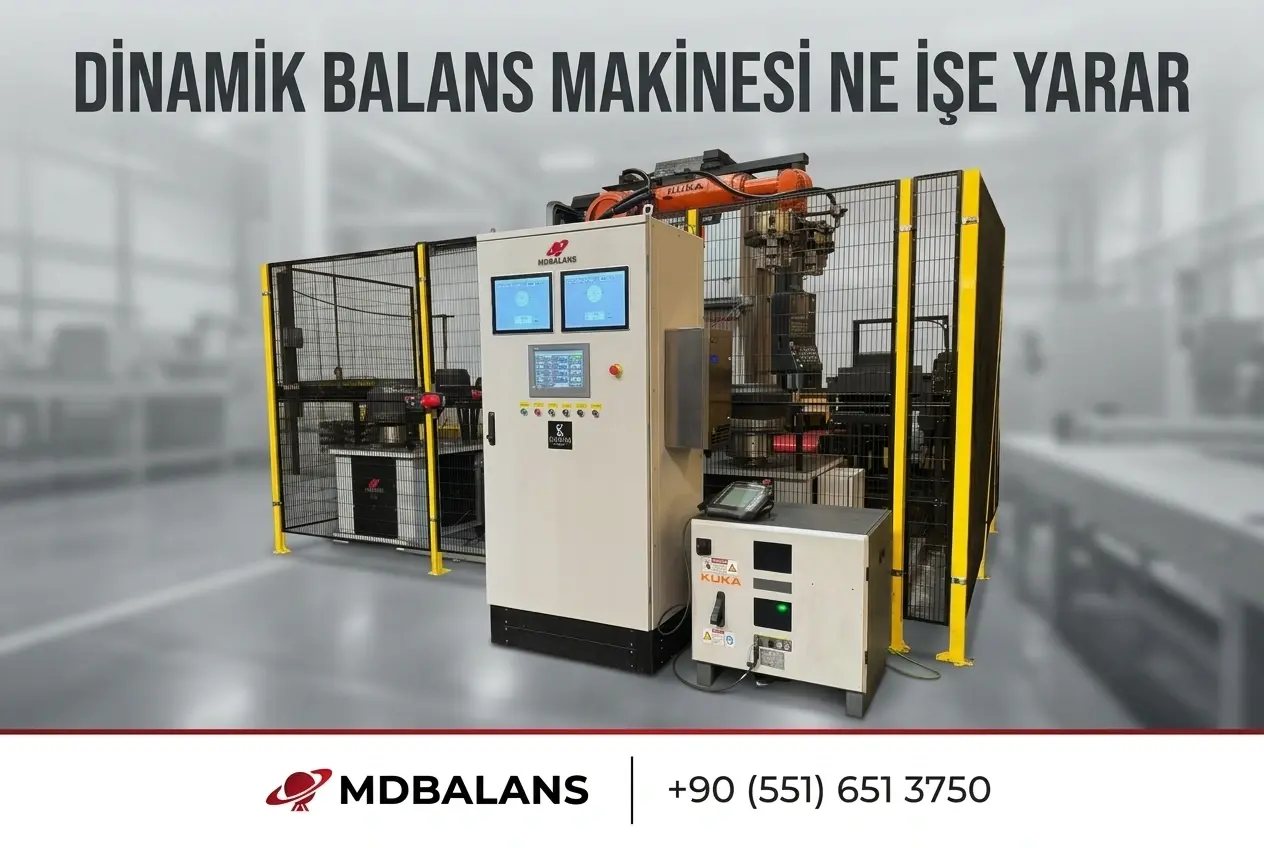
If a rotor generates enough vibration to shut down a production line, the problem is often not material quality but mass distribution. A Dynamic Balancing Machine is a core production and maintenance tool used to measure imbalance in a rotating part, determine correction points, and bring the equipment back into safe operating limits. Especially in high-speed, tight-tolerance, and continuous-operation applications, this machine is not just a quality control step but a direct part of process safety.
Why is a Dynamic Balancing Machine critical?
Imbalance may seem like a small deviation in theory. In practice, it leads to bearing failure, shaft stress, loosened connections, surface quality loss, and unplanned downtime. When the rotor’s center of mass does not align with its axis of rotation, centrifugal forces occur. As speed increases, these forces grow and spread throughout the system.
Therefore, balancing is not only performed to reduce vibration. It is also required to extend machine life, stabilize energy consumption, ensure product quality, and support operator safety. In serial production especially, a poorly balanced part creates a chain reaction of costs in downstream processes.
The Dynamic Balancing Machine provides a key advantage here because it measures imbalance while the rotor is in motion. Static checks may be sufficient in some cases, but dynamic measurement is required to understand two-plane imbalance or high-speed effects. Fan rotors, armatures, electric motor rotors, pump impellers, turbine components, crankshafts, and similar parts often require this approach.
How does a Dynamic Balancing Machine work?
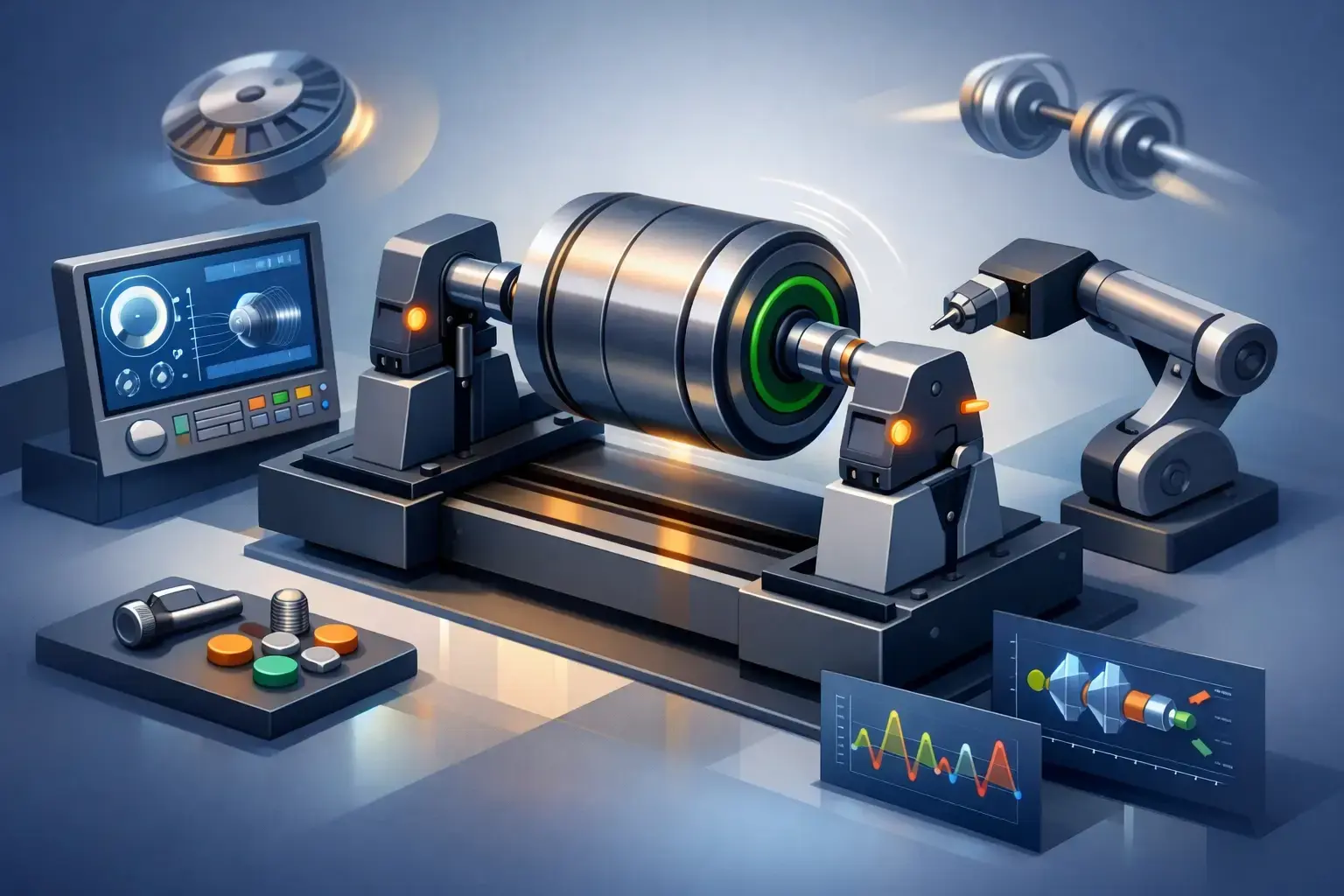
The operating principle is simple, but achieving accurate results requires engineering discipline. The rotor is mounted on the machine’s bearing system or fixtures. While it rotates at a defined speed, sensors measure vibration level, phase angle, and imbalance magnitude. The software processes this data and calculates correction plane, angular position, and required mass adjustment.
The operator then applies the correction using drilling, milling, weight addition, or welding depending on the process. The rotor is run again, and residual imbalance is checked. The process is repeated until the target tolerance is achieved.
The key point is that not every rotor can be balanced with the same setup. Geometry, weight, operating speed, bearing configuration, and quality class directly affect machine configuration. Therefore, accurate results depend not only on the machine, but also on proper fixtures, correct parameter input, and skilled operator handling.
Single-plane vs two-plane balancing
For disc-shaped or narrow rotors, single-plane balancing may be sufficient. However, when rotor length increases or mass distribution affects multiple zones, two-plane balancing becomes necessary. Otherwise, correcting one side may create a new imbalance at the opposite end.
This distinction is especially critical for fan rotors, long shafts, armatures, and multi-component rotating assemblies. Choosing the wrong method may result in acceptable measurement values but poor field performance.
Which industries use it?
A Dynamic Balancing Machine is used across a wide industrial range because any system with rotating parts carries imbalance risk. In the automotive industry, it is used for engine components, clutch parts, and fan assemblies. In electric motor and generator production, rotor quality directly depends on balancing performance. In pumps, compressors, and HVAC systems, vibration levels strongly affect maintenance intervals.
In defense, aerospace, and medical industries, tolerances are much tighter. In these fields, balancing is not only a mechanical requirement but also part of safety and certification processes. In rail, marine, mining, and heavy industry, component sizes are larger, operating conditions are harsher, and field durability becomes more critical.
The shared requirement across all sectors is the same: lower vibration, longer equipment life, and more predictable operating performance.
How to choose the right machine?
Balancing machine selection should not be based solely on rotor weight. This is one of the most common mistakes. While capacity is important, it is not the only factor. Maximum diameter, bearing distance, operating speed, production volume, required tolerance level, and correction method suitability must all be evaluated together.
For low-volume operations handling different rotor types, flexible solutions such as manual or semi-automatic systems may be more appropriate. In mass production environments, automatic data acquisition, recipe storage, operator guidance, and fast clamping systems provide significant efficiency gains. In high-volume lines, even seconds of cycle time matter.
Machine frame rigidity, sensor quality, calibration infrastructure, and software interface are also key selection criteria. Two machines that look similar on paper may perform very differently in terms of repeatability and service support in real operation. Therefore, purchasing decisions should be evaluated not only by initial investment cost but also by long-term operating cost.
Why are service and calibration as important as purchase?
A balancing machine is a precision measurement system. Without regular calibration, correct-looking data may become misleading. This leads to incorrect corrections, wasted time, and quality issues. Sensors, electronics, belt systems, support units, and software must be checked periodically.
Fast technical support is equally important. When a balancing machine in production stops, it often affects the entire workflow, not just one station. Spare parts availability, on-site service capability, and technical consulting are real value factors.
Key factors affecting balancing quality
A good Dynamic Balancing Machine alone is not sufficient. Several factors influence the result. Rotor surface cleanliness, correct mounting, and consistency of reference points are among the most important. If the part is mounted incorrectly, even the best sensors will produce wrong data.
Another critical factor is the representativeness of operating speed. Not every rotor must be balanced at its service speed, but the relationship between test speed and real operating conditions must be correctly established. This becomes more sensitive in flexible rotors and high-speed systems.
Operator skill also matters. Even with advanced software guidance, lack of understanding of correction logic can extend the process. Therefore, trained personnel and technical documentation are significant advantages.
New machine or retrofit?
The answer depends on the situation. An older balancing machine may still be mechanically sound, but its electronics and software may lag behind current requirements. In such cases, retrofit can be a cost-effective solution. Sensor upgrades, control panel modernization, software updates, and calibration can restore performance.
However, if capacity is insufficient, failures are frequent, safety risks exist, or production requirements have changed, investing in a new machine is more reasonable. When production volume increases, tolerances tighten, or automation becomes necessary, limitations of old systems become apparent quickly.
The correct approach is a technical evaluation of machine condition. What is theoretically possible is not always economically or operationally correct in practice.
Why does real field performance require more than one device?
Balancing is often seen as a machine purchase alone. In reality, it is a broader system. Fixture design, rotor analysis, tolerance definition, operator training, calibration planning, and service organization must all be considered together. If one link in this chain is weak, expected performance cannot be achieved.
For this reason, many industrial companies prefer solution partners that provide both equipment and technical support. Having a single point of contact for special part requirements, field balancing, or machine upgrades offers operational advantages. The value of engineering-focused manufacturers and service providers like MDBALANS lies in making the balancing process sustainable, not just supplying machines.
A properly selected and managed Dynamic Balancing Machine is a quietly operating but highly impactful piece of equipment in production. The benefits are clearly visible in reduced vibration, longer bearing life, and improved quality consistency. If rotating parts are central to your operation, balancing should be considered not as a final check, but as a core element of process reliability.