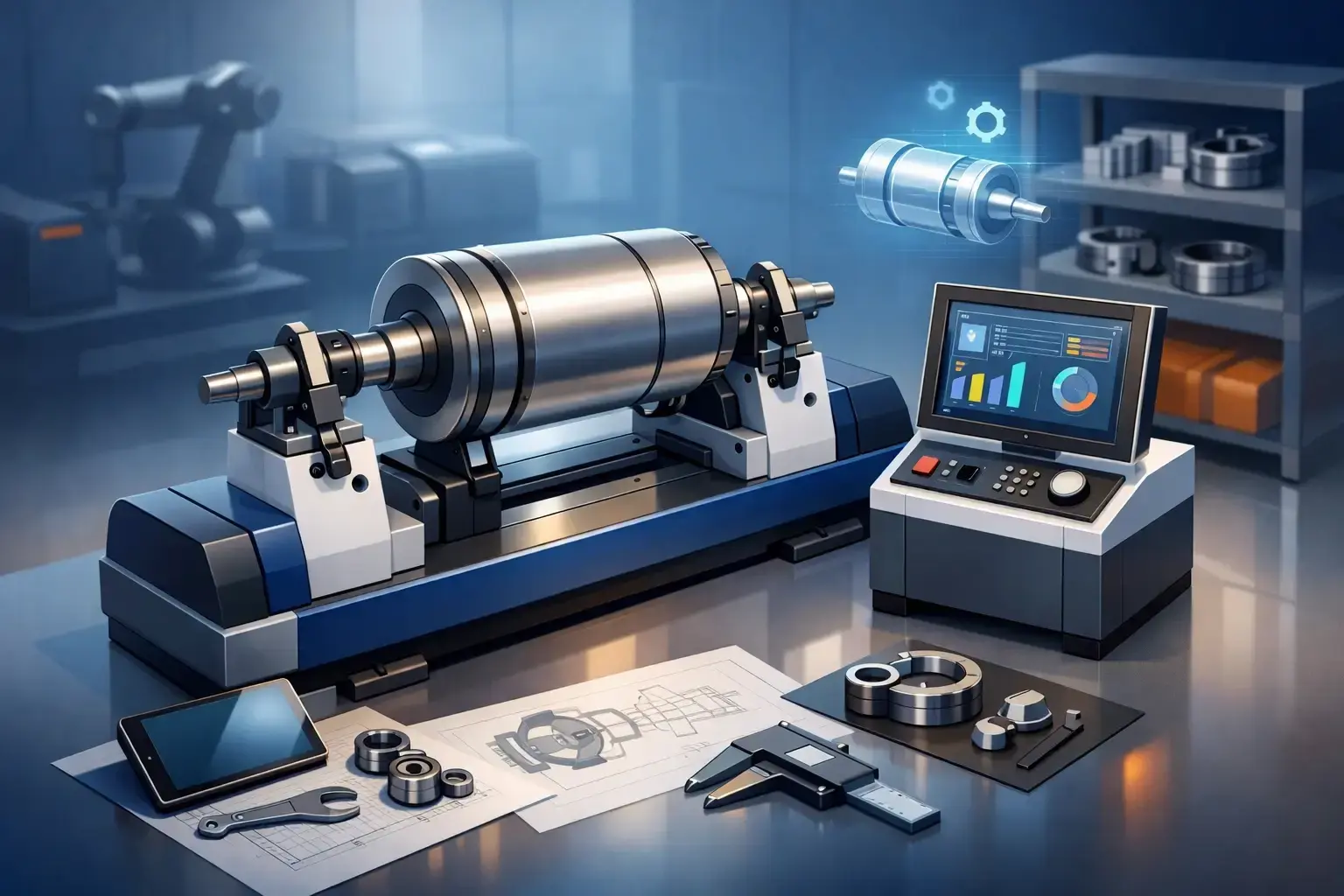
Choosing the wrong balancing machine does not only result in inaccurate measurements. Production flow slows down, operator intervention increases, the rate of repeat balancing rises, and most critically, confidence in rotor quality is lost. This industrial balancing machine buying guide was prepared to move the purchasing process beyond catalog specifications and evaluate real field requirements.
Why an industrial balancing machine buying guide starts with technical details
Purchasing a balancing machine should not be treated like buying standard equipment. The decision directly affects product quality, bearing life, vibration levels, and production efficiency. A machine selected with the wrong capacity or incorrect configuration may appear functional at first, but quickly becomes a production bottleneck.
For this reason, the first question should not be price, but which rotor family will be balanced and within which tolerance limits. Electric motor rotors, fans, pump impellers, compressor rotors, shafts, turbo components, or specialized defense industry parts cannot be evaluated with the same approach. Rotor geometry, weight, rotational behavior, number of balancing planes, and production volume all directly influence machine selection.
Define the rotor first, then select the machine
The correct purchasing process starts with rotor data. Technical teams often specify maximum weight, but this information alone is insufficient. Minimum and maximum rotor weight range, diameter, bearing distance, rotor length, balancing plane requirements, and clamping method must all be evaluated together.
Flexibility becomes especially critical for facilities balancing different product groups on the same line. A machine optimized for a single product may provide high precision, but setup times can increase significantly as product variety grows. On the other hand, a multi-purpose system offers broader usability, though certain specialized components may require additional engineering for cycle time or precision optimization.
The decision depends entirely on the application. Facilities with high-volume repetitive production and workshops operating with a maintenance-oriented approach do not benefit from the same machine architecture.
Horizontal or vertical balancing machine?
One of the most fundamental decisions in balancing machine selection is choosing between horizontal and vertical configurations. Horizontal balancing machines are generally more suitable for shaft-type rotors, long components, and parts rotating between two supports. Electric motor rotors, fan shafts, armatures, and similar components frequently fall into this category.
Vertical balancing machines are advantageous for disc-type components, impellers, flywheels, brake parts, and products with more suitable axial mounting characteristics. The clamping behavior of the part is decisive here. In some cases, even small parts may require a vertical solution because of their center of gravity and fixture design.
A common mistake in the field is making decisions solely based on the external shape of the component. In reality, the correct selection should consider clamping methods, production ergonomics, operator accessibility, and target cycle time.
Capacity selection is not only about maximum weight
In purchasing specifications, the first parameter often considered is maximum carrying capacity. While important, this alone does not guarantee a safe selection. The machine must also provide stable measurement performance at minimum rotor weights. Otherwise, the machine may appear to cover a broad capacity range while failing to deliver sufficient precision on lightweight rotors.
Support diameters, bearing spacing, drive systems, rotational speed range, and sensor sensitivity are just as important as capacity. A heavy-duty machine selected for large rotors may not be efficient for small precision components. Likewise, a low-capacity precision machine may become a production bottleneck when larger parts are introduced.
The best approach is to evaluate not only today’s components but also the production plan for the next two to five years. For companies likely to introduce new products, leaving room for growth is often beneficial. However, purchasing an unnecessarily oversized machine can extend return on investment.
Tolerance, precision, and compliance with standards
A good balancing machine is not simply one that displays the smallest residual imbalance. The real issue is whether it can consistently achieve the targeted quality level with repeatable results. For this reason, the required balancing quality grade must be clearly defined during purchasing.
Each industry has different expectations. In electric motor manufacturing, repeatability in mass production is critical, while aerospace or high-speed specialized applications require much tighter tolerances. In heavy industry, reliable and sustainable field performance may sometimes be more important than absolute precision.
In this context, not only the measurement system resolution but also the machine’s mechanical rigidity, calibration structure, and software algorithms play a decisive role. Technical values on paper may not produce the same results under real operating conditions. Therefore, validating performance using a test rotor is a highly valuable step.
Software and user interface should not be overlooked
In modern balancing machines, software has become just as critical as mechanical structure. The easier it is for operators to define balancing planes, enter tolerances, view correction amounts, and generate reports, the more stable the process becomes. Especially in facilities operating multiple shifts, interfaces that reduce operator dependency provide significant advantages.
The software should be capable of storing different rotor recipes, offering user authorization, generating reports, and supporting data transfer when necessary. In highly automated facilities, this becomes even more important because the balancing machine operates not as a standalone unit, but as part of the production line.
In simple applications, unnecessarily complex software can slow operators down. Conversely, in advanced manufacturing environments, limited software infrastructure quickly becomes inadequate. The right balance should be determined according to actual operational requirements.
Manual, semi-automatic, or fully automatic?
Production volume is one of the key factors in purchasing decisions. In low- and medium-volume production, manual or semi-automatic machines may be more reasonable investments. These systems are more flexible and require less infrastructure adaptation during product changes.
In high-volume production environments, fully automatic systems reduce cycle times, minimize operator influence, and ensure standardized quality. However, the investment involves more than just the machine itself. Fixture design, line integration, safety architecture, and maintenance planning must also be considered.
For this reason, automation decisions should not be based solely on labor reduction goals. Product variety, lot size, correction methods, and maintenance team capability should all be evaluated together.
Fixtures, correction methods, and process integrity
The performance of a balancing machine is often only as good as the fixture quality. In a system where parts cannot be mounted accurately and repeatedly, even the best sensors will not deliver the desired results. Therefore, custom fixtures should be planned alongside the standard machine during the purchasing process.
The same applies to correction methods. Whether the process involves material removal, drilling, milling, welding, or adding weights must be clearly defined. If the machine is incompatible with your correction process, cycle times increase and the risk of errors grows.
A good supplier does not simply sell a machine; they evaluate the entire process. When necessary, they also provide fixtures, operator training, trial production, and commissioning support. Especially for facilities establishing a balancing line for the first time, this support directly affects the success of the investment.
Service, calibration, and spare parts support
A balancing machine is a long-term investment, but maintaining its performance depends on service infrastructure. During purchasing, maintenance accessibility, calibration intervals, spare part lead times, and technical support capabilities must be thoroughly questioned. Without rapid intervention when the machine stops, even the most advanced system can create production problems.
Especially for industrial facilities operating throughout Türkiye, on-site service support is an important selection criterion. Revision services, periodic maintenance, software support, and recalibration ensure operational continuity. Structures like MDBALANS, which provide both machine manufacturing and technical service, can offer a more controlled solution in this regard.
The key point here is how clearly after-sales services are defined in the proposal. Training scope, commissioning duration, warranty conditions, and spare part lists should all be transparent from the beginning.
Final decision framework for an industrial balancing machine buying guide
The right machine is not necessarily the most expensive or the most complex one. The right machine is the one that matches your rotor type, tolerance targets, production volume, and service expectations. Therefore, capacity, precision, automation, and after-sales support should all be evaluated together.
The safest way to accelerate the purchasing process is not to send suppliers a generic catalog request, but to clearly share actual rotor data, target cycle times, and process expectations. The more accurate the technical information provided, the more accurate the resulting solution will be.
When purchasing a balancing machine, the goal should not simply be to establish a system that works today. The real goal is to select a solution that inspires confidence in production, provides measurement repeatability, and adapts to the rhythm of your operation for years to come.