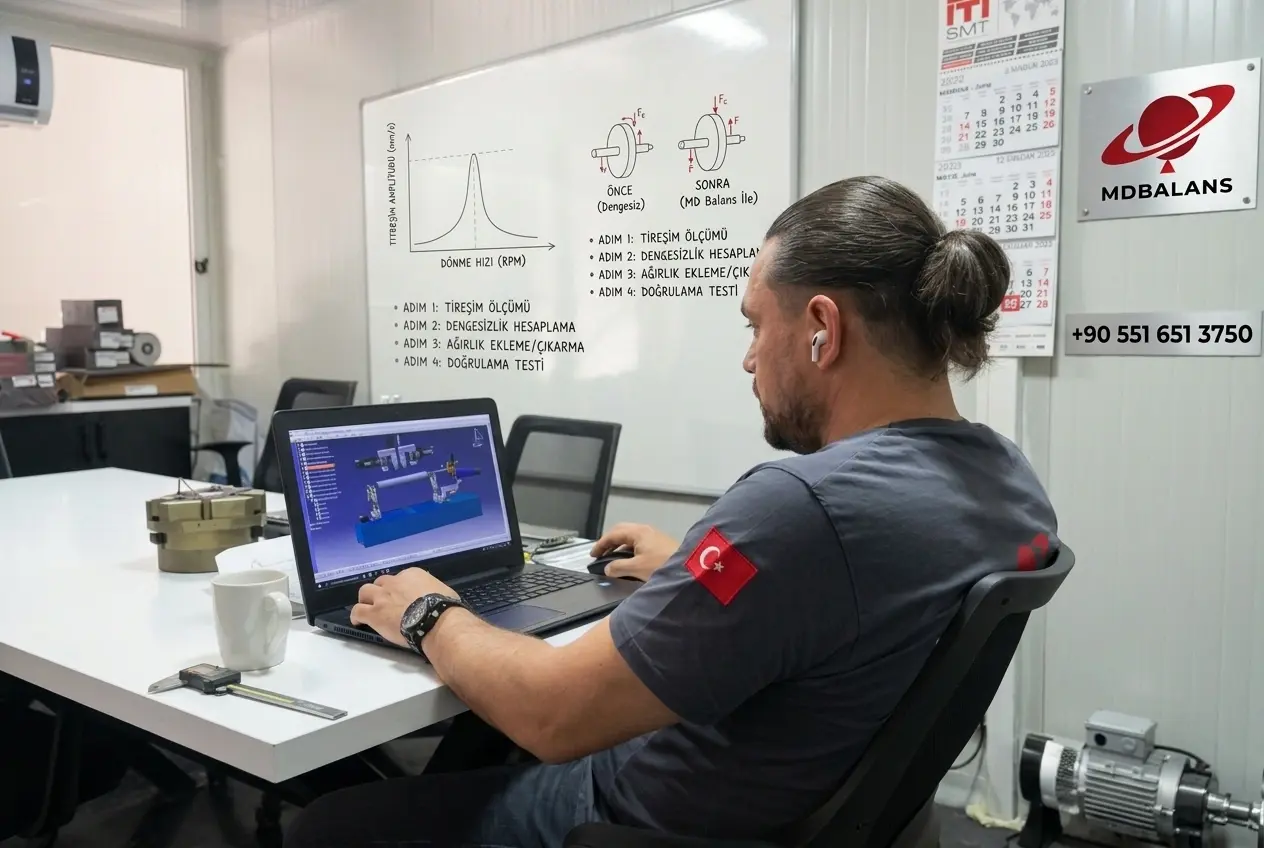
Increasing vibration in a production line, unexpected reductions in bearing life, and deterioration in surface quality often come down to a single root cause: imbalance. At this point, one of the most frequently asked technical questions is how dynamic balancing is performed. The answer involves much more than simply mounting a rotor on a machine and adding weight. Proper balancing requires evaluating rotor geometry, operating speed, bearing conditions, and acceptable tolerance limits together.
Dynamic balancing is applied to reduce the centrifugal forces created by mass distribution errors around the axis of rotation in a rotating component. While static balancing corrects imbalance in a single plane, dynamic balancing identifies and corrects imbalance occurring in two or more planes. This distinction becomes critical especially in fans, armatures, shafts, drums, turbine elements, coupled rotors, and high-speed components. A rotor may appear acceptable at low speed, yet generate serious vibration at operating speed.
How dynamic balancing is performed: the basic process sequence
Correct application in the field or on a balancing machine always begins with preparation. The first step is technical identification of the rotor. The part’s weight, length, diameter, operating speed, bearing points, mounting method, and balancing class must be determined before the process begins. Even if a result is achieved, it will not be sustainable without these details. In facilities with serial production, repeatability is just as important as the initial measurement.
The rotor is then cleaned and physically inspected. If there are welding burrs, adhered dirt, paint buildup, loose parts, missing bolts, or impact-related deformation on the surface, these must be corrected first. A balancing machine measures imbalance, not mechanical damage. Performing balancing on a rotor with a bent shaft, oval bearing surface, or shaft misalignment may hide the problem, but it will not solve it.
The rotor is then placed on the appropriate balancing machine. At this stage, the choice between a horizontal balancing machine and a vertical balancing machine depends on the part’s form. Long cylindrical rotors are generally measured on horizontal machines, while disc-type or single-face components are measured on vertical machines. The accuracy of the mounting fixture also directly affects the result. Incorrect mounting can cause the rotor’s own imbalance to mix with fixture-related errors.
During the first spin, the machine sensors measure vibration amplitude and phase angle. This data shows in which plane and at what angle the imbalance is located. If the rotor belongs to the rigid rotor class, two-plane correction is sufficient for most applications. However, flexible rotors, critical speed ranges, and long thin shafts require more advanced analysis. At this stage, experience and the right software infrastructure become decisive.
From measurement to correction
The measured values are converted into correction points on the rotor. Correction is generally performed using three main methods: removing material, adding material, or changing the position of mass. The selected method depends on the part’s material, safety requirements, rotational speed, and production standards.
For steel or cast rotors, removing material by drilling, milling, or grinding is a common method. In some applications, adding weight by welding or fixing balance weights may be more appropriate. However, in high-speed components, the mechanical safety of the added weight must always be evaluated. A correction method with loosening risk can quickly disrupt the balance value again.
After correction, the rotor is spun again and the remaining imbalance is measured. This cycle continues until the target tolerance is achieved. The goal is not simply to reach the closest possible value to zero. The result must be safe under operating conditions, repeatable, and compliant with standards. Over-correcting is also an incorrect practice. Excessive intervention can create a new error in another plane.
Why is tolerance so important?
The same balancing level is not required for every rotor. An electric motor rotor, fan wheel, pump impeller, or precision aerospace component are not evaluated under the same tolerance. Acceptance limits are usually determined according to the rotor’s intended use, speed, bearing structure, and vibration sensitivity. For this reason, a balancing report should clearly define not only the measurement result, but also the target class and acceptance criteria.
A common mistake in production is aiming for excessively precise balancing that looks impressive but creates unnecessary cost. On the other hand, insufficient balancing returns as bearing failure, shaft fatigue, increased noise, and unplanned downtime. The correct approach is achieving the optimum value appropriate for the application.
Equipment selection in dynamic balancing
Balancing quality depends not only on operator knowledge but also on the capability of the machine used. It is impossible to obtain reliable data from a machine with poor sensor resolution, weak calibration, or worn mechanical structure. For this reason, periodic calibration, mechanical inspection, and software verification of the balancing machine should never be neglected.
When selecting the right equipment, rotor weight range, bearing type, drive system, speed range, and production capacity should all be considered together. For individual maintenance applications, a flexible-use system may be sufficient, while automatic measurement and rapid correction are more efficient for serial production. At an industrial scale, lost time means not only service delay but production cost.
The auxiliary components used alongside the balancing machine are also important. Reference marking systems, correct fixtures, safety guards, and reporting software are all integral parts of the process. Even if the measurement is accurate, a balancing process that is not properly documented remains incomplete from a quality assurance perspective.
Field balancing or workshop balancing?
This choice depends entirely on the application. If the rotor can be removed and a controlled correction is required, workshop balancing usually provides higher accuracy. This is because mounting, measurement, and correction conditions can be managed more consistently. On the other hand, field balancing can offer major advantages for large fans, turbine groups, or systems where disassembly is costly.
During field balancing, variables such as machine foundation, coupling condition, alignment, and process load come into play. In other words, the measured imbalance may not be caused solely by the rotor. For this reason, field balancing must be carried out by experienced teams together with proper vibration analysis. Otherwise, symptoms may decrease while the root cause remains.
Most common mistakes in practice
Errors that reduce the success of dynamic balancing usually stem from weak process discipline. One of the most common issues is confusing mechanical faults with imbalance. In a system with shaft bending, misalignment, loose mounting, bearing clearance, or resonance problems, expecting permanent results from balancing alone is incorrect.
Another mistake is incorrect selection of reference planes. Especially in two-plane rotors, incorrectly identifying correction points extends the process and causes unnecessary material loss. In addition, incorrect application of trial weights or correction at the wrong angle by the operator is also a frequent problem.
Cleaning should not be underestimated either. If paint, coating, dirt, or process residue is added to the rotor after balancing, the initial measurement may lose its meaning. Therefore, it must be clearly determined at which stage of production balancing should be performed. For some parts, pre-balancing after rough machining and precision balancing after final processing gives better results.
The impact of proper balancing on operations
A properly performed dynamic balancing process does more than reduce vibration. It extends bearing life, reduces energy losses, lowers maintenance frequency, and improves surface quality. Especially in high-speed production lines, these gains directly affect capacity utilization. Lower vibration means a more stable process.
From a purchasing perspective, the issue is not only a machine investment. For a balancing solution to remain sustainable, service, calibration, spare parts, software support, and application consultancy must all be evaluated together. For this reason, many industrial companies prefer to obtain equipment and technical service from a single expert partner. This is where companies like MDBALANS, which both manufacture machines and provide technical service, clearly demonstrate their value in the field.
Not every rotor behaves the same. Even two parts with identical geometry can produce different results due to material distribution, machining tolerance, or assembly conditions. For this reason, dynamic balancing is both a standard procedure and an engineering interpretation. When correct measurement, proper correction, and accurate acceptance criteria come together, vibration problems are controlled permanently rather than temporarily.
A rotor that runs quietly, rotates smoothly, and delivers predictable performance in production is not a coincidence. Behind it is a disciplined balancing process. If vibration is increasing in your system, maintenance costs are rising, or quality is fluctuating, the question should not simply be how dynamic balancing is performed, but how it should be performed correctly for your rotor.