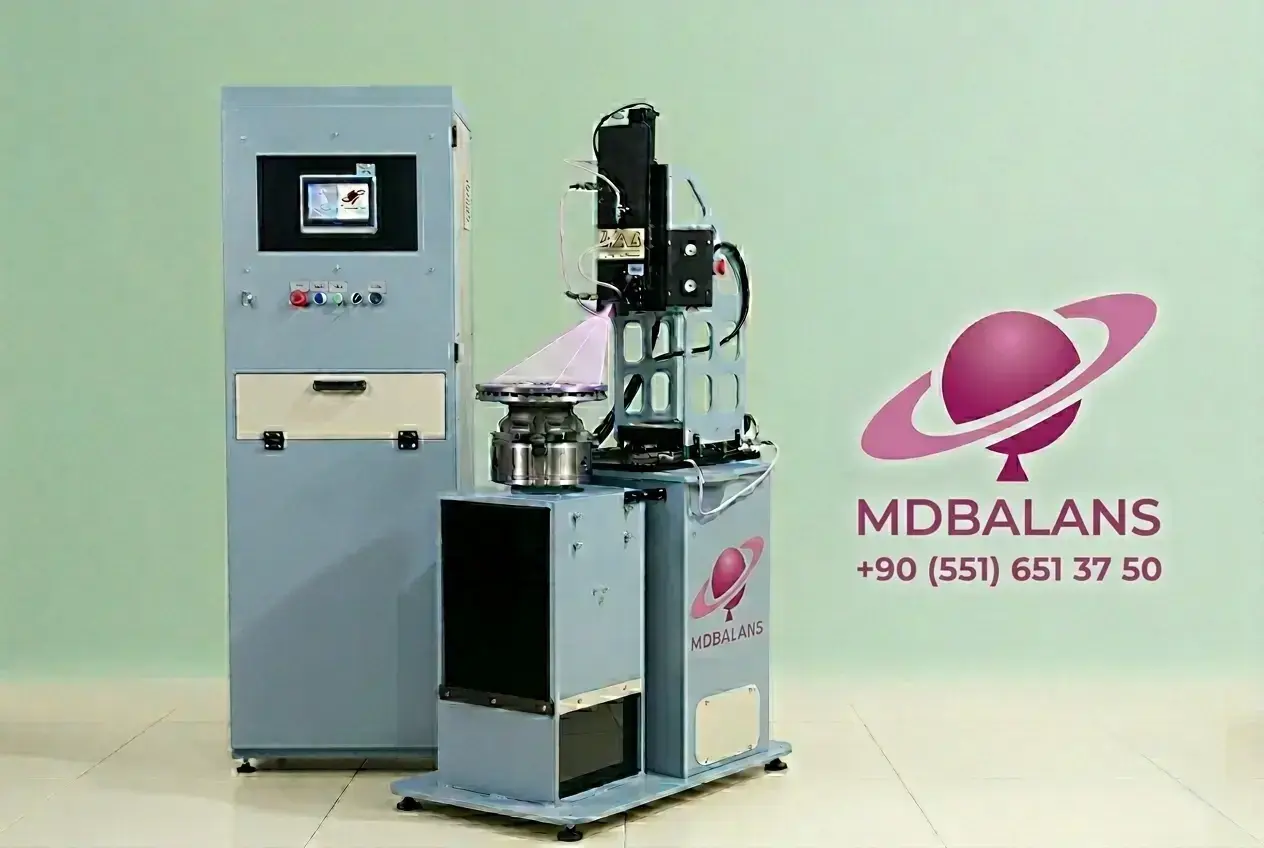
Even a few seconds of imbalance on a production line can directly affect acceptance rates, bearing life, and cycle time. For this reason, an automatic balancing system is not just an equipment investment; it is a critical production solution in terms of process stability, repeatable quality, and line efficiency. Especially in high-volume production, when the limits of manual intervention become apparent, an automation-supported balancing infrastructure stops being a technical preference and becomes an operational necessity.
Why is an automatic balancing system preferred?
The balancing process is basically the measurement of imbalance on the rotor and reducing it to acceptable tolerances. However, in mass production, the issue is not only balancing. The real need is to maintain this process with the same accuracy, the same speed, and the same recording discipline for every single part. Automatic balancing system comes into play at this point.
In manual processes, operator experience can be decisive. Experienced personnel can deliver high success, but shift changes, part diversity, production pressure, and human-related variations may affect process stability. In automatic systems, measurement, correction, and verification steps proceed within a defined cycle. This structure both reduces the risk of error and removes quality from being dependent on individuals.
Another important issue is traceability. In many industries, it is no longer enough for a part to simply be balanced; it is also important to know under which tolerance it was processed, in which cycle it was corrected, and how the result values were recorded. Since automatic systems can manage this data regularly, they provide serious advantages in quality assurance and audit processes.
How does an automatic balancing system work?
Although the operating logic of the system varies depending on the application, the basic flow is similar. The part is loaded into the machine, rotated, the imbalance value is measured, and the system software calculates the correction point. Then the selected correction method is applied. This method may involve material removal, drilling, milling, or in certain designs, adding weight. In the final step, the part is measured again, and if the target tolerance is achieved, the process is completed.
The critical difference here is that the entire cycle remains under control. Sensors, drive systems, fixture structures, safety elements, and software all work toward the same goal: producing the correct balancing result with minimum cycle time. For this reason, automatic system performance does not depend only on the mechanical body. Measurement sensitivity, software algorithms, part clamping repeatability, and process design must all be evaluated together.
For rotor groups requiring high precision, a system that simply works fast is not enough. The system must adapt to different part variations, manage tolerances correctly, and provide clear warnings to the operator when necessary. Otherwise, automation may appear to exist, but repeated intervention will still be needed on the production floor.
Why should measurement and correction be considered together?
One of the most common mistakes in the field is focusing on measurement precision while treating correction capability as secondary. However, if a correctly measured imbalance cannot be removed in a controlled way, the overall success of the system decreases. Drilling depth, tool stability, part surface tolerance, and clamping rigidity directly affect the result at this stage.
For this reason, a well-designed automatic balancing system should not only measure but also perform correction within process safety. It should not be forgotten that in mass production, micron-level deviations can accumulate and increase the rejection rate over time.
Which industries need it more?
Automatic balancing systems provide clear advantages in industries that produce rotors, fans, armatures, electric motor components, pump parts, turbine elements, and precision rotating parts. In automotive supply industries, cycle time can be the determining factor, while in aerospace and defense, traceability and precision may carry more weight. In white goods production, high volume stands out, while in energy and heavy industry, reliable operation and equipment life become the priority.
There is no single correct scenario here. For low-volume but highly critical parts, a semi-automatic structure may be more logical. On the other hand, in lines where the same rotor type is continuously produced in high volumes, a fully automatic solution provides a faster return. The main factor that determines the decision is not only production quantity but also process standardization and the cost of errors.
What should be considered when investing in an automatic balancing system?
The first question in the purchasing process is usually capacity. However, the real evaluation is broader than that. The part’s weight, diameter, length, balancing correction method, target tolerance class, expected cycle time, and operator intervention level should all be considered together. A system designed only for today's part may become insufficient when a new product enters production in the near future.
Software flexibility is just as important as the mechanical structure of the machine. Recipe management, ease of switching between different rotor types, data recording, user authorization, and fault diagnosis screens make a serious difference in daily production. Systems with easy maintenance access, planned spare parts supply, and fast service support reduce the total cost of ownership.
The safety aspect should not be ignored either. When working with parts rotating at high speed, cabin protection, locking scenarios, sensor integrity, and emergency stop infrastructure form the basis of production safety. For this reason, an automatic balancing system should be evaluated not only by performance data but also in terms of operational safety.
Is full automation necessary for every business?
No. This decision depends on the structure of the process. If product variety is very high, volumes are low, and part changes are frequent, full automation may not deliver the expected efficiency. In such cases, operator-assisted or modular solutions may produce more accurate results.
On the other hand, in high-volume and standardized production, full automation often provides a clear advantage. This is because cycle time, operator dependency, and quality deviations become more visible. Choosing the right system does not mean buying the most technologically advanced machine, but establishing the solution that best fits the production requirement.
Its impact on production is not limited to reducing vibration
When balancing is mentioned, most businesses first think of reduced vibration. This is true, but the impact is broader. Lower imbalance levels reduce the loads on bearings, housings, shafts, and connection elements. As a result, maintenance intervals can be extended, the risk of unplanned downtime can be reduced, and equipment service life can improve.
On the quality side, more stable rotating parts directly affect product performance. Noise levels in electric motors, flow stability in fans, and operational reliability in sensitive applications are among the main results. Especially in products where end-user performance is critical, balancing quality is a technical factor that affects product perception and warranty costs.
In addition, keeping process records regularly through automation contributes to continuous improvement efforts. When it becomes visible how much correction was made on each part, clearer data can be obtained about upstream production errors. This transforms the balancing station from being only a final control point into an active part of the production improvement process.
Service, calibration, and sustainable performance
It is important for an automatic system to perform well at initial installation, but its real value appears over the long term. If sensor accuracy, mechanical rigidity, tool condition, and software parameters are not monitored over time, the original precision cannot be maintained. Therefore, periodic maintenance, calibration, and technical support are integral parts of an automatic balancing system.
At this point, many businesses focus only on breakdown situations. However, the efficient approach is to monitor system performance before downtime occurs. Especially in heavily used production lines, even small deviations can increase the rate of rejected products over time. With regular technical inspections, these risks can be managed before they become larger problems.
This is where the field experience of the manufacturer becomes decisive. A professional structure that can provide machine design, process consultancy, commissioning, training, revisions, spare parts, and software support together strengthens the real value of the investment in the field. For engineering-focused solution providers like MDBALANS, this is exactly where the difference is created: not simply delivering a machine, but establishing a functioning and sustainable balancing process.
The right system creates value with the right process
When deciding on an automatic balancing system, it is not enough to look only at today’s vibration problem. Production targets, quality standards, data needs, operator structure, and service expectations should all be evaluated together. A technically well-designed system increases line efficiency, standardizes quality, and reduces maintenance load. However, this result can only be achieved with application-specific engineering and sustainable technical support.
If the balancing process in your line is limiting production speed, causing repeated quality deviations, or producing operator-dependent results, the issue is often not just the machine but the process architecture itself. For this reason, the best starting point is to clearly define the real technical needs of your product and production flow. Strong decisions are made exactly at this stage.