When a balancing machine is selected incorrectly, the problem goes far beyond measurement errors. Rework on the production line, increased vibration in operation, reduced bearing life, and unnecessary service costs quickly become apparent. For this reason, the question of how to choose the right balancing machine represents much more than an equipment purchasing decision. The right choice directly influences both product quality and maintenance reliability.
The selection process for a balancing machine is not the same for every facility. The requirements of a company balancing electric motor rotors differ significantly from those of a manufacturer balancing fans, pumps, turbines, compressors, or automotive components. The key issue is not simply evaluating the machine's technical capacity, but identifying a solution that matches the actual operating conditions.
How to Choose the Right Balancing Machine: Initial Evaluation
The correct selection begins with the rotor itself. A reliable machine cannot be selected without knowing the rotor type, weight, length, diameter, bearing arrangement, and production volume. Many facilities make purchasing decisions based solely on the maximum weight capacity. However, rotor geometry, balancing speed requirements, and workpiece mounting methods are often more important than weight alone.
The first step is to determine exactly which components will be balanced. Is there only one rotor family, or will the machine handle products of different sizes? If the product range is broad, a system offering flexible fixturing and compatibility with various rotor dimensions is essential. For dedicated production lines, more specialized solutions with faster cycle times may deliver higher efficiency.
The second critical factor is tolerance. Not every rotor requires the same balancing precision. High-speed motor rotors and industrial fans operating at lower speeds have different acceptance criteria. Therefore, the machine's accuracy level should match the actual quality requirements. Specifying unnecessarily high precision increases investment costs, while insufficient precision negatively affects product performance.
Should You Choose a Horizontal or Vertical Balancing Machine?
One of the most fundamental decisions when selecting a balancing machine is choosing between horizontal and vertical systems. This choice depends directly on rotor geometry, handling methods, and the production workflow.
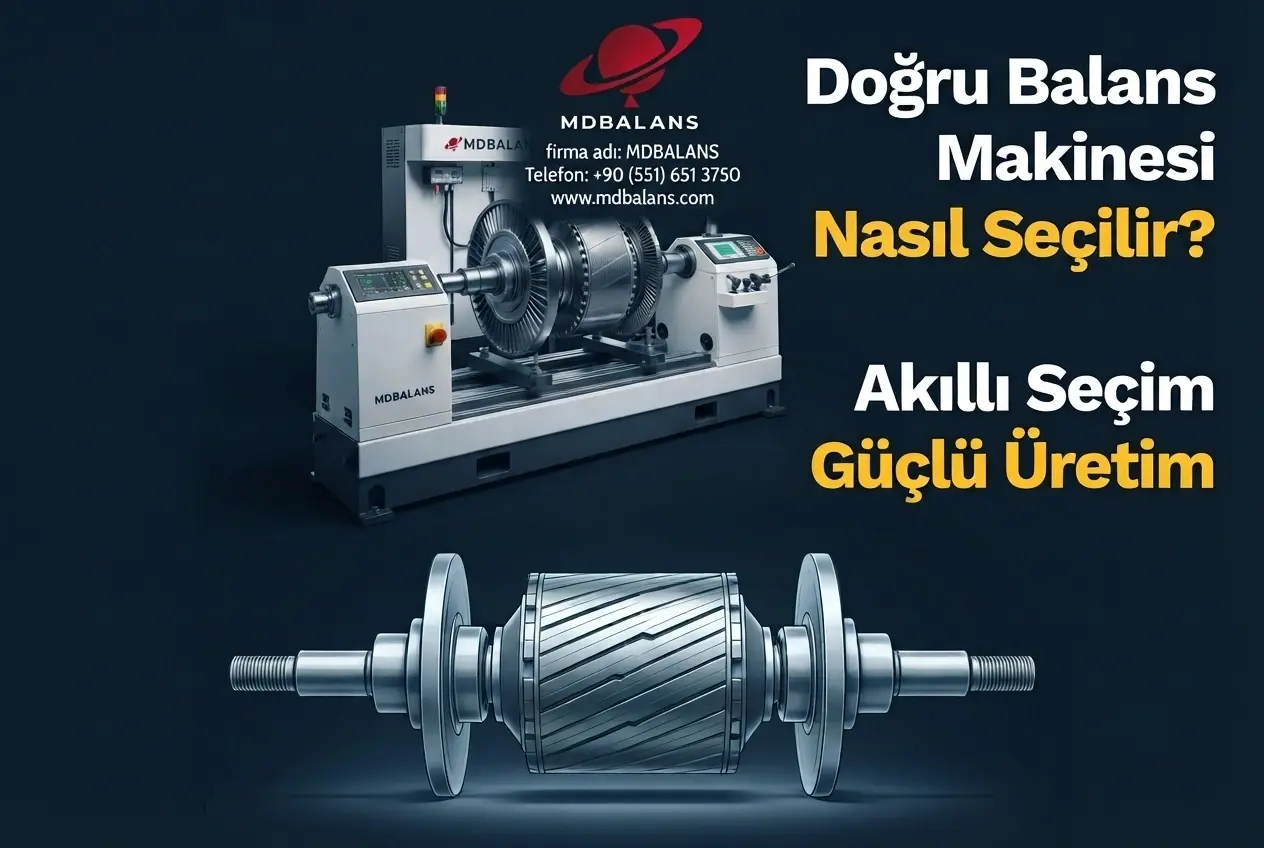
Horizontal balancing machines are generally suitable for shafts, armatures, fan shafts, electric motor rotors, compressor rotors, and long cylindrical components. The workpiece rotates along its own axis while being supported by bearings. This configuration provides better control for long rotors and applications requiring two-plane balancing. It also offers a wider range of applications for the rotor types most commonly used in industry.
When a balancing machine is selected incorrectly, the problem goes far beyond measurement errors. Rework on the production line, increased vibration in operation, reduced bearing life, and unnecessary service costs quickly become apparent. For this reason, the question of how to choose the right balancing machine represents much more than an equipment purchasing decision. The right choice directly influences both product quality and maintenance reliability.
The selection process for a balancing machine is not the same for every facility. The requirements of a company balancing electric motor rotors differ significantly from those of a manufacturer balancing fans, pumps, turbines, compressors, or automotive components. The key issue is not simply evaluating the machine's technical capacity, but identifying a solution that matches the actual operating conditions.
How to Choose the Right Balancing Machine: Initial Evaluation
The correct selection begins with the rotor itself. A reliable machine cannot be selected without knowing the rotor type, weight, length, diameter, bearing arrangement, and production volume. Many facilities make purchasing decisions based solely on the maximum weight capacity. However, rotor geometry, balancing speed requirements, and workpiece mounting methods are often more important than weight alone.
The first step is to determine exactly which components will be balanced. Is there only one rotor family, or will the machine handle products of different sizes? If the product range is broad, a system offering flexible fixturing and compatibility with various rotor dimensions is essential. For dedicated production lines, more specialized solutions with faster cycle times may deliver higher efficiency.
The second critical factor is tolerance. Not every rotor requires the same balancing precision. High-speed motor rotors and industrial fans operating at lower speeds have different acceptance criteria. Therefore, the machine's accuracy level should match the actual quality requirements. Specifying unnecessarily high precision increases investment costs, while insufficient precision negatively affects product performance.
Should You Choose a Horizontal or Vertical Balancing Machine?
One of the most fundamental distinctions when selecting a balancing machine is choosing between horizontal and vertical systems. This decision depends directly on the rotor geometry, handling method, and production process flow.
Horizontal balancing machines are generally suitable for shafts, armatures, fan shafts, electric motor rotors, compressor rotors, and long cylindrical components. The workpiece rotates on its own axis while being supported by bearings. This configuration delivers more controlled results for long rotors and applications requiring two-plane balancing. It also offers a broader range of applications for the rotor types most commonly used in industry.
Vertical balancing machines, on the other hand, are often more efficient for disc-type components, flywheels, brake drums, pulleys, gears, and high-volume production of small to medium-sized parts. Since the workpiece is mounted vertically, loading and unloading become much more practical. This configuration can provide a significant advantage, especially on production lines where operator cycle time is critical.
When making this decision, it is important to consider not only the shape of the workpiece but also operator ergonomics and the existing production workflow. Although some components can technically be measured on both machine types, the preferred solution should be the one that delivers fast, safe, and repeatable performance in daily production.
Hard Bearing or Soft Bearing?
This question often receives attention late in the purchasing process, even though it has a direct impact on performance. Hard-bearing systems generally perform measurements at lower speeds and, thanks to their calibration structure, are highly practical for repetitive production. They also provide the advantage of fast commissioning across different rotor weights and production environments.
Soft-bearing systems can offer greater flexibility and higher precision in certain applications. However, their operating principles, installation conditions, and operator experience become more critical. The most suitable option depends on the rotor family being balanced and the operating habits of the facility. There is no single correct choice—the right solution is the one that best fits the application.
Capacity Selection Is More Than a Weight Rating
One of the most common mistakes when choosing a balancing machine is evaluating capacity solely based on the maximum rotor weight. In reality, true capacity should be assessed together with the rotor's weight, the distance between support points, diameter, rotational characteristics, and safe operating limits.
For example, a machine with a 300 kg load capacity will not necessarily deliver the same performance for every 300 kg rotor. If the rotor is exceptionally long, has a different center of gravity, or requires specialized fixturing, a standard machine may not be sufficient. Likewise, for small rotors requiring extremely high precision, the machine's mechanical quality and measurement system become the determining factors.
For this reason, the technical proposal should evaluate not only the weight range but also the minimum and maximum rotor dimensions, the number of balancing planes, target cycle times, and potential future workpieces. Selecting equipment based on a long-term production plan rather than short-term needs generally provides better results.
Why the Measurement System and Software Matter
No matter how well the mechanical structure is designed, the machine cannot deliver maximum performance if its measurement electronics and software are inadequate. When purchasing a balancing machine, a modern-looking display is not enough. The real issue is how accurately, quickly, and clearly the system provides information to the operator.
A high-quality measurement system should clearly display the amount of unbalance, angular position, correction recommendations, and, when necessary, tolerance evaluations. User-friendly interfaces that reduce operator training time, minimize the risk of errors, and accelerate repeated measurements make a significant difference in real production environments.
On the software side, reporting capabilities, recipe storage, program creation for different rotor types, and quality monitoring are essential features. Especially for high-volume manufacturers, software that reduces operator dependency can significantly improve overall machine efficiency. If traceability is important in your facility, data recording capabilities should be included among your selection criteria.
How to Choose the Right Balancing Machine: Production Volume and Automation Level
Single-piece maintenance work and high-volume production do not require the same type of balancing machine. Flexible workshop-style machines are often ideal for maintenance centers and facilities handling a wide variety of rotor types. However, in mass production environments, systems requiring excessive operator intervention reduce productivity.
As production volumes increase, automatic or semi-automatic solutions become more valuable. Automatic loading, automatic marking, integrated drilling or milling stations, and recipe management all help reduce cycle times. However, the investment should remain proportional to production needs. Excessive automation for low-volume production may unnecessarily extend the return on investment period.
The best approach is to evaluate both current production volumes and future growth plans. If a facility operating manually today plans to transition to mass production within the next six months, the balancing machine should be selected accordingly.
The Importance of Service and Technical Support in Purchasing Decisions
A balancing machine is a long-term production asset. Therefore, the purchasing decision should not be based solely on delivery time or initial investment cost. Calibration and maintenance, spare parts availability, software support, and rapid on-site technical service are just as important as the machine itself.
In industrial environments, production downtime often costs far more than the machine itself. Waiting days for technical support after a failure reveals the true cost of choosing an inexpensive but unsuitable solution. For this reason, the supplier's technical team, spare parts availability, commissioning expertise, and after-sales service approach should be carefully evaluated.
For companies requiring nationwide support, local technical service offers a significant advantage. Working with specialized manufacturers such as MDBALANS, which provide both manufacturing and service capabilities, offers customers not only a machine but also a long-term, sustainable solution.
What Questions Should You Ask When Requesting a Quotation?
A good quotation should include much more than pricing. It should clearly answer questions such as: What is the rotor capacity range? What tolerance levels can the machine achieve? What calibration method is used? What does the training program include? Who is responsible for commissioning after delivery? How long does spare parts procurement take? How is software support provided?
Whenever possible, you should also request a trial or technical evaluation using your own workpiece. Catalog specifications are useful, but real confidence comes from practical testing. This step is especially valuable when balancing custom or specialized rotors, as it significantly reduces project risks.
The Right Machine Delivers Results Only with the Right Process
Even the best balancing machine cannot achieve the desired results if incorrect fixtures, insufficient operator training, or improper correction methods are used. Therefore, the selection process should include not only the machine itself but also the entire balancing process. Questions such as how the workpiece will be mounted, how corrections will be performed, how acceptance criteria will be verified, and which standards operators will follow should all be defined from the very beginning.
A sound investment decision is based on real application requirements rather than catalog comparisons. Once you clearly define your rotor characteristics, quality targets, cycle time expectations, and service requirements, the right balancing machine becomes evident. A rushed purchasing decision can create problems for years, whereas a well-planned selection establishes a production infrastructure that operates quietly, reliably, and continuously adds value.