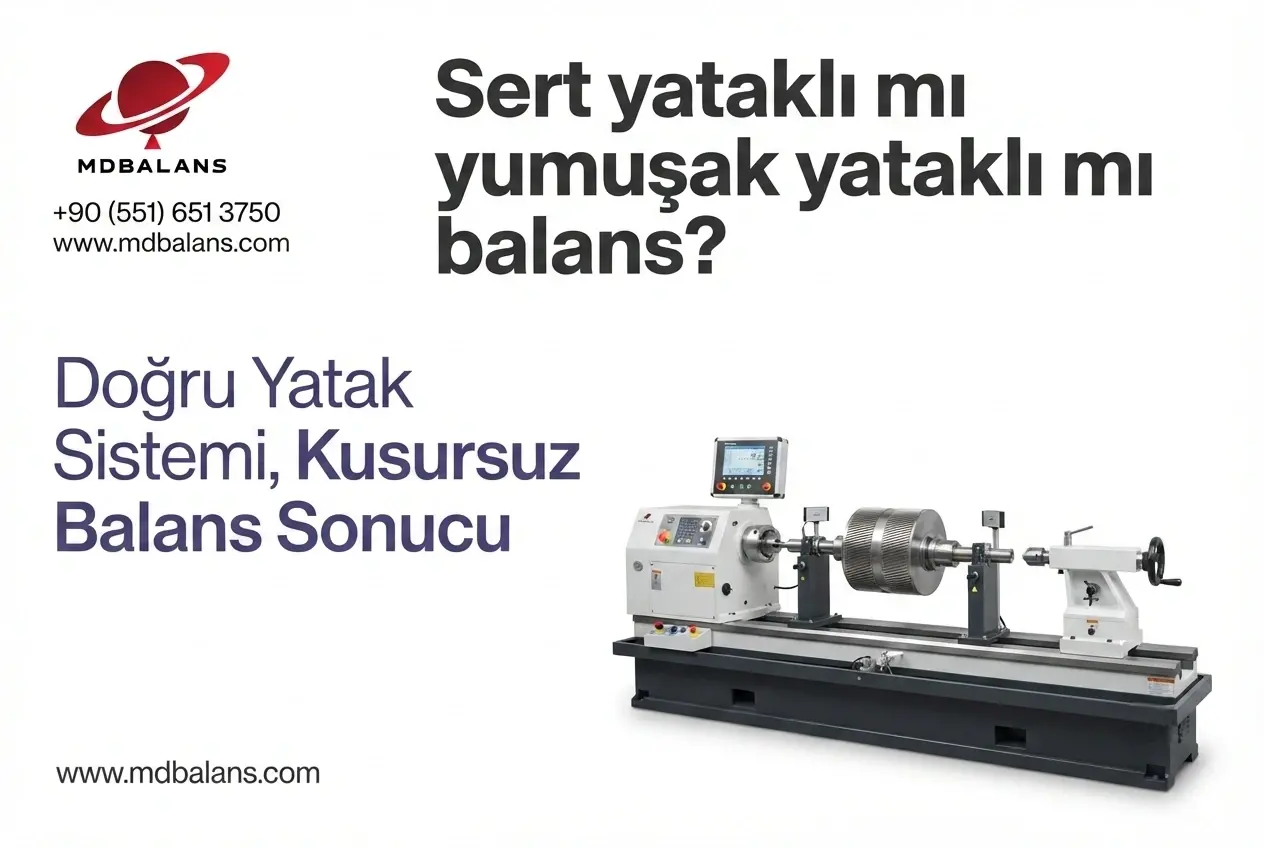
When selecting a balancing machine, mistakes are often made not in the machine’s capacity but in its bearing characteristics. One of the most common questions we encounter in the field is whether a hard-bearing or soft-bearing balancing system is the right choice. There is no single correct answer to this question; the right choice depends on the rotor’s geometry, operating speed, part variety, tolerance expectations, and production setup.
The main objective of the balancing process is to measure the imbalance in a rotating part and reduce it to an acceptable level. However, how this measurement is performed varies according to the machine’s bearing structure. Hard-bearing and soft-bearing machines solve the same problem, but they do so through different physical behaviors. This difference is not merely a theoretical detail. It directly affects measurement speed, operator habits, calibration requirements, and part changeover times.
Hard-bearing vs. soft-bearing balancing: What is the main difference?
In hard-bearing balancing machines, the bearing system has a more rigid structure. Measurement is generally taken through the force at the support points. The machine’s natural frequency is above the operating speed. Therefore, the machine operates below the resonance range. In practical terms, this means switching between different rotors is faster, and because the machine operates according to geometric and parametric data, it does not require a lengthy calibration procedure for every part.
In soft-bearing balancing machines, on the other hand, the bearing system is more flexible. The machine’s natural frequency is below the operating speed, and the system measures in the above-resonance range. Measurement is evaluated through displacement or vibration amplitude characteristics. This structure may offer advantages in certain applications requiring very high precision. However, the need for reference calibration is generally more pronounced for each rotor type.
For this reason, it can be misleading to approach the subject simply by saying that hard-bearing systems are better or soft-bearing systems are more precise. When the application area changes, the right answer changes as well.
Under which conditions do hard-bearing balancing machines stand out?
If rotors with different diameters, lengths, and weights arrive consecutively on the production line, hard-bearing systems provide a significant operational advantage. Electric motor rotors, fans, pump components, armatures, and general manufacturing parts are frequently preferred for this reason. Once the operator enters the part information into the system, measurement can begin with shorter preparation time.
Another strong advantage of the hard-bearing structure is its ability to provide effective measurement at low speeds. This is particularly beneficial in terms of safety, cycle time, and part clamping stability. For certain rotor groups with large diameters or critical surface quality requirements, low operating speed creates a serious advantage.
For maintenance teams, the practical value of hard-bearing machines in the field is also clear. If repetitive jobs, different part families, and shift-based use are involved, process standardization becomes easier. Operator dependency decreases, training time is shortened, and measurement discipline within production can be maintained more easily.
The point to consider here is that hard-bearing systems are not automatically the right choice in every situation. If your process requires very tight tolerances, specific single-type rotors, and a specialized measurement discipline, a soft-bearing system may be more suitable in some scenarios.
When are soft-bearing balancing machines preferred?
Soft-bearing machines deliver strong results especially for specific rotor families, high-precision balancing applications, and production environments with single-type or limited-variety parts. It is not a coincidence that this approach is preferred for turbine-like precision rotors, specialized spindle groups, or certain aerospace and energy applications.
The logic of this system is to read the rotor’s imbalance behavior through a more pronounced vibration response. With correct calibration and proper fixturing, highly qualified results can be achieved. However, this requires strong process discipline. It is important for the operator to understand machine behavior, apply the reference weight procedure correctly, and manage clamping conditions in a repeatable manner.
Measurement quality can be high in a soft-bearing structure, but if there is time pressure in the production environment and rotor variety is high, this advantage can sometimes turn into an operational burden. In short, technical accuracy and production efficiency must be evaluated together within the same equation.
Precision is not the only decision criterion
One of the common statements in the industry is that soft-bearing machines are always more precise. This statement is incomplete. Actual precision emerges through the combination of machine design, sensor quality, software algorithms, bearing condition, calibration discipline, rotor clamping accuracy, and operator practice.
A soft-bearing system operating with weak fixturing will not provide reliable results despite its theoretical advantage. Similarly, a well-designed hard-bearing machine can offer highly consistent and sufficiently precise measurement in many industrial applications. For this reason, it is risky to make a purchasing decision based only on general statements in a catalog.
Technical criteria that determine the selection
For a proper evaluation, you first need to define your rotor. Rotor weight, distance between supports, number of balancing planes, operating speed, and the allowable residual imbalance level are the first factors to consider. Then comes the production type. Is mass production being carried out, are different parts arriving for maintenance purposes, or are low-volume but highly critical rotors being processed?
If part variety is high, hard-bearing systems generally provide more economical and faster results. If the same type of rotors will be processed continuously and the process will be standardized accordingly, a soft-bearing solution may be a strong candidate. When large and heavy rotors are involved, the machine frame, support system, and safe speed range become just as important as the bearing type.
The software infrastructure should not be overlooked either. In modern balancing machines, the operator interface, tolerance management, reporting, recipe recording, and error guidance make a major difference. Especially in facilities with multiple operators, even the most suitable mechanical system may fail to provide the desired efficiency if software support is weak.
Common mistakes when choosing hard-bearing or soft-bearing balancing systems
The first mistake is making a decision based on the habits of the existing supplier. A facility may have used a certain type of machine for years; this does not mean that the same structure is also correct for a new requirement.
The second mistake is focusing only on the initial investment cost. The actual cost is determined by commissioning time, operator training, calibration frequency, cycle time, scrap risk, and service accessibility. A lower-cost solution may lead to greater losses in production.
The third mistake is treating rotor clamping and support equipment as secondary considerations. Even if the balancing machine is selected correctly, improper belt drive, insufficient bearing support, or weak fixturing will impair measurement quality. The machine may be blamed, while the real problem lies in the auxiliary equipment.
The fourth mistake is failing to consider service capability. In industrial facilities, continuity is just as critical as machine accuracy. If access to calibration, overhaul, spare parts, and technical support is not strong, the sustainability of the investment weakens.
Which industries are closer to which structure?
In general manufacturing, electric motors, fans, pumps, white goods, and production environments where different rotor types are processed consecutively, hard-bearing machines often provide more functional results. The reason is their speed, repeatability, and ability to adapt to different parts.
In facilities with more specialized rotor geometries, high process discipline, and work focused on specific product families, soft-bearing machines may offer meaningful advantages. This need may be more visible in defense, energy, or specialized machinery manufacturing. However, the industry name alone is not decisive. Two manufacturers operating in the same industry may have completely different rotor characteristics.
The right question should be this
The question of whether to choose hard-bearing or soft-bearing balancing is not sufficient on its own. The real question is: which system provides the right overall performance for our rotors, production setup, and tolerance target? A technically suitable solution may not be the right investment in the long term if it slows down the production flow.
For this reason, sample part analysis, process evaluation, and, where possible, an applied testing approach are the healthiest methods during the selection process. An engineering perspective makes the difference here. A machine is not merely a piece of equipment that performs measurement; it is a process component that directly affects production quality and maintenance reliability.
The value of working with expert organizations such as MDBALANS, which have experience in both machine manufacturing and technical service, also becomes clear at this point. This is because the right solution is determined not only by catalog data but also by real field conditions.
Do not rush during the final decision stage. When you clearly define your rotor, cycle time, and acceptance criteria, selecting the bearing type becomes less complex and more technically defensible. A properly selected balancing system does not only reduce vibration; it also builds confidence in production.