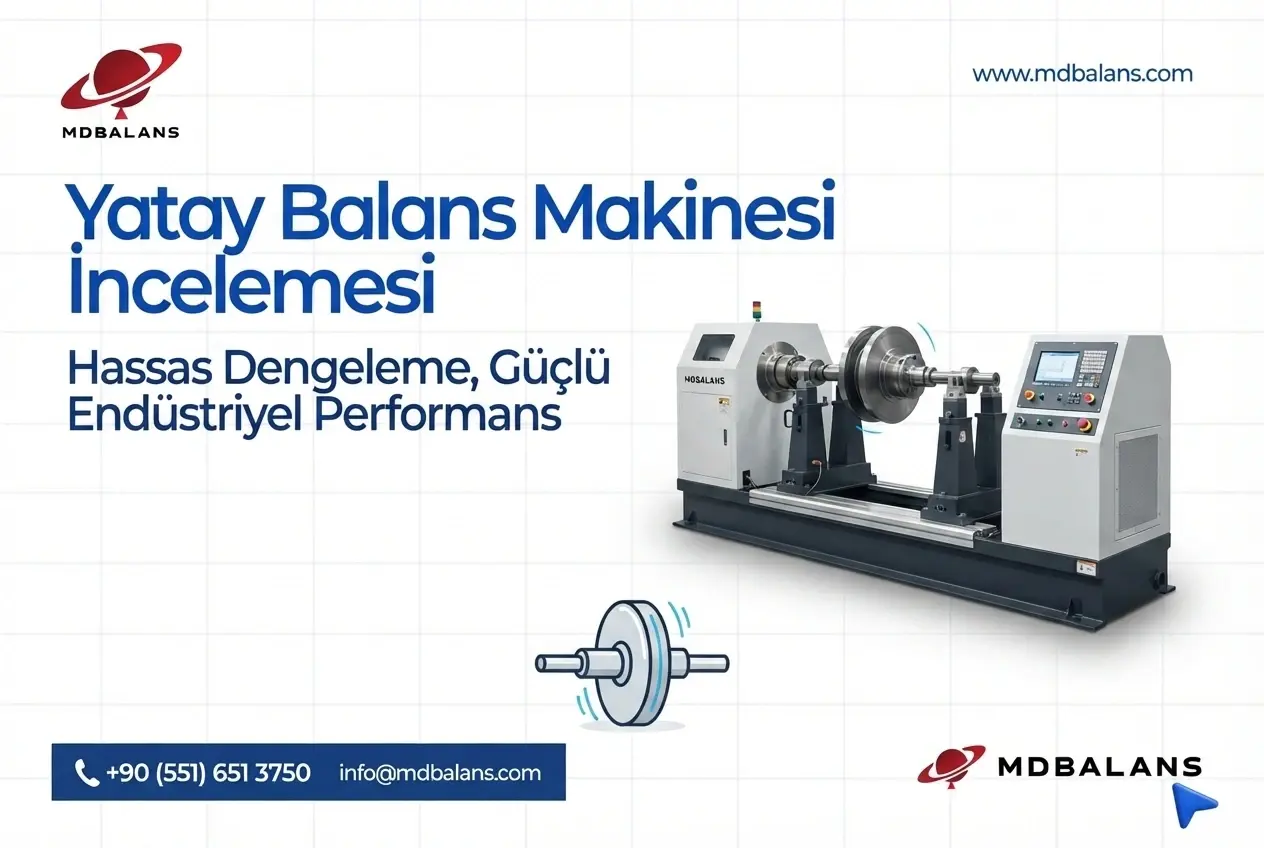
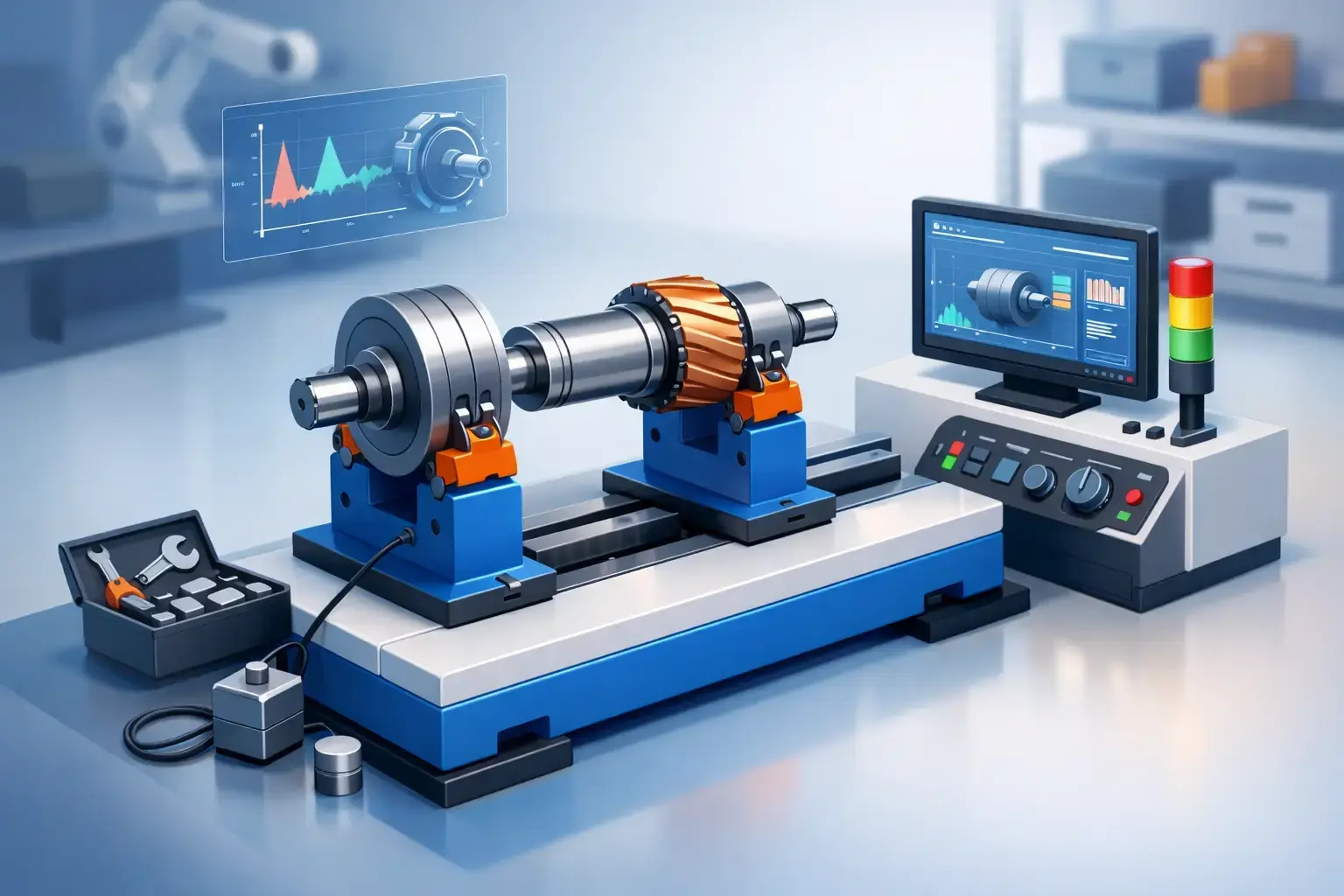
What truly makes a horizontal balancing machine effective in the field is not the maximum rotor weight listed in the catalog; it is repeatable measurement, tolerance against operator error, and how little it interrupts production during service. Therefore, a horizontal balancing machine review should not be limited to listing technical specifications; it should also evaluate how the machine performs under daily production conditions.
Horizontal balancing machines play a critical role in a wide range of components, from electric motor rotors and fans to pumps and shafts. However, there can be significant performance differences between two machines that appear to be in the same capacity class. This is often due to bearing design, sensor quality, frame rigidity, software logic, and manufacturer support. If this difference is overlooked during the purchasing stage, the result may be longer cycle times, unstable measurements, and an increased risk of scrap.
Why should a horizontal balancing machine review be technical?
Investing in a balancing machine is not simply an equipment purchase. Measurement accuracy directly affects product quality, bearing life, vibration levels, and even warranty risks at the customer site. Therefore, the only question during the evaluation process should not be "does the machine work?" The real question is whether it delivers the same result on the same rotor across different shifts and with different operators.
A good horizontal balancing machine measures imbalance and guides correction. A very good machine does this quickly, consistently, and in a traceable manner. Especially in mass production, systems that require additional operator interpretation waste time. In contrast, user-friendly software with sufficient technical depth both shortens training time and reduces the error rate.
Critical evaluation criteria for horizontal balancing machines
The first point to examine is the mechanical structure. If the frame is not rigid, the machine's own structural behavior affects the measurement. This can lead to incorrect guidance, especially for rotors requiring tight tolerances. A system designed for heavy rotors must remain stable even at low speeds. Although lightweight systems with weak frames may initially appear economical, they create instability in the long term.
The bearing and support system is the second critical factor. Proper seating of the rotor on the machine is the foundation of measurement quality. If roller supports, belt drives, centering elements, and bearing geometry are not suitable for the rotor type, the balancing value may appear correct in theory but fail to represent actual operating conditions. Especially when different rotor families are planned to be balanced on the same machine, a quickly adjustable and repeatable support system provides a major advantage.
Sensor technology should not be overlooked either. A good sensor does not merely detect vibration; it separates it from noise. Low-quality sensors or weak signal processing show fluctuating values to the operator. In this case, unnecessary material removal or additional correction may be required. As a result, the cycle becomes longer and the part is put at risk.
Software and operator experience
Balancing software is the visible face of the machine, but its impact is not limited to the screen. Proper software should provide rotor-type-based recipe management, clearly display tolerance classes, and give the operator the correction angle and amount in a clear manner. In addition, recording the results provides a significant advantage for quality systems.
A balance is needed here. Highly complex interfaces may be flexible for advanced users, but not everyone on the production line has the same level of experience. On the other hand, overly simple systems may lack technical depth. The best structure is software that provides speed in basic operation while offering engineering control through advanced parameters.
Calibration, verification, and long-term stability
A machine may deliver good results during initial installation. The real test is whether it maintains the same accuracy months later. Therefore, the calibration procedure, the verification method using a reference rotor, and periodic maintenance discipline should be included in the evaluation. In systems without strong service support, small deviations can turn into chronic quality problems over time.
Especially for businesses engaged in precision production, it is important to know how calibration is performed, how long it takes, and whether it is carried out on-site or under workshop conditions. Because every downtime affects the production plan. Local service capability and spare-part availability directly determine the total cost of ownership.
Which machine delivers better results for which application?
Not every horizontal balancing machine review reaches the same conclusion because application conditions vary. The speed, repeatability, and operator convenience required for electric motor rotors are not the same as the frame strength required for large fan rotors. Likewise, while centering precision becomes prominent for thin shafts, carrying capacity and safety measures become decisive for heavier parts.
For serial parts with low and medium weight, fast loading, recipe recall, and short cycle time carry greater value. In heavy industrial applications, a slower but reliable, rigid, and serviceable design may be the more appropriate investment. For this reason, process compatibility should be prioritized over catalog comparison.
Strengths of a good horizontal balancing machine
Successful systems share a common profile. Measurement is stable, the operator reaches the result after a few attempts, and no meaningful deviation occurs across different shifts. The machine does not waste unnecessary time during rotor changes. The software clearly identifies out-of-tolerance parts. The service team does not disappear after installation.
At this point, the manufacturer's approach becomes important. A supplier that sells machines but does not understand the application will not deliver the same result as a manufacturer that understands rotor behavior, balancing correction methods, and field problems. Technical support is decisive not only during failures but also in selecting the correct configuration. This is why structures such as MDBALANS, with both machine and service capability, stand out.
Common weaknesses
Some machines on the market attract attention with a price advantage but remain weak in overall performance. One of the most common problems is systems that are presented with high theoretical capacity but fail to deliver stable results in actual production. Especially if the base structure is not strong enough, expectations of high precision may be disappointed.
Another weakness is software structures with high service dependency. Requiring external support even for simple product definitions slows down the production team. Likewise, long spare-part supply times can turn a minor malfunction into major downtime. In industry, a good machine is not only one that measures correctly, but one that operates sustainably.
What should be considered when making a purchasing decision?
The machine's capacity range is certainly important, but it is not sufficient on its own. It is necessary to see the demo result with a test rotor and examine stability across parts with different weights and geometries. If possible, testing should be carried out using an actual production part. Because a system that performs well under laboratory conditions may not deliver the same performance at the pace of the production floor.
In addition, the following questions should be answered clearly: In which tolerance class does the machine operate reliably? How long does operator training take? How are calibration and verification performed? What is the spare-part supply time? How quickly are remote support or on-site service provided? These questions are as critical commercially as they are technically.
When evaluating price, life-cycle cost should be considered instead of only the initial investment. A cheaper machine may become more expensive within a few years due to low accuracy or frequent service requirements. In contrast, a correctly selected system with strong service infrastructure increases production efficiency and accelerates return on investment.
Final technical evaluation
The most reliable approach in a horizontal balancing machine review is to consider mechanical structure, measurement stability, software usability, and service sustainability together. A claim of precision alone is not sufficient. That precision must be maintained in real field conditions. Especially in sectors where the cost of production loss is high, fast support and reliable calibration are at least as valuable as the machine itself.
The right machine does not only bring the rotor within balancing tolerance; it strengthens the quality assurance process, reduces the maintenance burden, and lowers the risk of vibration at the customer site. Therefore, when making a selection, it is more accurate to focus not on catalog data but on how much confidence the machine provides in your process. A good evaluation takes time before purchase, but it saves much more time during production.