If a rotor starts generating vibration strong enough to shut down a production line, the issue is usually not comfort but imbalance. Bearing life shortens, couplings are stressed, energy consumption increases, and the risk of unplanned downtime grows. For this reason, the topic of best rotor balancing methods is not a theoretical maintenance subject for maintenance teams and production managers, but a direct cost and continuity issue.
Choosing the correct rotor balancing method is not only about adding correction weights. The rotor’s geometry, operating speed, support structure, tolerance class, production volume, and whether disassembly is possible all determine the method. For the same rotor, workshop balancing may be the best solution, while in another case on-site balancing may be more efficient. The real technical value lies in knowing which method delivers the best result under specific conditions.
Why do the best rotor balancing methods differ?
Not every imbalance has the same character. In some rotors, the imbalance is concentrated in a single plane and can be corrected relatively easily. In others, mass distribution extends along the rotor length, requiring two-plane or even more advanced analysis. Short and disk-like components cannot be treated the same as long, flexible, or high-speed rotors.
The balancing approach also depends on production and maintenance goals. In mass production, cycle time is critical, so automated or semi-automated systems are preferred. In maintenance operations, accessibility, fast intervention, and avoiding disassembly are often more important. Therefore, method selection must consider both technical accuracy and operational realities.
Most common rotor balancing methods
Static balancing
Static balancing is used for cases where imbalance exists primarily in a single plane. The rotor is placed on a low-friction system and rotates freely until the heavy point settles downward. Correction is then made by removing mass or adding counterweights.
This method is suitable for short rotors, fan impellers, disk-shaped parts, and applications with lower precision requirements. It is simple, fast, and cost-effective. However, it is not sufficient for long rotors or parts that exhibit two-plane effects during operation. A rotor that appears statically balanced may still generate significant vibration at high speed.
Dynamic balancing
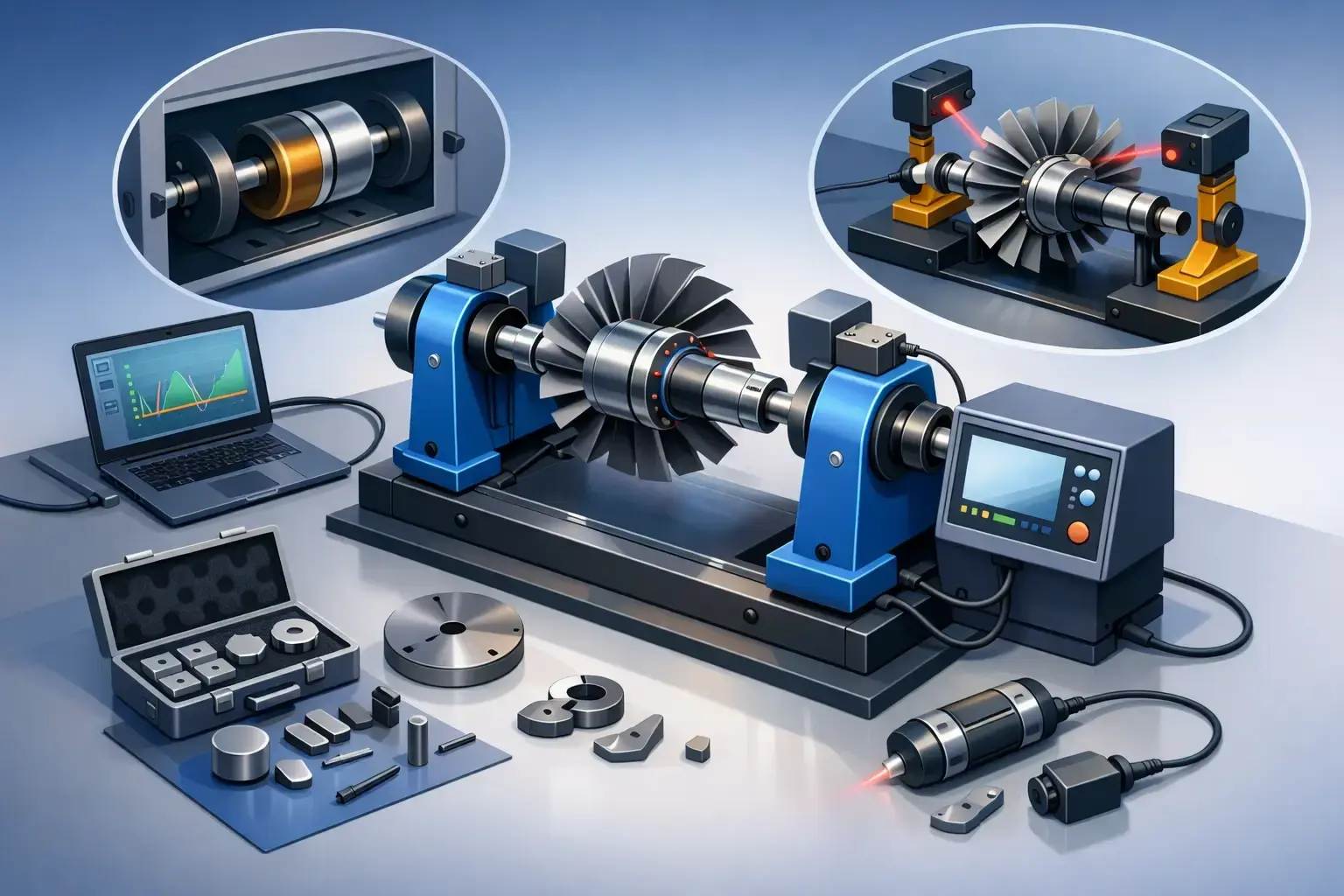
Dynamic balancing is one of the most critical industrial methods because it reflects the real behavior of the rotor under operating conditions. The rotor is spun at a defined speed in a balancing machine, sensors collect vibration amplitude and phase data, and the required correction plane and amount of mass adjustment are calculated.
This method is especially preferred for electric motor rotors, armatures, shafts, fans, pumps, turbine components, and high-precision rotating parts. It provides more reliable results than static balancing because it measures imbalance under real operating conditions. However, correct machine selection, proper fixturing, and operator experience are decisive factors. The method is powerful, but poor setup can lead to misleading results.
Single-plane balancing
Single-plane balancing is used when imbalance can be represented in one plane of the rotor. It is generally sufficient for short rotors and disk-type components. It offers shorter cycle times and practical advantages in production lines.
However, as rotor length increases or mass effects appear at both ends, single-plane balancing becomes insufficient. In such cases, correction on one side may introduce new vibration on the other side. It is fast but only effective for the correct type of part.
Two-plane balancing
Two-plane balancing is the standard approach for long rotors and most industrial applications. Imbalance is analyzed separately in two different planes, and corrections are applied at both points. This allows both force and moment-induced vibration to be controlled.
It is widely used in electric motors, compressor rotors, long shafts, and industrial rolls. The disadvantage is that it requires more measurements and a more careful process compared to single-plane balancing. However, it is often the correct choice in terms of operational reliability.
On-site balancing
When disassembly is difficult, costly, or disruptive, on-site balancing becomes the preferred solution. In large fans, blower systems, pumps, mills, and process equipment, field balancing provides significant time savings. Measurements are taken while the machine operates in its own bearings, and corrections are performed on site.
The main advantage is reduced downtime. Additionally, the rotor is evaluated under real operating conditions, which provides more accurate insight into actual behavior. However, field conditions are not always ideal. Looseness, misalignment, foundation issues, or resonance can interfere with results. Therefore, on-site balancing requires not only equipment but also vibration analysis expertise.
Automatic balancing systems
In mass production environments, automatic balancing systems offer significant efficiency advantages. Loading, measurement, evaluation, and correction steps are executed in a controlled automated cycle. This is especially important in automotive, white goods, electric motor production, and precision manufacturing lines where repeatability is critical.
The main advantage is standardized quality and high cycle speed. Human variability is reduced, reporting becomes easier, and production data becomes more consistent. On the other hand, initial investment cost is higher and the system must be designed specifically for the part. It may not always be the most economical solution for low-volume or highly variable production.
Which method should be chosen?
The first question is: what is the rotor type and operating condition? A short, rigid, low-risk component may be sufficiently balanced with static or single-plane methods. A long, high-speed, or tight-tolerance rotor usually requires dynamic and often two-plane balancing.
The second key factor is where the process will be performed. Workshop balancing in a controlled machine environment offers advantages in repeatability and accuracy. However, if disassembly costs are high, on-site balancing becomes more practical.
The third factor is production volume. Maintenance operations and serial production environments should not be treated the same. Maintenance focuses on flexibility and fast response, while mass production prioritizes cycle time, operator independence, and data traceability.
Factors affecting balancing quality
No matter how correct the method is, several conditions determine the final quality. Calibration of the measurement system balancing machine calibration, sensor accuracy, correct rotor referencing, and proper support fixtures are essential. A poorly mounted rotor can generate false imbalance values.
The correction method is also important. Weight addition, material removal, drilling, milling, or welded corrections are not equally suitable for all parts. Mechanical strength, thermal behavior, and post-process usage must be considered. For high-speed rotors especially, incorrect corrections may introduce serious safety risks.
Accurate diagnosis of vibration sources is also critical. Not every high vibration level is caused by imbalance. Bearing wear, misalignment, shaft bending, looseness, resonance, or installation errors may produce similar symptoms. A proper balancing process may therefore also require fault separation when necessary.
The most efficient approach within best rotor balancing methods
The most efficient approach in practice is not applying a single method to every problem, but selecting the right method for the specific case. Simple solutions are effective for low-complexity rotors, while critical production equipment requires advanced dynamic analysis and precision balancing.
For industrial operations, the most effective model is working with an engineering partner that has strong measurement infrastructure, fast service capability, and technical decision-making expertise. Balancing is not only a corrective action but an engineering process that directly affects machine life, energy efficiency, and production continuity. Structures such as MDBALANS, which combine machine manufacturing and technical service capability, provide a strong advantage in this area.
Good balancing results are not only about reducing vibration levels. The goal is safe operation, longer maintenance intervals, and stable production performance. When the method is selected based on real rotor behavior, balancing becomes not a cost item but a technical investment that directly improves operational reliability.
The best balancing method is often not the most complex one, but the most suitable one for your application. When decisions are made based on measurement data rather than speed, both equipment protection and downtime reduction are achieved.