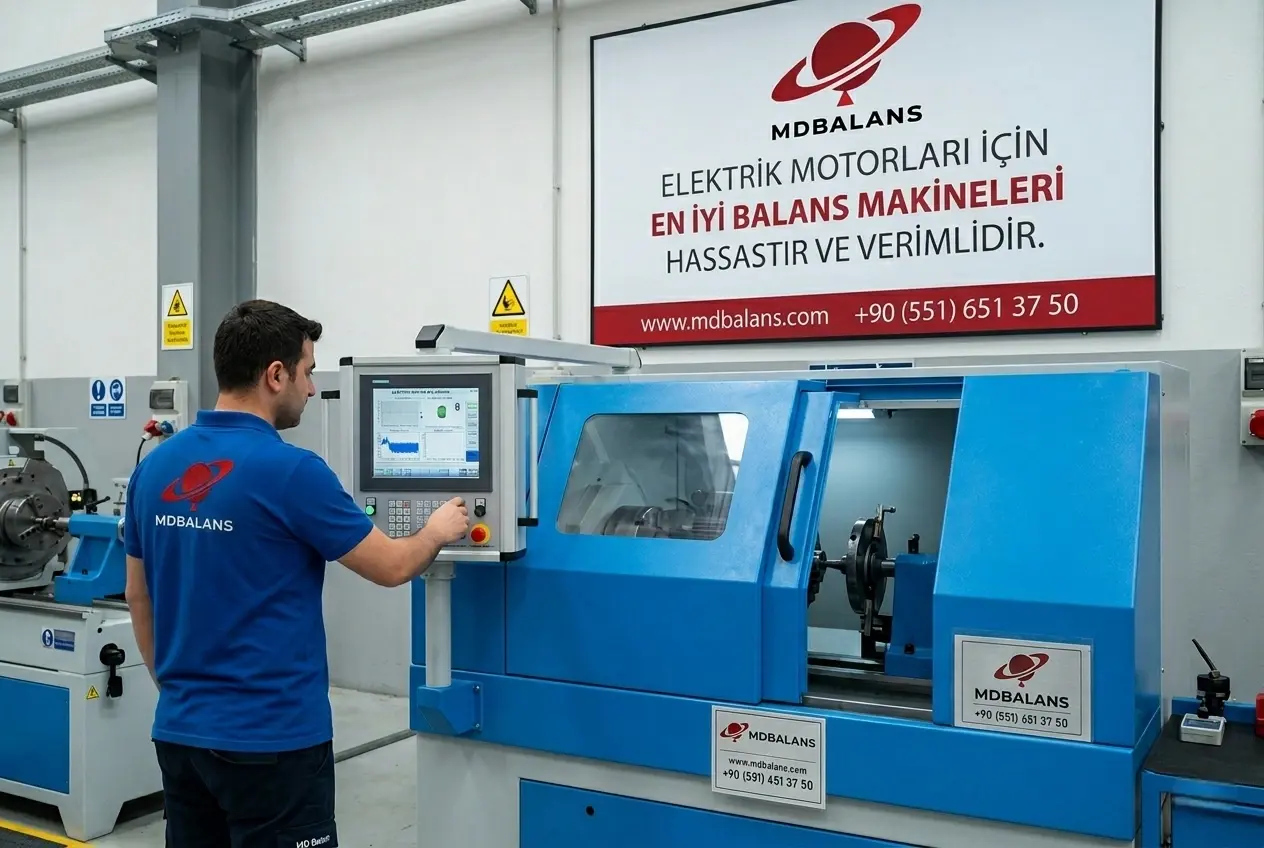
In electric motor manufacturing, problems often appear not during design, but during final inspection. Rotor geometry may be correct, materials may be suitable, and bearing selection may be accurate; yet if vibration levels remain high, noise increases, or bearing life becomes shorter, the real focus should be balancing quality. For technical teams searching for the best balancing machines for electric motors, the key question is not a single brand or model, but which machine type best matches specific production and tolerance requirements.
In electric motors, balancing quality directly affects not only product performance but also production efficiency and field reliability. An unbalanced rotor creates vibration, energy loss, bearing wear, increased noise levels, and early failure risks. Especially in mass production facilities, choosing the wrong machine can become just as costly as inaccurate measurements. For this reason, the selection process should be driven not by catalog comparisons, but by real application requirements.
How are the best balancing machines for electric motors determined?
The best balancing machines for electric motors may not be the same for every facility. The needs of a manufacturer producing small rotors are very different from those of a maintenance workshop balancing heavy industrial motor rotors. Four main factors define the right solution: rotor type, production volume, required precision class, and operator workflow.
For example, in high-volume production lines operating with short cycle times, automation-compatible horizontal balancing machines provide major advantages. On the other hand, maintenance, repair, or low-volume custom production environments may benefit more from operator-controlled systems with flexible adjustment capabilities. In short, the best machine is not the one with the most features, but the one that delivers the most accurate, repeatable, and efficient results within your rotor range.
Why do horizontal balancing machines stand out?
For most electric motor rotors, horizontal balancing machines are the preferred choice. The main reason is their ability to support the rotor in a way that closely replicates real operating conditions while adapting easily to different shaft geometries. Horizontal systems offer broad application flexibility for fan rotors, squirrel cage rotors, armatures, and many other shaft-based motor components.
In horizontal balancing machines, measurement accuracy alone is not enough. The quality of the mechanical support structure is equally important. Weak bearing systems, poor sensor placement, or low structural rigidity reduce measurement stability. For this reason, evaluating only the electronic measuring unit is not sufficient. Strong machine frames, precision support elements, and continuous calibration consistency form the foundation of long-term performance.
In mass production environments, belt-driven or semi-automatic solutions can reduce operator dependency. However, there is always a trade-off. As automation levels increase, investment costs also rise. If production volume does not justify the investment, a more controlled and operator-friendly manual or semi-automatic system may provide higher efficiency.
Which rotor types are suitable?
In general, horizontal balancing machines are ideal for small and medium-sized electric motor rotors, generator rotors, fan-driven motor rotors, and components with varying shaft lengths. They are especially valuable for facilities frequently switching between different product groups because of their operational flexibility.
When are vertical balancing machines the better choice?
For certain electric motor components, vertical balancing machines provide a more stable and practical solution. Disk-type rotors, short-axis components, wheel-like geometries, or parts requiring single-plane balancing may benefit from vertical systems in terms of both fixturing simplicity and cycle efficiency.
The major strength of vertical systems lies in their ability to load parts quickly according to fixture design while creating standardized workflows for specific product families. In facilities balancing high volumes of identical parts, this structure can significantly reduce production time. However, for long-shaft rotors or applications requiring highly precise two-plane corrections, horizontal systems generally remain the better option.
The key question is simple: which machine layout reads your part geometry, support method, and balancing plane requirements more accurately? The correct answer depends entirely on the application.
Machine type alone does not determine the best results
When selecting a balancing machine, many facilities initially focus on maximum rotor weight and size. These are important criteria, but they are not enough by themselves. What truly separates the right balancing machine for electric motors is measurement resolution, repeatability, and process compatibility.
First, the balancing precision class must be clearly defined. If the target quality level of your product does not match the machine’s actual measurement capability, you may either overinvest in unnecessary precision or produce products that fail to meet customer expectations. Second, cycle time must be evaluated carefully. A highly precise but slow system can create bottlenecks in high-volume motor production.
The third critical factor is operator usability. Complex interfaces require intensive training and may create measurement inconsistencies between shifts. User-friendly software, clear correction guidance, and easy recipe management directly improve shop-floor performance. Finally, service accessibility should always be considered. Purchasing a balancing machine is not a one-time transaction; calibration, maintenance, revision support, and spare part continuity are just as important as the initial investment.
Which features should be evaluated when searching for the best balancing machines for electric motors?
When evaluating the best balancing machines for electric motors, decisions should not rely solely on technical brochures. The real selection depends on how reliably the machine performs under actual production conditions. Key evaluation points include measurement accuracy, machine rigidity, software capability, operator ergonomics, adaptability to different parts, service support, and calibration continuity.
A highly sensitive measuring unit alone is not sufficient. If the mechanical support system holding the rotor is weak, even the most advanced electronics will produce unstable results. Likewise, a strong mechanical design paired with insufficient software can increase operator errors. A good balancing machine solves both aspects together.
Another important factor is the correction method. Does your facility use manual material removal, controlled milling corrections, or automatic correction integration? The machine must match your correction process. Otherwise, even accurate measurements may slow down the entire production workflow.
Why are manufacturer and maintenance workshop requirements different?
A factory producing new motors and a repair workshop performing rotor overhauls may not require the same balancing machine. In manufacturing environments, cycle time, standardization, and repeatability are critical. In maintenance workshops, flexibility for different rotor types, adjustable setups, and operator-controlled structures may be more valuable.
This difference directly affects purchasing decisions. A highly automated system may perform exceptionally well for a single product type but create unnecessary complexity in a repair workshop handling many rotor sizes and geometries. On the other hand, a highly flexible but manual-oriented system may become insufficient in large-scale mass production.
For this reason, the best approach is first to analyze your rotor portfolio and daily workflow. Only then should machine type, capacity, and automation level be determined.
The most common mistake during purchasing
The most common mistake is selecting a machine based only on today’s rotor dimensions without considering future production needs. A capacity that seems sufficient in the short term may become inadequate as the product range expands. The opposite is also true. Investing in an oversized and overly complex system can unnecessarily extend the return-on-investment period.
Another common mistake is treating after-sales technical support as secondary. Balancing machines are precision production systems. Without proper installation, operator training, periodic maintenance, calibration, and rapid service support, performance can decline over time. This is why selecting the right solution partner is just as important as selecting the machine itself.
At MDBALANS, this approach is never limited to equipment alone. From machine commissioning and software support to calibration and on-site technical intervention, the entire process should be handled as a complete system. This is the structure industrial users can truly rely on.
How should the right investment be made?
The right investment begins only after answering several key questions clearly: Which rotor types will be balanced? What is the target tolerance level? What will the daily production capacity be? How will the correction process operate? What is the operator skill level? Any decision made before answering these questions carries technical risk.
If your production includes a wide range of small and medium-sized electric motor rotors, high-precision horizontal balancing machines are generally the safest option. If production focuses on specific disk-type components with standardized high-volume workflows, vertical systems can provide significant advantages. For even higher production volumes, automatic loading, recipe management, and process integration should also be evaluated.
During the final decision stage, do not focus only on what the machine can do under normal conditions. Also evaluate how quickly it can restore your production when problems occur. A balancing system is not simply a purchasing item; it is a strategic production asset directly affecting product quality and operational continuity.
Quiet operation, low vibration, and long service life in electric motors are never accidental. They result from accurate measurement, the right balancing machine, and proper technical support. For this reason, when making your selection, do not choose the most visually impressive system. Choose the solution that integrates most reliably with your actual production process.