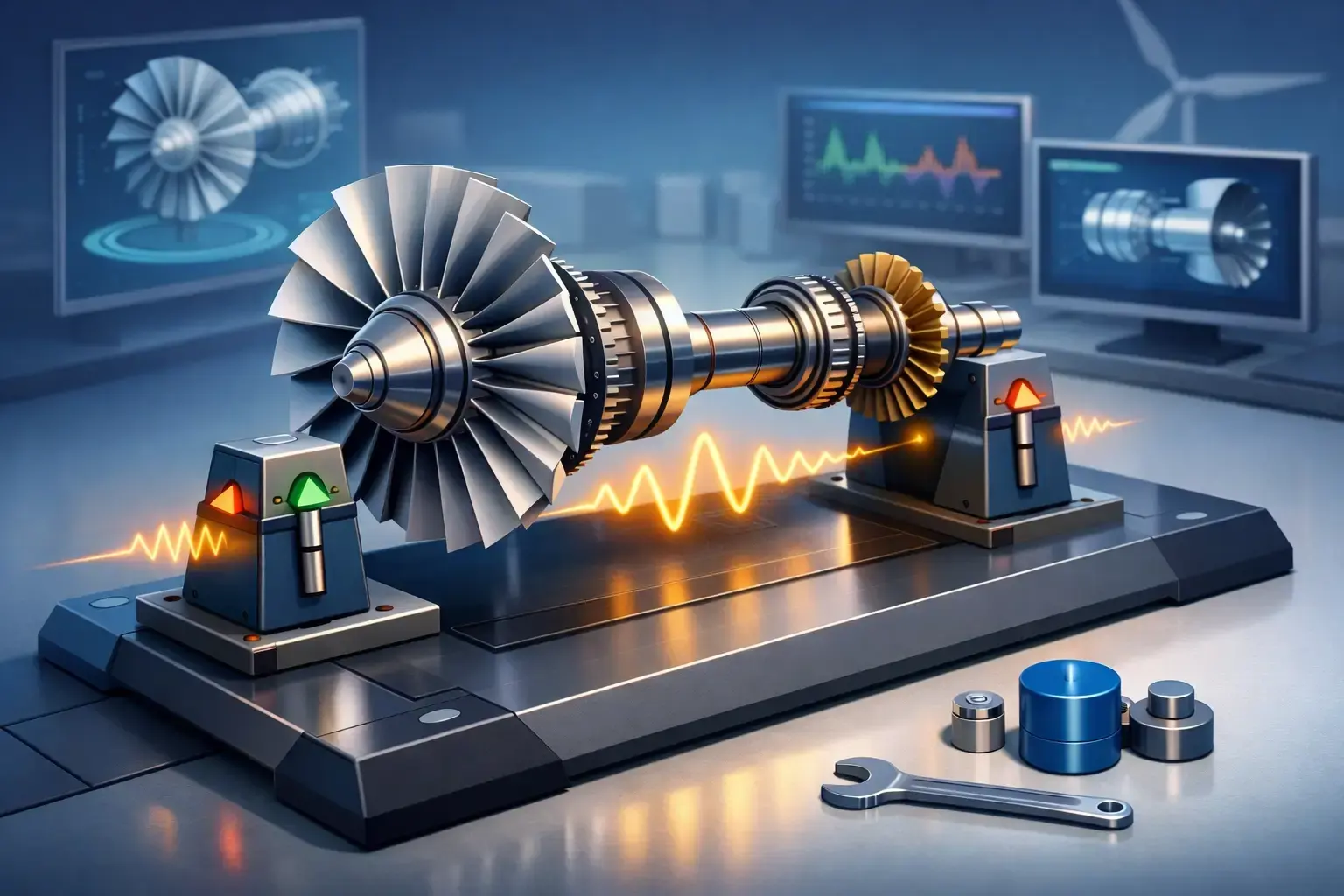
A slight exceedance of vibration limits in a turbine is often not just a comfort issue or a measurement deviation. It can be a signal of a much broader mechanical chain extending from bearing loads to coupling behavior, from sealing elements to energy losses. Turbine rotor balance is one of the most critical links in this chain; because even a small mass imbalance can grow significantly at high speeds and turn into a serious operational risk.
Turbines operate under high speed, continuous load, and tight geometric tolerances by nature. Therefore, balance quality is not only important during initial commissioning but also during maintenance planning and post-overhaul verification. Especially in power generation, process industries, maritime, and heavy industry applications, stable rotor operation is essential not only for equipment health but also for production continuity.
What does turbine rotor balance directly affect?
The first visible effect is vibration levels. However, the real-world consequences are not limited to increased vibration. Bearings carry higher loads, bearing temperatures may rise, coupling alignment sensitivity can degrade, and shaft fatigue effects can accelerate. In some cases, operators may misinterpret the issue as bearing failure, installation error, or misalignment, while the root cause may actually be rotor imbalance.
Another critical impact is energy efficiency. An unbalanced rotor causes the system to generate higher mechanical losses to perform the same work. Although this loss may not always be directly visible in the energy bill, it clearly reflects in increased equipment stress, reduced component life, and more frequent unplanned shutdowns, ultimately increasing total operating costs.
Turbine rotor balance also affects maintenance strategy. A well-balanced rotor improves the accuracy of predictive maintenance data interpretation. When imbalance is dominant, it becomes harder to isolate other fault modes in vibration analysis, which can delay maintenance decisions or lead to incorrect interventions.
Why does rotor imbalance occur in turbines?
Even if a rotor is properly balanced at production, it does not remain stable throughout its entire life. Wear, contamination, blade damage, thermal effects, changes in welded regions, machining during overhaul, and component replacements can all alter balance over time. Especially in high-temperature turbines, material behavior and geometric deformation can gradually shift mass distribution.
A common issue in the field is insufficient post-overhaul verification. When a rotor is disassembled and reassembled, even very small geometric differences can cause significant effects at high speeds. Therefore, post-maintenance balance verification should not be optional but a standard part of safe commissioning.
In many turbines, the issue is not only static imbalance. In most industrial applications, dynamic imbalance—mass distribution differences across multiple planes—is the dominant factor. At this point, the selected balancing method must match rotor length, diameter, operating speed, and bearing configuration.
How should turbine rotor balance be evaluated?
Proper evaluation is not limited to simply rotating the rotor and reading a measurement device. First, rotor type, service conditions, critical speed zones, bearing structure, and tolerance class must be clearly defined. Then calibration of measurement systems, accuracy of mounting fixtures, and consistency of reference points must be verified.
One of the most common mistakes in balancing is confusing symptom with root cause. High vibration does not always indicate a balance problem. Bending, eccentricity, looseness, bearing issues, or aerodynamic effects can produce similar results. Therefore, turbine rotor balance analysis must always be combined with vibration diagnostics and mechanical inspection.
Operating speed range is also critical in interpreting results. An imbalance that seems acceptable at low speed may exceed limits at nominal operating speed. Therefore, balance quality must be evaluated under real operating conditions.
Workshop balancing or on-site balancing?
There is no single correct answer. If the rotor can be safely removed and transported, workshop balancing can provide higher precision due to controlled conditions and machine accuracy. However, in many turbines, downtime constraints or logistical limitations make on-site balancing more practical.
On-site balancing provides significant time savings, especially in critical production environments. However, environmental influences and system variability must be managed more carefully. The correct approach depends on equipment criticality and intervention constraints.
Why does the balancing method change results?
Not all rotors are balanced using the same method. The choice between single-plane and dynamic balancing depends on geometry and operating behavior. Short disk-type rotors may require only single-plane correction, while long multi-stage turbine rotors typically require multi-plane or advanced analysis.
The key objective is not just to meet tolerance limits but to achieve stable operating behavior. A theoretically acceptable balance result may still perform poorly under real operating conditions due to thermal expansion, coupling effects, and bearing dynamics.
Is balance tolerance the same for every facility?
No. Standards provide a baseline, but acceptance criteria vary depending on equipment function, criticality, and operating conditions. A backup system and a continuous production turbine cannot be evaluated under the same risk level.
The goal is to ensure long-term reliability rather than short-term compliance. The correct tolerance balances technical requirements with operational economics.
What happens if balancing is neglected?
The initial cost often starts invisibly. Vibration increases, bearing life shortens, and maintenance intervals become more frequent. Eventually, a condition that could have been managed during planned maintenance turns into an unplanned shutdown, bringing production loss and operational disruption.
In critical turbines, this chain reaction is even more severe. A small imbalance issue can evolve into major operational losses over time. Therefore, balancing should not be treated as a corrective action after failure but as a core preventive maintenance practice.
Not every vibration indicates the same level of risk, but every deviation should be evaluated seriously. Early detection allows controlled intervention, while delayed action increases both damage and cost. Proper balancing at the right time provides far greater operational security than most facilities initially expect.