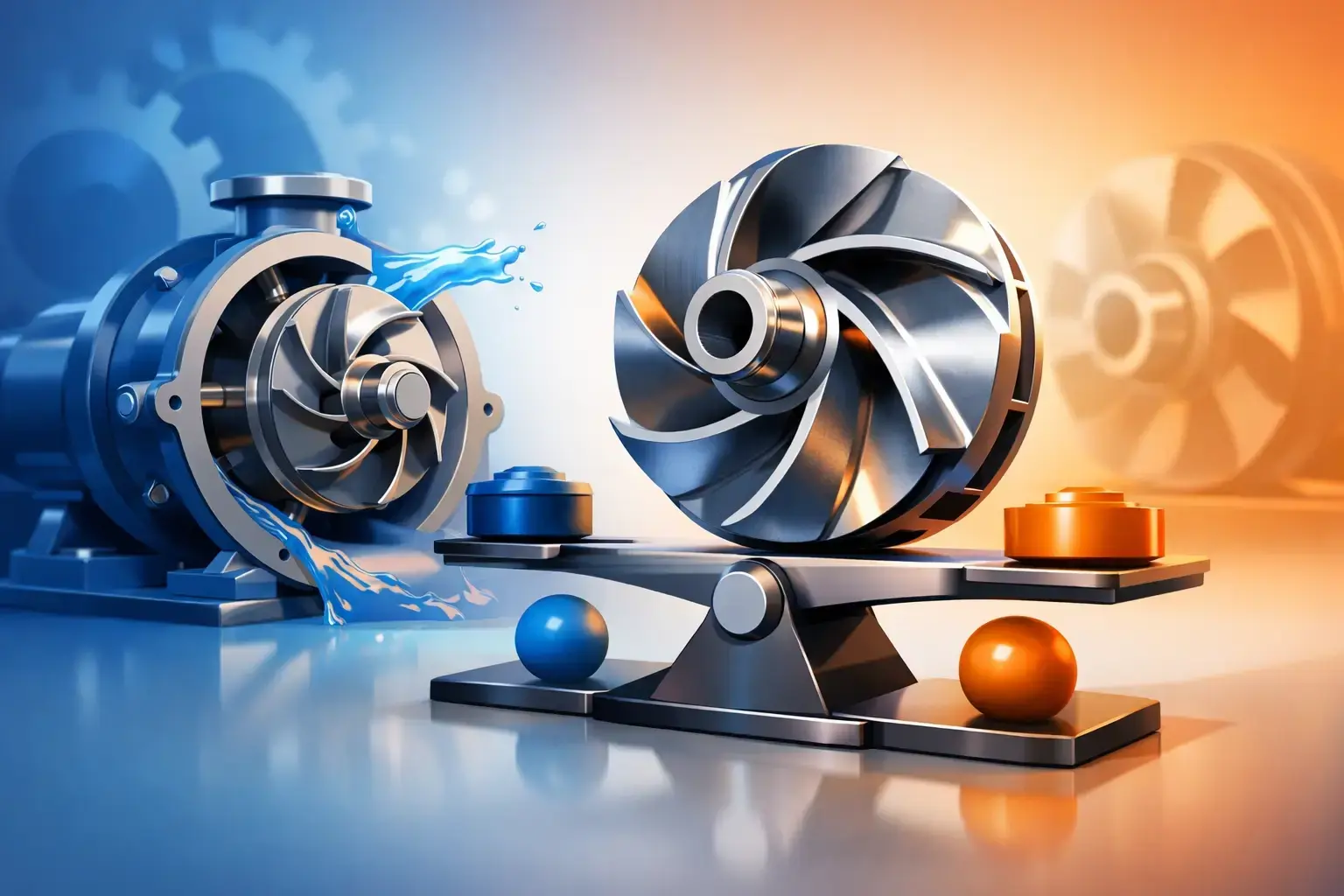
A pump failing prematurely in the field—whether through bearing damage, frequent mechanical seal leakage, or persistent vibration in the casing—can often be traced back to a single component: the impeller. When pump impeller balance is compromised, the issue extends far beyond vibration; shaft loads increase, energy consumption is affected, maintenance intervals shorten, and the risk of unplanned downtime rises. In continuous process systems, this is not a minor mechanical deviation but a serious operational concern.
The impeller is one of the key elements that determines the hydraulic performance of a rotating system. However, beyond hydraulic design, mass distribution is equally critical. Even if the geometry is manufactured correctly, casting tolerances, machining variations, weld repairs, coatings, corrosion, wear, or material buildup can shift the center of mass away from the rotational axis. As rotational speed increases, this deviation turns into centrifugal force, generating dynamic loads that stress the entire system.
What does pump impeller balancing directly affect?
The most visible effect is vibration, but field consequences go much further. An unbalanced impeller imposes additional radial loads on bearings. This reduces bearing life and can increase operating temperatures. At the same time, shaft deflection, coupling misalignment, and irregular seal surface behavior may occur.
Another consequence appears in energy efficiency. Not every vibration issue translates directly into a dramatic increase in electricity cost, but an unbalanced pump generally operates more aggressively, generates higher mechanical losses, and disrupts stable system behavior. Over time, this impact becomes more evident through increased maintenance costs and reduced equipment life.
From a process reliability perspective, impeller balance is not just a maintenance concern. It directly affects production continuity, product quality, and operational safety. In industries such as chemicals, energy, mining, water treatment, marine, and manufacturing, pump failures often create cascading effects across the system.
Why does pump impeller imbalance occur?
Even newly manufactured impellers may require balancing. Components that appear symmetrical can still contain micron- and gram-level deviations due to casting voids, material density differences, and machining tolerances.
In field operation, conditions become more variable. Abrasive fluids can unevenly wear blade profiles. Corrosion may cause localized mass loss. Fluids containing solid particles can lead to erosion. Repaired impellers—especially those involving welding or machining corrections—almost always require rebalancing.
A critical distinction must be made here: hydraulic problems and balance problems are not the same. Cavitation, suction issues, or incorrect operating points can also generate vibration. However, even if those are resolved, the problem will persist if mass imbalance remains. Proper diagnosis must therefore consider the entire operating condition, not just vibration levels.
Static vs dynamic balancing
When evaluating pump impeller balance, the key distinction is between static and dynamic balancing. For narrow, disc-type impellers, static balancing may be sufficient in some cases. This method focuses on correcting imbalance in a single plane.
However, for larger, high-speed, or geometrically complex impellers, dynamic balancing provides more reliable results. These components may exhibit imbalance across two planes, not just one. Dynamic balancing reflects real operating forces more accurately and produces data closer to actual field behavior.
The choice depends entirely on component type, operating speed, mounting conditions, and application requirements. Applying the wrong balancing method can result in measurements that appear correct but fail to resolve the issue.
How should the correct balancing process proceed?
A proper balancing process is not simply about mounting the part and adding or removing weight. First, the physical condition of the impeller must be assessed. If there are issues such as deformation, cracks, weld repairs, excessive wear, mounting surface damage, or reference misalignment, these must be addressed before balancing. A geometrically flawed component cannot produce stable results.
Next, the correct mounting method must be selected. Improper mounting can mix actual imbalance with setup errors. Measurement accuracy depends heavily on proper machine calibration, sensor condition, and operator experience. This is why balancing machine calibration is a key factor.
Correction is typically achieved by controlled material removal, and in some cases by adding weight. However, this must be done within engineering limits. Random grinding or uncontrolled welding may reduce imbalance temporarily but can compromise mechanical strength and hydraulic performance. Correction points must be determined based on engineering principles.
How is balancing tolerance determined?
A common mistake in the field is assuming a single balance quality level is sufficient for all pumps. In reality, acceptable imbalance depends on impeller mass, diameter, operating speed, pump function, and process sensitivity.
High-speed and critical process pumps require tighter tolerances. Lower-speed or less critical auxiliary systems may allow more flexibility. The goal is to avoid unnecessary risk from loose tolerances while also preventing excessive cost and time from overly strict ones. The correct tolerance is a balance between technical necessity and operational efficiency.
When should pump impeller balancing be checked?
Balancing should be considered when vibration increases, but waiting for failure is often too late. For new impellers, pre-commissioning checks are essential. Impellers that have undergone repair, welding, coating, or wear-related machining must also be rebalanced.
Including balance evaluation in periodic maintenance plans offers significant advantages, especially in high-duty operations. Some imbalances develop gradually and may not be immediately noticeable. A measurement-based maintenance approach is far more cost-effective than reacting to unexpected failures.
Typical field symptoms
Common indicators of imbalance include increased bearing vibration, frequent bearing failures, reduced seal life, coupling wear, loosened bolts, and increased casing noise. However, none of these symptoms alone definitively confirm imbalance.
Misalignment, structural looseness, shaft bending, or hydraulic instability can produce similar effects. Therefore, the correct approach is to combine vibration analysis with mechanical inspection. Applying balancing without confirming the root cause can result in wasted time and effort.
Why service and equipment selection matters
The capacity, precision, and proper fixturing of the balancing machine directly affect result quality. Equally important is the experience of the technical team. Some impellers do not behave like standard rotors; blade design, hub structure, and mounting geometry require specialized handling.
This is why working with a solution partner that provides not only measurement but also revision, calibration, field service, and engineering interpretation makes a significant difference. Companies like MDBALANS, focused on balancing technology, deliver value not just by generating data but by correctly interpreting it in real operating conditions.
Reliable pump operation often depends on details that seem minor. Impeller balance is one of the most critical among them. If your facility is experiencing vibration, premature bearing failure, or recurring maintenance costs, examining the impeller more closely is often the right starting point.