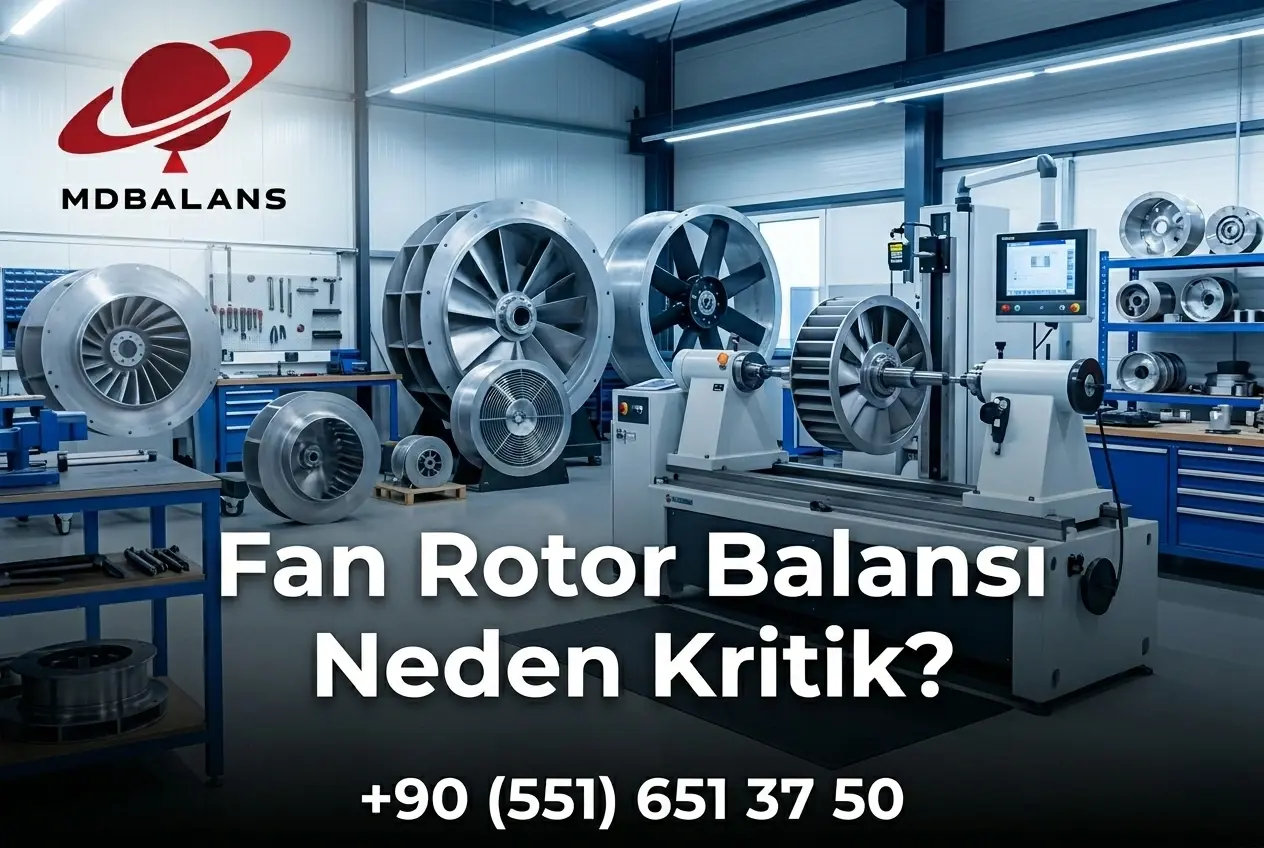
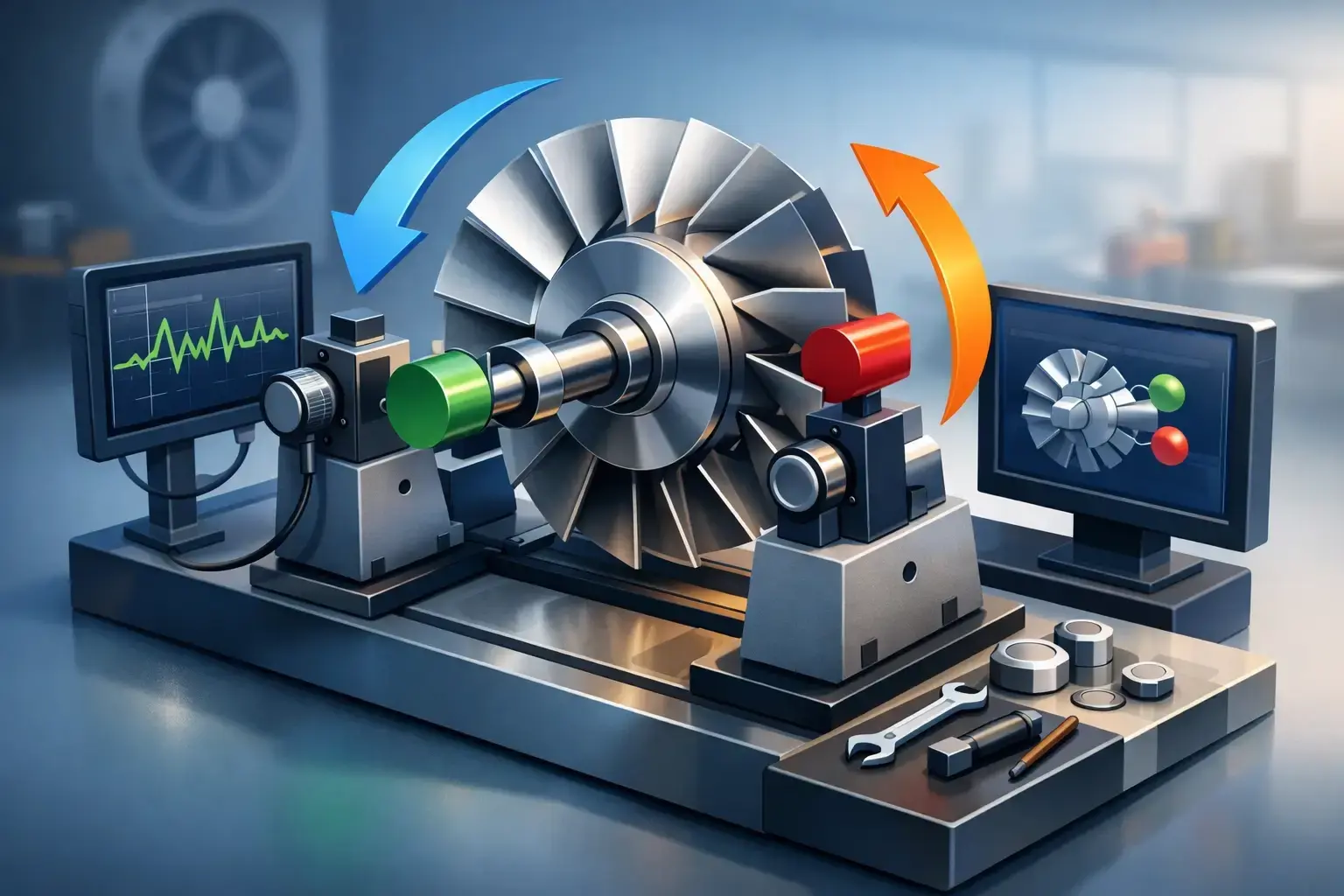
In a fan line, problems rarely start with noise. First, bearing temperature rises slightly, then vibration increases on the housing, fasteners begin to loosen, and eventually an unplanned shutdown occurs. At the center of this chain lies a critical issue often overlooked in many facilities: fan rotor balancing.
In industrial fans, balance quality is not just a mechanical detail. It directly affects system safety, energy efficiency, bearing life, maintenance intervals, and process stability. Especially in high-speed, large-diameter, or continuously operating fan applications, even a small imbalance can quickly turn into a significant operational cost.
What does fan rotor balancing affect?
If the mass distribution of the fan rotor is not equal around the axis of rotation, centrifugal forces occur. As speed increases, these forces grow. As a result, bearings, shafts, couplings, base structures, and connected equipment are subjected to higher-than-normal loads. Vibration does not only affect the fan; it can also impact the motor, frame, and even the duct system.
The most common field effects include bearing failures, mechanical looseness, rubbing inside the casing, increased noise, and higher energy consumption. In some facilities, product quality can even be indirectly affected, as unstable airflow can cause fluctuations in sensitive processes.
The key point here is this: not every vibration problem is caused by imbalance, but imbalance is one of the most common root causes. Therefore, correct diagnosis is just as important as the correct intervention.
Why does fan rotor imbalance occur?
Even a newly manufactured rotor can lose its balance over time under operating conditions. This is because the rotor is shaped not only by manufacturing tolerances but also by real working conditions.
Dust accumulation is one of the most common causes. In industries such as cement, mining, textiles, woodworking, and foundries, material buildup on blade surfaces changes the mass distribution. What initially seems minor can turn into a significant imbalance force as rotational speed increases.
Wear has a similar effect. If fan blades experience erosion, corrosion, or material loss, the rotor no longer maintains its original geometry. Weld repairs, uncontrolled grinding, added components, or improper coating applications can lead to the same outcome.
Another cause is related to assembly and maintenance processes. Misalignment after bearing replacement, loose connections, shaft bending, or coupling issues can sometimes be confused with imbalance. Therefore, simply adding correction weights is not the right approach. The root cause of vibration must first be technically identified.
Difference between static and dynamic balancing
One common mistake in fan rotors is evaluating all balancing needs in a single plane. However, the rotor’s geometry, length, diameter, operating speed, and application determine the correct balancing method.
Static balancing focuses on correcting the shift of the center of mass relative to the axis of rotation. It may be sufficient for shorter and relatively narrow rotors in some cases. However, in many industrial fan rotors, the issue does not occur in just one plane.
Dynamic balancing evaluates the rotor behavior in two or more planes. For long rotors, wide fan impellers, and high-speed applications, this is usually the required approach. Because imbalance on one side of the rotor and angular deviations on the other side together generate vibration, single-plane correction may reduce the issue but not eliminate it completely.
Therefore, the balancing method must be selected according to the rotor type. Otherwise, maintenance may be performed, but operational reliability will not reach the expected level.
What are the signs of fan rotor imbalance?
A continuously increasing vibration level in the fan system is the primary indicator. Accompanying bearing overheating, unusual noises, and frequent loosening of connections should also be considered. Fluctuations in motor current, base cracks, or premature wear of vibration isolators also support the diagnosis.
However, caution is necessary. Misalignment, mechanical looseness, resonance, bearing damage, or shaft bending can produce similar symptoms. Therefore, decisions should be based not only on operator observations but also on measurement data.
Vibration analysis is critical at this stage. When frequency components, phase relationships, and operating conditions are evaluated together, imbalance-related issues can be identified more clearly. In critical fan systems, avoiding diagnostic errors is just as important as saving time.
How should the correct balancing process proceed?
A proper fan balancing process is not limited to adding weights and trial runs. It must start with a technical inspection. Material buildup, cracks, blade deformation, weld defects, mechanical rubbing, shaft misalignment, and bearing conditions must be checked before balancing. Otherwise, the results may not be permanent.
Next, the required tolerance class for the rotor must be defined. Not all fans require the same level of precision. Process fans, HVAC fans, high-speed special fans, and heavy-duty exhaust fans have different acceptance criteria. Factors such as speed, rotor mass, mounting type, and application purpose must be considered together.
Balancing in a workshop environment generally provides higher precision due to controlled conditions. However, for large fans, disassembly and transport may cause downtime. In such cases, on-site balancing may be the better option, especially when minimizing downtime is critical.
That said, on-site balancing is not always ideal. If the rotor has structural damage, severe geometric distortion, or irregularities caused by buildup, mechanical correction must be performed first. Balancing should not be used to mask mechanical problems.
Why is tolerance important in fan rotor balancing?
Completing a balancing process does not necessarily mean it has been done at the correct level. The key question is: according to which tolerance was the rotor balanced? Too loose a tolerance may make vibration appear acceptable, while too strict a tolerance can be inefficient in terms of time and cost.
The correct tolerance depends on operating conditions. Fans running continuously, operating at high temperatures, or serving critical processes require higher precision. Auxiliary equipment operating at lower speeds may allow a different approach.
The engineering goal is to match the optimal technical result with the most efficient operational cost. In other words, the objective is not just minimum vibration, but sustainable and economical operation.
Impact of balancing on maintenance costs
An unbalanced fan increases the maintenance workload more than it appears. Failures do not remain localized; bearings, seals, couplings, motor supports, fasteners, and base components are all affected in a chain reaction. Replacing a single component may temporarily reduce the issue, but if the root cause is rotor imbalance, the failure will reoccur.
Proper fan rotor balancing breaks this cycle. Lower vibration levels extend bearing life, reduce unplanned downtime, and make maintenance planning more predictable. Energy savings may also be achieved, although this varies depending on the initial condition of the rotor and system operation.
Therefore, balancing should not be viewed merely as a repair activity. When applied correctly, it becomes a technical investment that protects equipment life and controls maintenance costs.
When should professional support be considered?
If a fan frequently experiences bearing failures, vibration persists despite recent overhaul, or the rotor has a history of welding, wear, buildup, or deformation, the issue may exceed standard maintenance limits. In critical production lines, trial-and-error approaches can significantly increase downtime.
In such cases, it is essential to work with expert teams that have strong measurement capabilities, field experience, and knowledge of both balancing machines and on-site applications. The correct solution may involve workshop precision balancing, on-site dynamic balancing, or mechanical repair followed by rebalancing. The decision must be based on the actual condition of the equipment.
Working with specialized providers like MDBALANS offers a clear advantage. Combining machinery, measurement, service, and engineering evaluation under one roof minimizes the gap between diagnosis and implementation.
Reliable operation in fan systems is usually achieved not through major overhauls but through timely correction of small deviations identified correctly. Delaying rotor balancing may seem to maintain production in the short term, but it increases costs in the long run. If your fan has started to “speak” through vibration, the most effective way to silence it is to clearly identify the root cause.