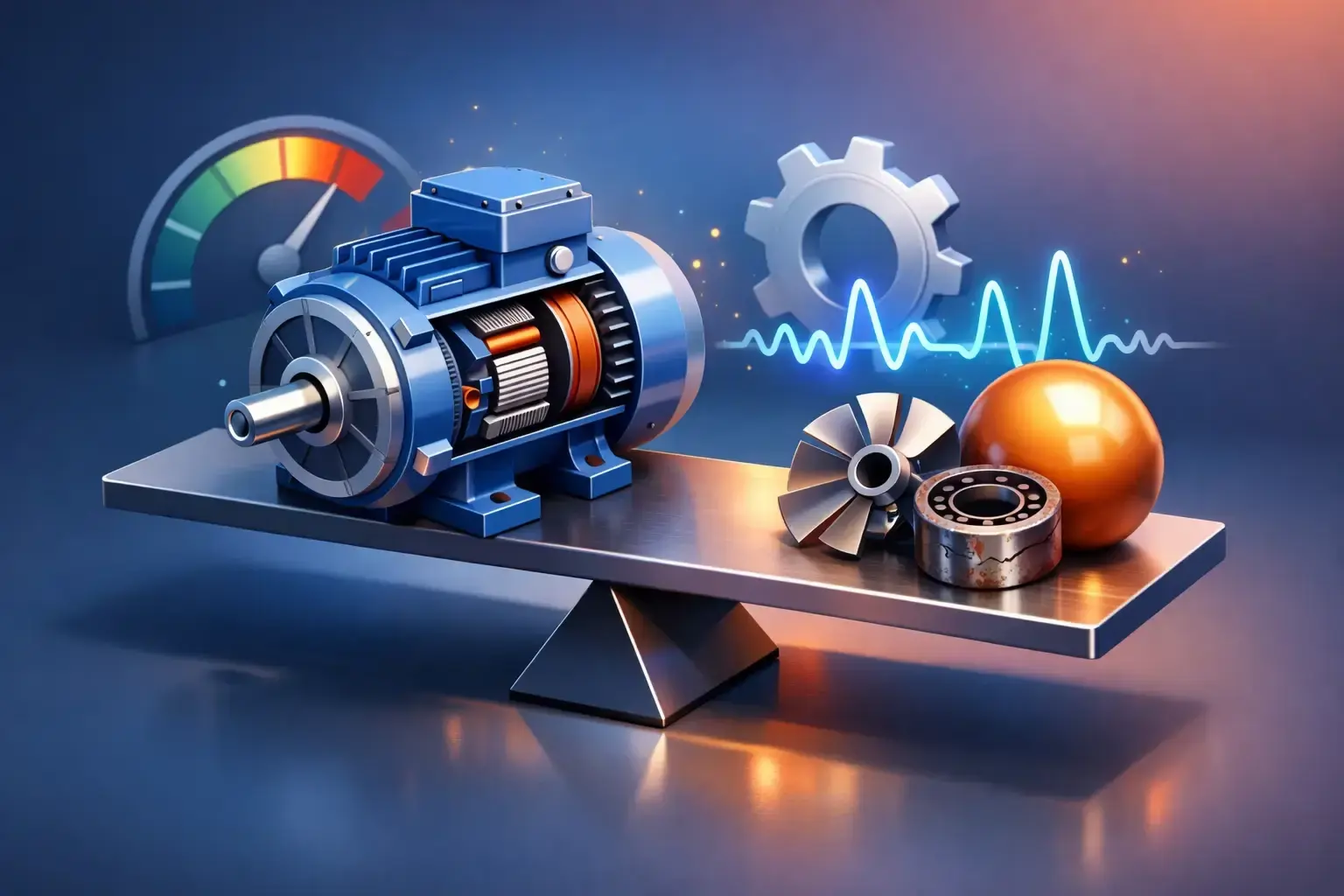
If the same bearing point is repeatedly replaced on a production line, unusual heating appears on motor housings, or recurring vibration complaints develop around the coupling side, the issue is often more fundamental than expected. When electric motor balancing is insufficient, the problem does not remain only in the rotor; it affects the entire system, from bearing life and energy consumption to product quality and unplanned downtime.
In many facilities, electric motor balancing is only considered after a clear failure appears. However, when imbalance is detected early and corrected properly, it reduces maintenance costs, improves operational reliability, and extends equipment life. For this reason, balancing is more than a corrective action; it is a critical engineering practice that protects production continuity.
What does electric motor balancing mean?
Electric motor balancing is the process of checking and, if necessary, correcting the mass distribution of the rotor around its axis of rotation. The goal is to keep centrifugal forces generated during rotation within acceptable limits. When rotor mass is not distributed evenly around the shaft axis, the motor creates vibration during operation. This vibration may increase at certain speeds and spread to other system components.
The critical point is this: not every vibration problem is caused only by imbalance, but imbalance is one of the most common root causes. Shaft bending, incorrect installation, coupling misalignment, looseness, electromagnetic effects, or bearing damage can create similar symptoms. Therefore, accurate diagnosis must come before accurate balancing correction.
How does imbalance affect the motor?
An unbalanced rotor first increases vibration levels. Increased vibration raises bearing loads, causes wear in bearing housings, and can loosen connection elements. Over time, this can lead to secondary damage in the shaft, coupling, fan, and motor frame.
Energy efficiency is also affected. A motor operating with imbalance can become less efficient because of increased mechanical losses. This difference may seem small for a single motor, but in facilities with many motors, the total impact on energy costs can become significant.
The effects are also visible in production quality. In processes requiring precise rotational movement, vibration can reduce product quality. In fans, pumps, compressors, gearbox inputs, and special drive systems, balancing quality is important not only for motor health but for overall process stability.
Why does imbalance occur in electric motors?
Imbalance does not always mean a manufacturing defect. Dirt accumulation on the rotor, material loss from fan blades, improper maintenance, geometry changes after rewinding, or mass variations after repairs can all disturb rotor balance.
This risk becomes higher in overhauled motors. During rotor removal and reinstallation, component replacement, or machining corrections, the original mass distribution can change. In high-power motors, even small deviations can create significant centrifugal forces at high speed.
Operating conditions are another important factor. Dusty environments, high temperatures, chemical exposure, or shock loads can gradually change rotor behavior. For this reason, balancing evaluation should consider not only workshop conditions but also the actual operating environment of the equipment.
Which symptoms indicate the need for balance inspection?
If bearings are regularly replaced in an electric motor but no lasting improvement is achieved, balance inspection should be considered immediately. Increasing vibration at specific speed ranges, loose base connections, higher noise levels, noticeable housing movement, and repeated issues near the coupling area are also strong indicators.
Another common situation is when a newly overhauled motor produces higher vibration than expected after startup. In this case, simply performing general vibration measurement in the field may not be enough. The rotor balance condition must be evaluated with proper equipment.
Some facilities make the mistake of focusing only on alignment or bearing quality. However, if balance problems are not corrected first, other maintenance actions may still lead to repeated failures in a short time. This unnecessarily increases maintenance budgets.
How is electric motor balancing performed?
Proper balancing starts by selecting the correct balancing method according to rotor characteristics. Rotor type, weight, diameter, length, operating speed, single-plane or two-plane requirements, and tolerance level all determine the correct approach. Small standard rotors and highly sensitive custom applications cannot be treated the same way.
The balancing process generally consists of measurement, correction, and verification. During measurement, the amount of imbalance and its angular position are identified. In the next step, material is removed, correction weights are added, or other design-specific correction methods are applied. In the final measurement, the required tolerance is confirmed.
Equipment quality is a decisive factor here. Calibrated balancing machines with high measurement accuracy provide reliable data. Otherwise, the rotor may be corrected excessively or at the wrong location, creating new problems instead of improving balance.
Single-plane or two-plane balancing?
This is a common question in practice. For short rotors and certain geometries, single-plane balancing may be sufficient. However, as rotor length increases or operating precision becomes more critical, two-plane balancing becomes necessary. This is because imbalance can create different effects at two separate axial locations along the rotor.
Incorrect plane selection can lead to misleading interpretation of the measurement. The motor may seem to run better temporarily, but vibration can continue at actual operating speed. For this reason, rotor geometry and application conditions must always be evaluated together.
Field balancing or workshop balancing?
This depends entirely on the application. If correction can technically be performed without removing the rotor and downtime is critical, field balancing can provide a major advantage. This is especially valuable in large systems where disassembly, transport, and reinstallation are costly.
However, for rotors requiring tighter tolerances, post-repair verification, or geometry inspection, workshop balancing often delivers better results. Measurements taken in controlled conditions are generally more repeatable. The ideal approach is to decide based on equipment size and failure characteristics.
Why balancing tolerance matters
Not every motor requires the same balancing level. Operating speed, intended use, rotor design, and connected equipment directly influence tolerance selection. A tolerance that is too loose may leave the problem unresolved. A tolerance that is too strict is not always economical and can create unnecessary processing time.
For this reason, balancing quality should be determined by considering technical standards together with actual operating needs. This is where engineering judgment becomes essential. The goal is not simply to make the rotor spin, but to make it reliable under real operating conditions.
Common mistakes in the balancing process
The most common mistake is evaluating balance only by vibration level. In reality, vibration direction, frequency, speed dependency, and the mechanical condition of the system must all be analyzed together. Confusing imbalance with misalignment often leads to incorrect intervention.
Another frequent mistake is putting the rotor back into service immediately after repair. Motors that undergo rewinding, fan replacement, shaft repair, or welding often experience repeated failures when balance verification is skipped. In addition, measurements performed with poorly calibrated equipment do not produce reliable results.
The most expensive mistake for facilities is delaying the issue. Vibration may appear tolerable for a while, but damage often grows progressively. Professional balance inspection at an early stage can prevent major repairs later.
Why the right technical partner matters
Electric motor balancing is not limited to mounting a rotor on a machine and taking a reading. Reliable results require a technical team that can understand rotor geometry, choose the correct tolerance for the application, interpret measurement data, and provide field support when needed.
For industrial facilities, expertise matters as much as speed. Especially in plants where production losses are costly, it is not only important to respond quickly but also to respond correctly. When balancing machines, calibration, overhaul, software support, and technical service are handled together, the process becomes far more controlled. Solution partners such as MDBALANS, with expertise in both equipment and application, therefore provide stronger value in industrial operations.
Accepting vibration in an electric motor as normal is often the most expensive choice. When the issue is addressed early, balancing becomes not a cost item but a form of production protection. With correct measurement, correct correction, and proper technical evaluation, the motor becomes not only quieter, but also longer-lasting, more efficient, and more predictable.