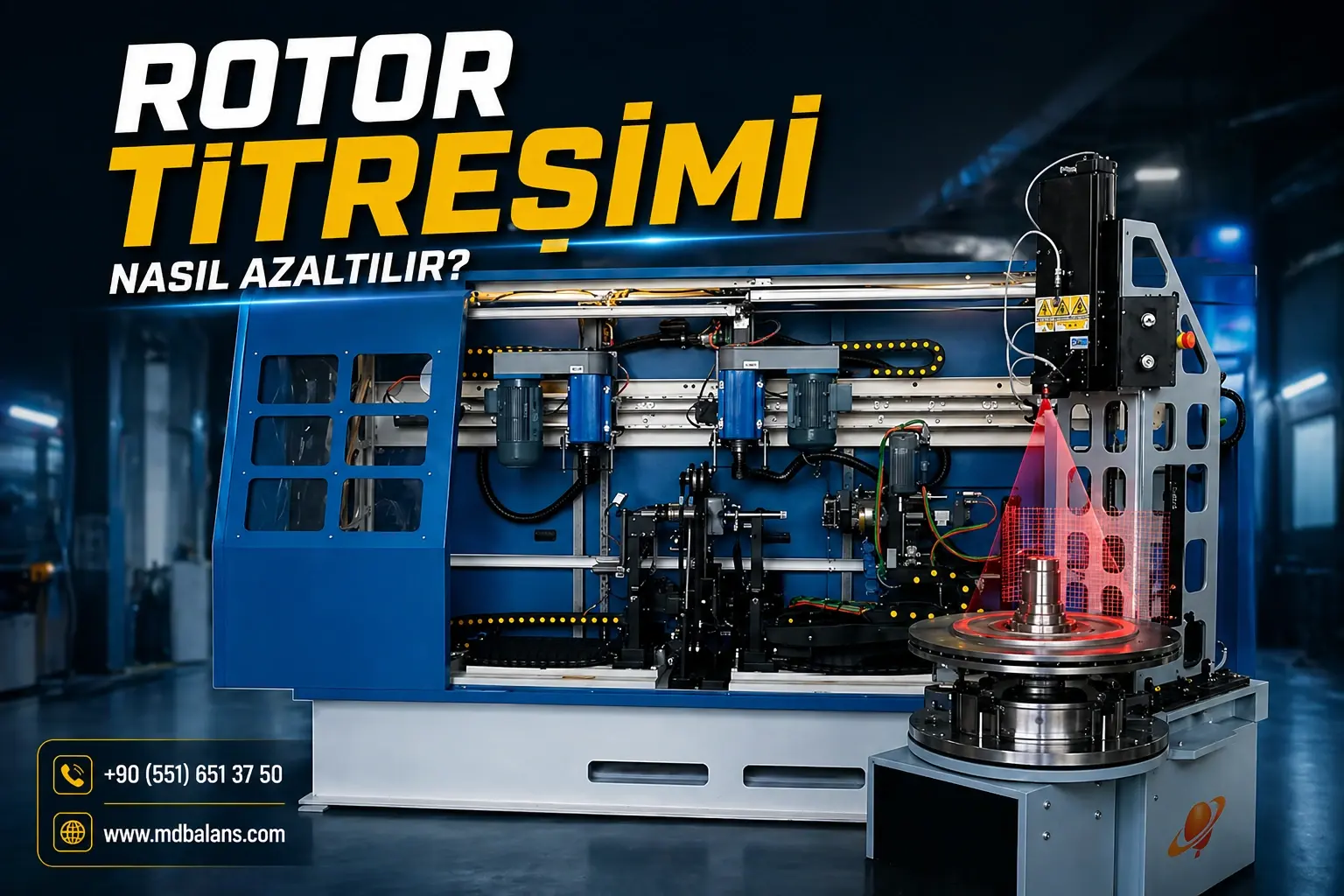
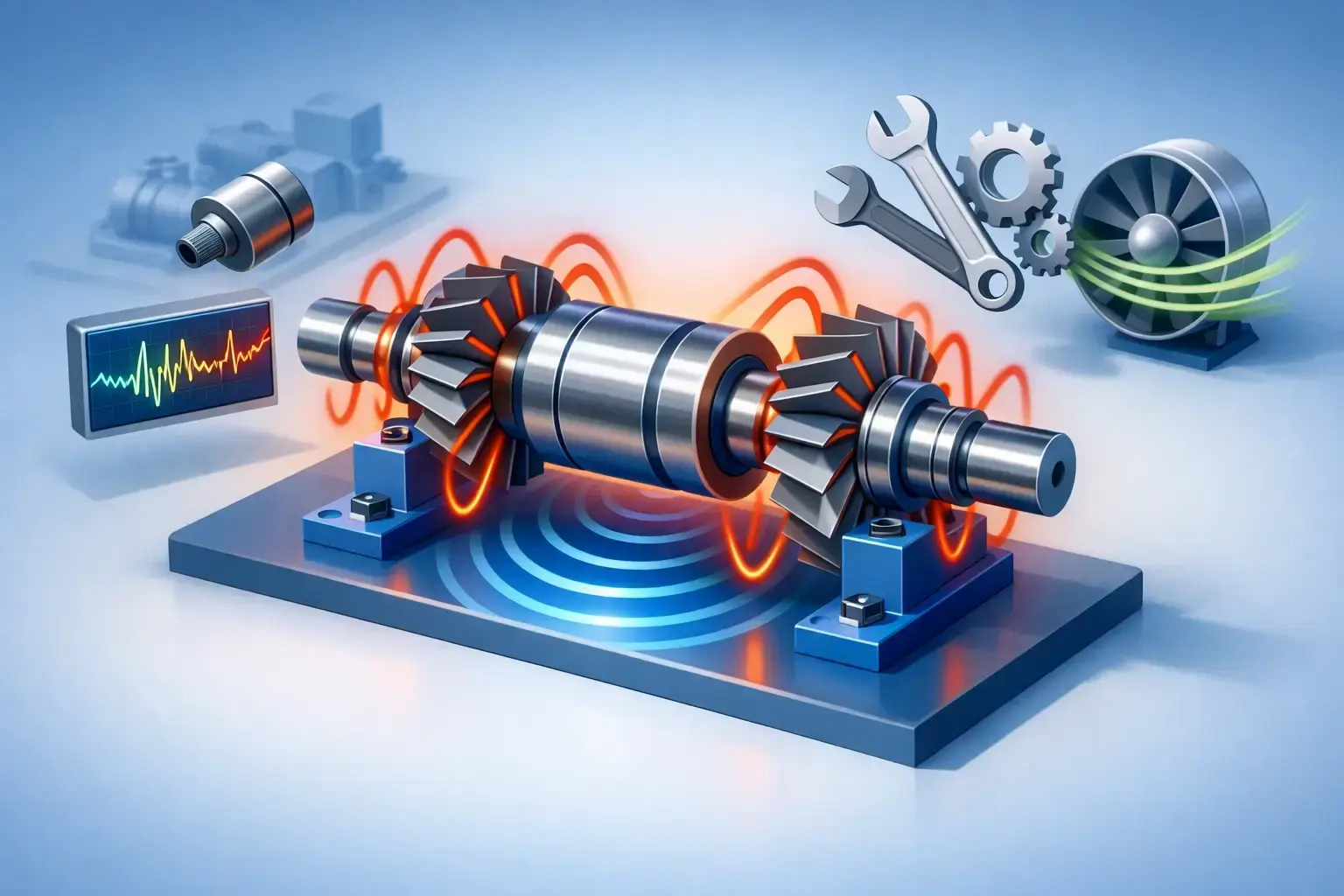
If rotor vibration on the production line appears one day as acceptable and the next day as problematic, the issue is often not the rotor alone. The real problem is the failure to identify the mechanical or process-related root cause behind the vibration in time. For this reason, the correct answer to how to reduce rotor vibration is not simply balancing the rotor, but measuring, separating, verifying, and applying a permanent correction.
In rotating systems, a certain level of vibration can be considered normal. However, increasing vibration shortens bearing life, increases shaft and coupling loads, raises energy consumption, and directly affects surface quality or process stability. Especially in high-speed fans, electric motors, turbine rotors, pump groups, compressors, and precision spindle applications, even a small imbalance can quickly turn into a serious operating cost.
The correct approach to reducing rotor vibration
The most common mistake in the field is assuming that imbalance is the only cause of vibration. In reality, rotor vibration can result from mass imbalance, shaft misalignment, coupling offset, bearing wear, shaft bending, looseness, resonance, weak foundations, and aerodynamic or hydraulic effects. For this reason, effective vibration reduction begins with correctly reading the vibration characteristics.
It is necessary to evaluate at what speed the vibration increases, whether radial or axial vibration is dominant, whether it rises under load, whether it changes with temperature, and which frequencies stand out in the spectrum. When field vibration data is analyzed together with balancing machine results, it becomes much clearer whether the source of the problem is truly the rotor or the complete system.
Imbalance is the most common cause, but not the only one
When the mass distribution on a rotor is not equal around the axis of rotation, centrifugal force is created. As speed increases, this force grows and places dynamic loads on the bearings. In single-plane imbalance, the issue often appears simpler, while long rotors and dual-bearing systems usually require two-plane balancing. If this distinction is not made correctly, vibration may continue in the field even though the rotor appears balanced.
Typical signs of imbalance include increasing radial vibration at certain speeds, overheating around bearing locations, loosened mounting elements, and recurring bearing failures. Especially when vibration returns after maintenance, it is important to check whether a new geometric or installation-related issue occurred during disassembly and reassembly.
When is balancing essential?
If the rotor has undergone material loss, welding repair, coating, dirt buildup on fan blades, impeller deformation, winding changes, or shaft replacement, balancing inspection becomes essential. For newly manufactured rotors, production tolerances alone are not enough; balance verification should be carried out according to the appropriate quality grade for actual operating conditions.
Balancing at this stage is not only about reducing vibration, but also about extending machine service life and reducing the risk of unplanned downtime. Accurate measurement with the proper equipment also prevents unnecessary part replacement.
Alignment and installation errors should not be ignored
If rotor vibration remains high despite acceptable balancing results, the second suspicion should be misalignment. In motor-pump, motor-fan, or gearbox-driven systems, coupling misalignment usually reveals itself through increased axial vibration. Here, not only the rotor geometry itself but also the shared operating line of all connected rotating elements must be evaluated.
Soft foot is another frequent source of vibration. When one machine foot does not fully contact the base, stress develops in the housing and rotor centering is affected. In this case, even if balancing is performed, vibration often returns shortly afterward. Similarly, loose foundations, weak frame rigidity, and incorrect tightening torque directly influence vibration levels.
Why bearing condition is critical
Worn bearings, damaged housings, or lubrication issues change rotor behavior. Operators often mistake this for rotor imbalance. However, once clearance develops inside the bearing, the rotor’s center of rotation shifts, measurements become unstable, and balancing corrections can become misleading.
For this reason, bearing type, installation condition, lubrication status, and bearing surfaces should always be checked before balancing. Balancing a mechanically unstable system does not provide a permanent solution.
The technical process for reducing rotor vibration
An effective solution depends on following the proper sequence of measurement and correction. The first step is identifying the vibration level and its characteristics. Then the rotor’s mechanical condition is examined. Shaft runout, surface defects, eccentricity, and assembly tolerances are verified. If necessary, the rotor is moved to a balancing machine and balanced in the correct number of planes.
After balancing, machine results alone should not be considered sufficient. Once the rotor is reinstalled, field verification under actual operating conditions must be performed. A rotor that is acceptable on the balancing machine may behave differently under real coupling load, bearing load, temperature, and process conditions. This difference becomes more visible in systems operating close to critical speed ranges.
In some applications, in-place balancing delivers better results. For large fans, difficult-to-remove rotors, or process-integrated equipment, balancing under real operating conditions can reduce vibration faster and with greater control. However, this method requires the right measurement infrastructure and experienced technical expertise.
If resonance is present, balancing alone is not enough
One of the most challenging field scenarios is resonance. When the natural frequency of the machine approaches operating speed, vibration levels can increase unexpectedly. In such cases, even if rotor balance is acceptable, the housing, frame, or foundation may amplify vibration.
If resonance is suspected, speed sweep testing should be performed, phase data should be analyzed, and structural rigidity should be evaluated. The solution may involve changing operating speed, increasing foundation stiffness, or redesigning the support structure. Not every high vibration problem should be treated by simply adding correction weights.
Production quality and tolerance management matter
Keeping rotor vibration low is not solely the responsibility of the maintenance team. The foundation is established during manufacturing. If shaft machining precision, bearing seat surfaces, post-weld deformation control, coaxiality, and geometric measurement quality are inadequate, vibration problems begin at assembly.
Especially in serial production, every component should behave consistently. To achieve this, balancing machine calibration, fixture accuracy, operator standards, and quality grade selection must be managed together. This perspective does not only correct one rotor; it builds a process that minimizes vibration from the beginning.
When professional support is required
If vibration does not decrease after maintenance, bearing failures continue, or problems remain at a certain speed even after balancing, more advanced technical analysis is required. The same applies to heavy industrial rotors, high-speed spindles, multi-plane systems, and critical process equipment. In these cases, data-driven specialist intervention is often more cost-effective than repeated standard maintenance.
The selection of the balancing machine also matters. A system that does not match the rotor’s size, weight, speed characteristics, and precision requirements may delay rather than solve the issue. In specialist organizations such as MDBALANS that provide both balancing machines and field technical service, the disconnect between measurement and implementation is removed and decision-making becomes faster.
Monitoring is essential for long-term reduction
Once rotor vibration is reduced, the work should not be considered finished. In facilities without trend monitoring, the issue is often not noticed until vibration returns to a critical level. Periodic vibration measurements, balance verification, bearing checks, and alignment inspections allow deterioration to be detected early.
This approach offers major advantages in 24-hour production environments. A small correction during scheduled maintenance is far less costly than unplanned downtime. From a technical perspective, the goal is not simply reducing vibration, but controlling the rotor’s entire life cycle.
The most reliable way to reduce rotor vibration is to manage the problem with data rather than assumptions. When proper measurement, accurate analysis, and correct balancing are combined, vibration decreases, equipment life extends, and production becomes more predictable. Especially in critical rotating equipment, early intervention is often the most economical solution.