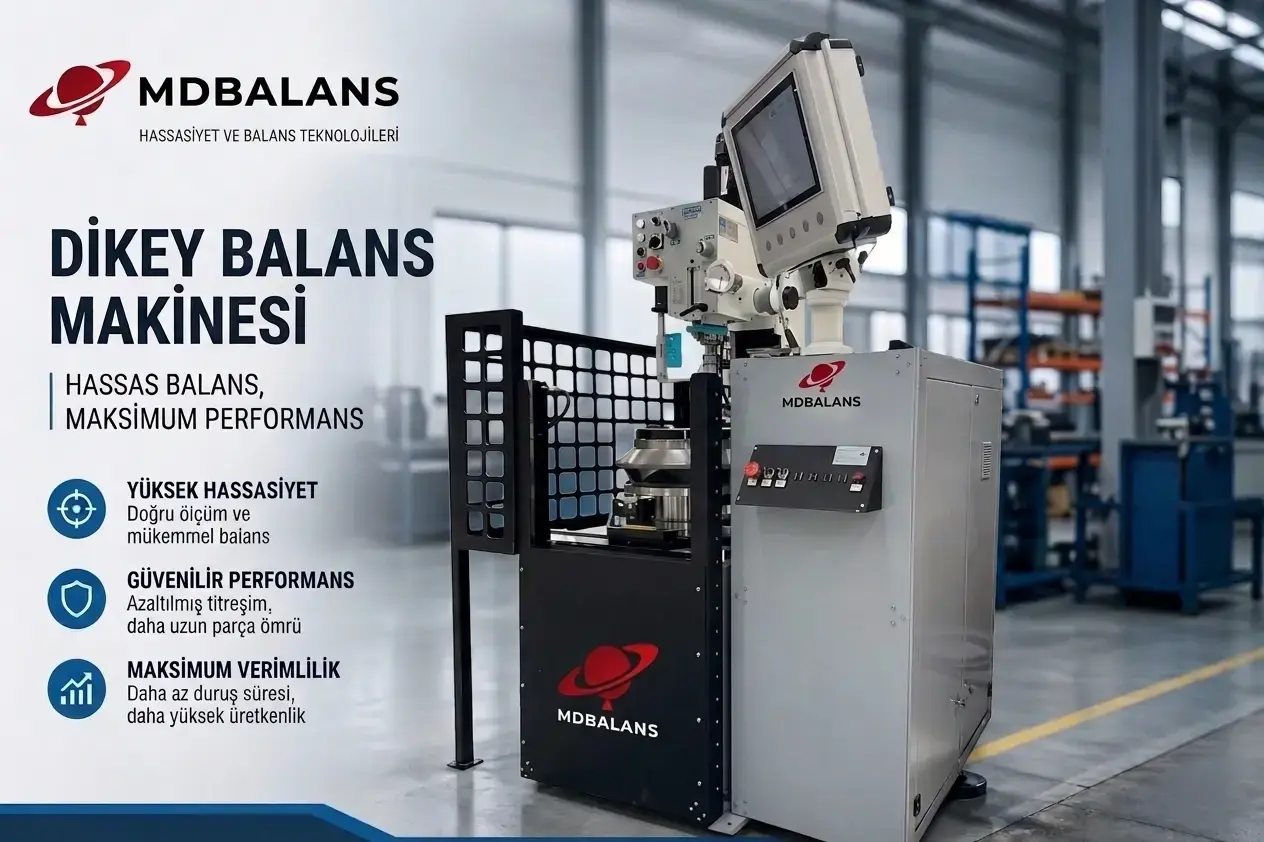
Some rotors should not be evaluated on a horizontal axis, but rather in a vertical position that more closely reflects their actual operating conditions. For this reason, a vertical balancing machine is often preferred for disc-type components, fan impellers, flywheels, clutches, and short rotor assemblies. Choosing the right machine directly affects not only balancing quality, but also production speed, repeatability, and maintenance costs.
When purchasing balancing equipment or revising an existing production line, the fundamental question is this: which machine structure is better suited to the component’s geometry, mounting method, and operating speed? The answer is often hidden not in the capacity chart alone, but in the details of the application. Vertical machines provide clear advantages for certain part families, but technically it would not be correct to say they are the right choice for every job.
What is a vertical balancing machine?
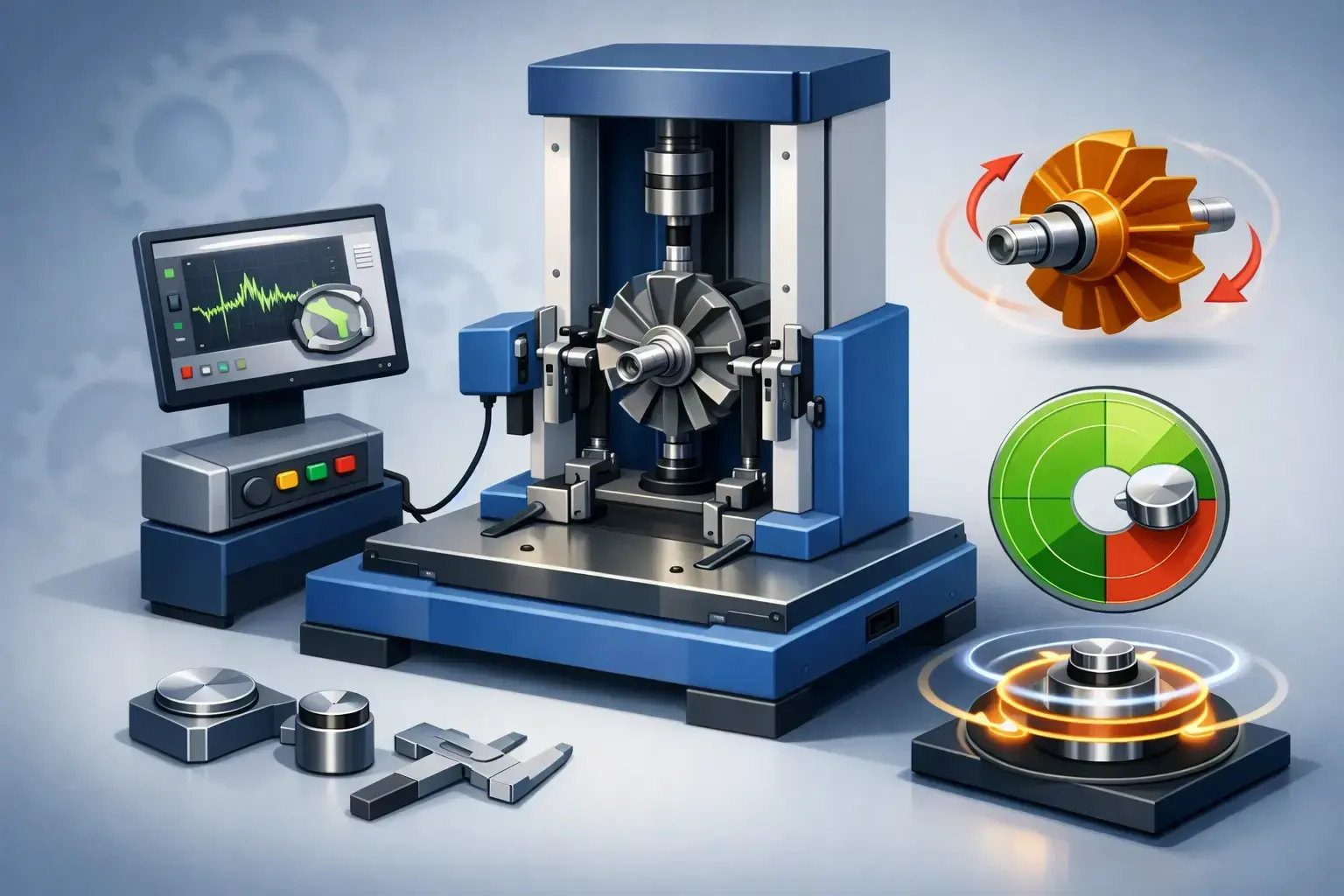
A vertical balancing machine is a balancing system in which the rotor or component is mounted on a vertical spindle and the unbalance value is measured in this axis arrangement. This design delivers efficient results especially in balancing components that are axially short, relatively large in diameter, and disc-shaped.
The primary purpose of the machine is to measure mass distribution errors within the part and provide the operator with precise data for correction. These corrections can be made through drilling, milling, adding weight, or position-based compensation methods. Measurement quality here does not depend solely on the sensor. The spindle structure, fixture design, software algorithm, calibration accuracy, and the operator’s application discipline all work together to produce reliable results.
Which components are best suited for vertical machines?
The vertical structure offers the greatest advantage for components with short axial lengths and surfaces that are corrected from the face of the part. Fan impellers, pump impellers, brake discs, pulleys, clutch components, flywheels, thin-walled discs, and various rotating table elements all fall into this category. If the center of gravity is close to the mounting point and loading/unloading time is critical, a vertical machine can provide significant time savings in production.
By contrast, for long shaft rotors, multi-stage shafts, or components whose bearing behavior becomes more evident on a horizontal axis during operation, a horizontal balancing machine may be more suitable. This means the choice should not be based only on the weight of the component. Proportion, rigidity, number of balancing planes, and actual operating conditions must all be evaluated together.
Main advantages of vertical balancing machines
The strongest aspect of vertical systems is operational practicality. The operator places the part from above, secures it, and proceeds to measurement in a short time. In high-volume production environments, this setup can reduce cycle times considerably. Centering large-diameter but short-length parts can also be achieved with greater control in many cases.
Another advantage is ease of correction access. On disc-type parts, the correction surface is usually accessible from above or around the perimeter. This speeds up the workflow between measurement and correction. In facilities planning automation integration, vertical machines can be matched efficiently with loading stations and custom fixtures.
However, for these advantages to remain sustainable, the machine frame, spindle quality, and fixture design must be at the correct level. A weak fixture can reduce the performance of even the best measurement system. Many balancing deviations observed in practice are caused more by unsuitable tooling than by the machine itself.
Technical factors that determine measurement accuracy
When purchasing a vertical balancing machine, many users first look at the maximum part weight. This is important, but not sufficient on its own. The real determining factor is whether the machine can provide repeatable measurements at the required tolerance level.
The first issue is spindle and bearing quality. The spindle’s vibration characteristics, system rigidity, and mechanical runout directly affect measurement reliability. The second critical point is sensor structure and signal processing capability. No matter how advanced the electronics are, the results will not be consistent if the mechanical foundation is weak.
Software is just as important as mechanics. It is not enough to simply display the amount of unbalance to the operator. Functions such as angular position indication, correction guidance, tolerance limits, reporting, and product-based recipe management strengthen production discipline. For repetitive tasks, stored program structures provide a major efficiency advantage.
What should be considered when selecting a vertical balancing machine?
For the right selection, components should first be classified. Making a machine decision based on a single sample part is a common mistake. If the facility handles products of different diameters and weights, fixture change logic should be evaluated alongside capacity range.
The maximum part weight, diameter, and mounting method are the first pieces of data. After that, the required balancing quality level, target cycle time, and whether single-plane or two-plane balancing is needed should be clearly defined. Some components may appear to require only single-plane balancing in theory, but in real operation, two-plane evaluation may produce safer results.
The production environment also matters. A machine operating in a laboratory-like clean area does not require the same protection as one working on a heavy industrial line. Dust, temperature variation, operator workload, and shift patterns all influence machine design decisions. For this reason, a standard solution may not always be sufficient.
Most common mistakes in practice
Weak results from a vertical balancing machine are usually caused not by the measurement principle, but by application details. The most common issue is incorrect mounting. If the component does not sit properly on the spindle or there is axis misalignment in the fixture, the machine measures not only the real unbalance but also the mounting error.
Another issue is dirty or damaged reference surfaces. In mass production, even small chip residues can distort measurements. Inconsistent loading by the operator, uncontrolled correction processes, and neglected calibration intervals can also make results unstable.
In some facilities, speed is also misunderstood. Taking measurements at higher speeds does not always mean more accurate results. The component type, machine characteristics, and safe operating limits must be considered. The correct speed is the one at which the system delivers stable and repeatable data.
Why service, calibration, and refurbishment are critical
A balancing machine is not equipment that maintains the same accuracy for years after installation without attention. Mechanical wear, sensor aging, cable issues, electronic drift, and fixture deformation all affect measurement quality over time. For this reason, periodic inspection and calibration are essential to maintain true performance.
Refurbishment is also common, especially in older machines. A system with a solid frame can often be restored to high efficiency with proper engineering intervention. The critical point is not only to repair faults, but to adapt the machine to current production needs. Software updates, new fixture designs, or electronic modernization can often deliver benefits close to a new machine investment.
Fast response on the service side is also important. For a facility experiencing balancing issues, every hour of waiting means production loss. Therefore, the technical support structure should be considered just as carefully as the machine supplier. Specialist companies such as MDBALANS that provide both manufacturing and service expertise can offer a centralized solution for industrial operations.
When is a custom design required?
A standard vertical machine covers many applications, but in some cases a custom design becomes unavoidable. If the part geometry is unusual, the connection surface is limited, automation line integration is required, or high precision demands a special fixture, a standard solution may not be enough.
For example, in thin-walled fans, even clamping pressure can alter the geometry. In such cases, fixture design becomes as critical as the measurement itself. Likewise, in very high-volume production, the time loss created by manual processes can become unacceptable. In these scenarios, automatic marking, correction guidance, or fully automatic balancing systems become relevant.
Is price alone enough for an investment decision?
No. In a vertical balancing machine investment, the initial cost is important, but the total cost of ownership is more decisive. Rework caused by unstable measurements, scrap risk, downtime, and service waiting times can quickly make a low purchase price meaningless.
For this reason, machine sensitivity, spare parts availability, software support, operator training, service speed, and calibration infrastructure should all be evaluated together. A technically correct system supported by reliable service increases production safety, reduces vibration-related failures, and helps maintain quality standards.
If you are considering a vertical solution, define the component and your process correctly before focusing on the machine itself. A clearly defined need leads to the right engineering solution, and balancing quality can only become sustainable on that foundation.