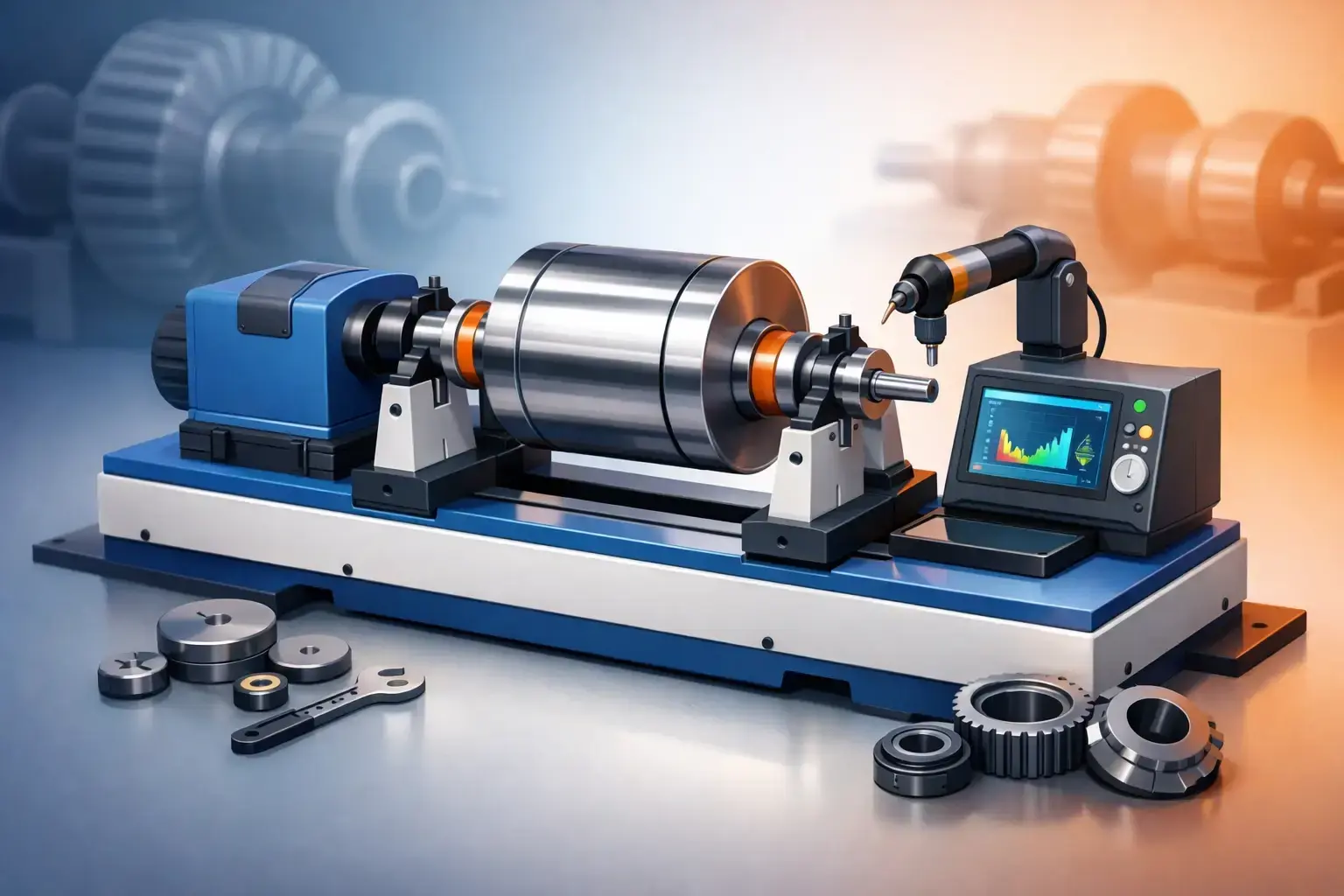
If a rotor generates vibration in the field, the issue is often not the bearing but the imbalance itself. At this point, a horizontal balancing machine measures the component under conditions close to its actual operating behavior, revealing the source of the problem while turning the correction process into a data-driven procedure. Especially for cylindrical workpieces such as shafts, fans, armatures, drums, pump rotors, and similar parts, proper balancing is not just a quality control step — it is a process that directly affects operational reliability.
Why is a horizontal balancing machine used?
Imbalance occurs when the center of mass of a rotating part does not align with its axis of rotation. As a result, vibration increases, bearing life shortens, energy consumption rises, and equipment service intervals become shorter. In a production line, this appears as returns, rework, and quality loss. In the field, it leads to unplanned downtime, maintenance costs, and equipment damage.
A horizontal balancing machine makes this problem measurable. The part is rotated on supports along a horizontal axis, while sensors detect the amount and angular position of the imbalance. Based on the data provided by the software, the operator can add weight, remove material, or make positional corrections. This means decisions are based on measurement rather than guesswork.
These machines are particularly preferred for rotors that are relatively long in axial dimension, operate between two bearings, or are naturally suited to horizontal positioning. Electric motor rotors, fans, paper rollers, textile shafts, pump rotors, and similar components all fall into this category.
How does a horizontal balancing machine work?
The basic principle is simple, but accuracy is directly related to the machine’s mechanical structure and measurement quality. The part is mounted onto the support system using suitable fixtures. While the drive unit rotates the component at a specified speed, sensors detect the resulting vibration or force. The system then processes these signals to calculate in which plane the imbalance exists and how large it is.
At this point, the distinction between single-plane and two-plane balancing becomes important. For narrow or disc-shaped parts, single-plane balancing may be sufficient. However, in longer rotors, imbalance often needs to be evaluated in two separate planes. Otherwise, a correction made at one point may negatively affect the other end. For this reason, machine selection should consider not only the part’s weight, but also its geometry and balancing method.
Factors affecting measurement accuracy include the support system, drive type, sensor quality, calibration condition, software algorithm, and operator experience. A machine that appears high-capacity on paper may fail to deliver the desired results if configured incorrectly. In practice, what matters most is whether the machine is designed for the specific family of workpieces being processed.
Which parts is it suitable for?
Horizontal balancing machines have a wide range of applications. Electric motor and generator rotors are among the most common examples. In addition, ventilation fans, blower rotors, pumps, compressor components, crankshafts, rollers, turbine subcomponents, and various defense industry parts can also be balanced on these machines.
The determining factor is not simply the part name. Weight range, diameter, bearing distance, drive method, surface sensitivity, and production volume all directly influence the selection. For example, large individual components may require a flexibly adjustable system, while repeatability and cycle time become more critical in mass production. Two applications that seem similar on the surface may actually require completely different machine approaches.
Mass production and maintenance workshops have different needs
In mass production, systems that reduce operator intervention, allow quick mounting, and automatically record results provide a significant advantage. In maintenance workshops, however, compatibility with many different part types, flexible fixture options, and strong technical support become more important. Ignoring this difference can reduce efficiency even if the investment itself appears correct.
What should be considered when choosing a horizontal balancing machine?
The first value most buyers look at is usually maximum rotor weight. However, this alone is not enough. Rotor diameter, length, center of gravity, balancing tolerance, operating speed, and correction method are equally important. In industries requiring tight tolerances, it is especially important to question how accurately a low-speed measurement represents actual operating conditions.
The rigidity of the support system and the mechanical quality of the machine are crucial for long-term performance. A weak frame or a mechanical structure requiring frequent maintenance may seem acceptable initially, but over time it can reduce measurement repeatability. Similarly, while a user-friendly software interface is helpful, the real value lies in measurement reliability, reporting capability, and calibration stability.
Service and spare parts availability are also often overlooked during purchasing. A balancing machine is not simply a product to be delivered and used. Installation, training, calibration, software support, periodic maintenance, and possible future upgrades should all be considered together. In facilities where downtime is expensive, rapid technical support can be just as important as the machine’s technical specifications.
The operational impact of proper balancing
A properly balanced rotor does more than just run quietly. Bearing life is extended, shaft loads are reduced, and stress on couplings and connection elements decreases. As a result, maintenance intervals become more predictable and the risk of unexpected shutdowns is reduced. On the energy side, even small vibration-related losses can become significant costs over time.
From a quality perspective, balancing results are part of the product’s performance. In companies producing motors, fans, pumps, and high-speed rotating equipment, it directly affects the end-user experience. Many complaints involving noise, vibration, and premature wear can be traced back to poor balancing quality. For this reason, a horizontal balancing machine should be viewed not only as a final inspection tool in the production line but also as a key part of product reliability.
Why revision, calibration, and technical support matter
A balancing machine does not maintain its original accuracy automatically. Mechanical wear, sensor behavior, electronic drift, and operator habits can all affect measurement quality over time. For this reason, regular calibration and technical inspection are essential. If the measurement system cannot be trusted, the balancing result cannot be trusted either.
For many facilities, upgrading an existing machine can also be a smart investment. Purchasing a new machine is not always the only solution. In some cases, renewing the support system, updating sensors, modernizing software, and revising the control panel can restore efficiency to existing equipment. The right decision depends on the fundamental mechanical condition of the machine and the process requirements of the operation.
Engineering-focused companies that provide service across Türkiye can make a real difference at this stage. The goal should not simply be selling a machine, but maintaining long-term measurement quality. This is exactly where the MDBALANS approach stands out — combining machine supply, service, calibration, consultancy, and after-sales support in one integrated solution.
Common mistakes in horizontal balancing machine investments
One of the most common mistakes is choosing a machine based only on current part dimensions without considering future production needs. Without capacity flexibility, introducing new products later may require additional fixtures, modifications, or even another machine. Another mistake is evaluating tolerance levels independently from industry requirements. Not every application needs the highest sensitivity, but some cannot be handled with average solutions either.
Another critical issue is operator training. Even the best machine can produce incorrect results if the part is mounted improperly or if the wrong correction method is used. An operator who understands why measurements change, uses reference parts correctly, and understands correction logic can unlock the true performance of the system.
Finally, focusing only on the initial purchase cost can become more expensive in the long run. A low upfront investment may seem attractive, but a system with weak service access, slow spare parts supply, and limited software support can put production reliability at risk. In industrial equipment, the real cost emerges over the entire service life.
Choosing a horizontal balancing machine is a decision where production quality and maintenance reliability intersect. A properly configured system does more than measure imbalance — it helps a business manage vibration, failure risk, and quality control. If rotating equipment is a critical part of your production, it is always more effective to view balancing not simply as equipment, but as a process control system.