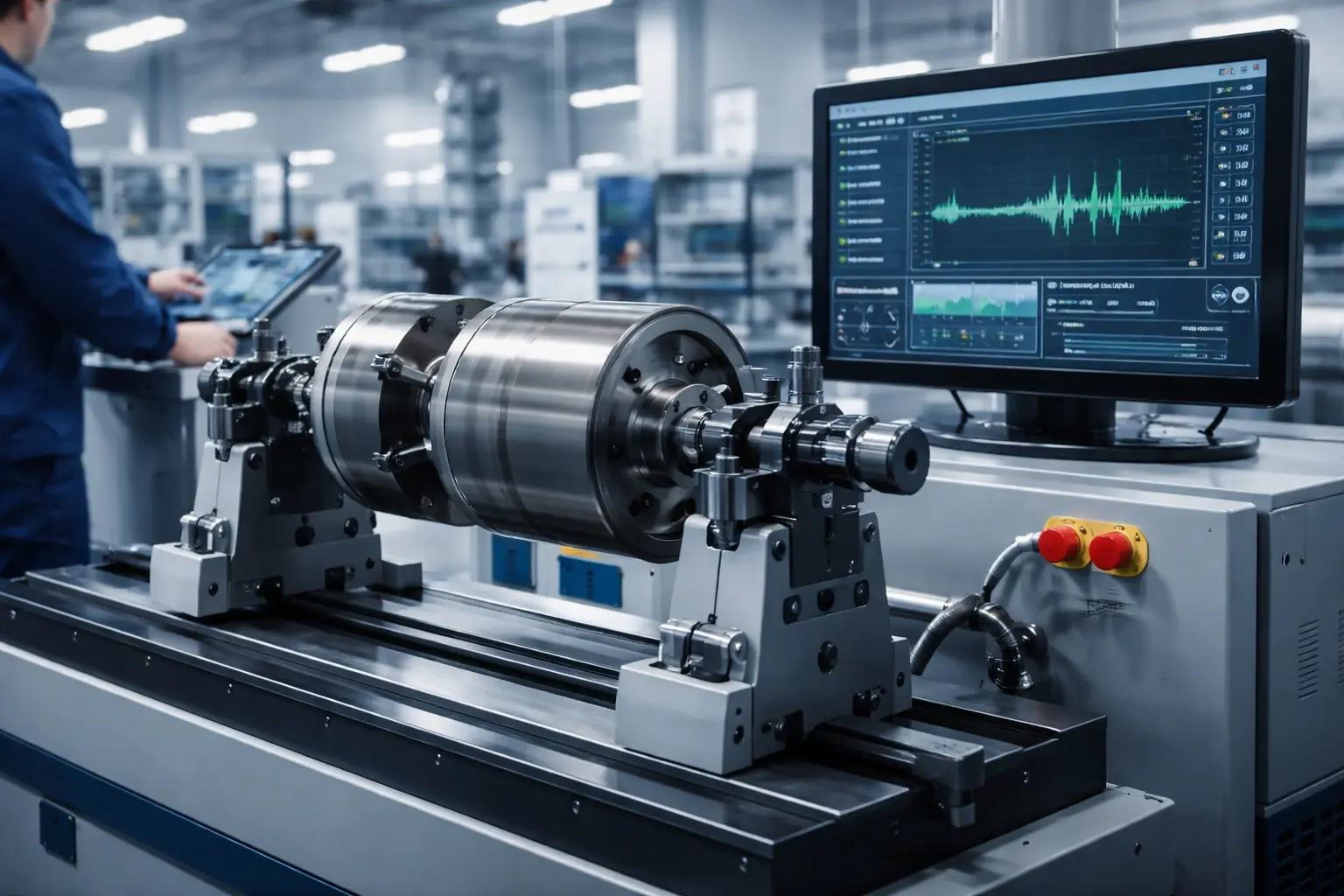
If a rotor is generating vibration in the field, the issue is often not limited to the bearing, coupling, or installation. The root cause may be mass imbalance itself. At this point, the question “what is a balancing machine?” is not just a theoretical curiosity for the maintenance team; it is a direct operational matter in terms of downtime, quality loss, and equipment lifespan.
A balancing machine is a precision measurement system that detects imbalance in the mass distribution of rotating parts and helps determine the correction point. Its purpose is to ensure the rotor operates more stably around its axis of rotation, reduce vibration, and minimize related mechanical stress. Electric motor rotors, fan impellers, pump impellers, shafts, drums, turbine components, and many other rotating parts require balance control during production or maintenance.
What is a balancing machine and why is it critical?
The reliability of rotating equipment in industry largely depends on vibration levels. An unbalanced rotor generates centrifugal force at high speed. This force places additional load on bearings, support systems, housings, and fastening elements. As a result, premature wear, noise, energy loss, and the risk of unplanned shutdowns occur.
A balancing machine makes this problem measurable. It does not simply indicate that “there is vibration”; it shows the amount of imbalance, its angular position, and the plane where correction is required. This distinction is important because it allows maintenance decisions to be based on data rather than guesswork. Especially in mass production, balance control is essential to ensure every part leaves the line at the same quality level.
How does the working principle operate?
The basic principle is simple. The rotor is spun at a certain speed, sensors detect the force or vibration response caused by the imbalance, and the software analyzes the data to generate correction information. However, the details that determine success in practice begin here.
In a balancing machine, the support system, drive unit, measuring sensors, and evaluation software usually work together. When the rotor turns, if the center of mass deviates from the geometric axis, the system reads this as amplitude and phase information. Based on this data, the operator removes material, adds weight, or adjusts position. The part is then measured again to verify whether it is within tolerance.
The critical point is that balancing is not simply placing a part in the machine and receiving a result. Correct adapter selection, proper clamping method, accuracy of reference surfaces, and operator experience directly affect measurement quality. For this reason, the process design is just as important as the balancing machine itself.
What types of balancing machines are used?
Not every rotor is measured with the same method. The geometry, weight, diameter, length, speed range, and production quantity of the part determine the machine selection.
Horizontal balancing machines
Horizontal balancing machines are widely used for shaft-type or axially supported rotors. Electric motor rotors, fan shafts, pump rotors, armatures, and similar long components fall into this category. The rotor is rotated on bearings or support elements. This provides a flexible solution for industrial rotors of different sizes.
Vertical balancing machines
Vertical balancing machines are generally preferred for disc-type, wheel-type, or single-face mounted parts. They deliver efficient results for brake discs, flywheels, fan impellers, and similar components. Mounting the part on a vertical axis offers easier fixturing for certain geometries.
Automatic balancing systems
In high-volume production lines, manual processes may not be sufficient. Automatic balancing systems make measurement, marking, and correction faster and more repeatable. The initial investment cost is higher, but they offer significant advantages in cycle time, reduced operator dependency, and quality standardization. In low-volume or highly variable production, full automation may not always be the most economical option.
Single-plane and two-plane balancing difference
This is one of the most commonly misunderstood aspects of balancing. For short and disc-like rotors, single-plane balancing is often sufficient. The imbalance can be corrected in one correction plane.
For long rotors, the situation changes. Since imbalance can occur in different areas along the rotor, two-plane balancing is required. This method corrects in two separate planes, allowing more accurate control of the rotor’s dynamic behavior. Choosing the wrong plane may produce technically correct measurements while vibration continues in real operation.
Why is balancing so important?
In many facilities, balancing only becomes a concern after a vibration problem appears. However, the real benefit comes from keeping the system under control before failure occurs. A properly balanced rotor operates with lower vibration, extends bearing life, and reduces stress on shafts and fasteners. Surface quality, noise level, and overall product performance can also improve.
There is also an impact on energy efficiency. An unbalanced rotating system can increase mechanical losses. In high-speed applications, even a small imbalance can generate large dynamic forces. This can affect not only the equipment itself but also surrounding systems.
For manufacturers, balancing is a quality standard. For maintenance teams, it is reliability. For purchasing departments, it affects total cost of ownership. Therefore, balancing is not just a quality control step; it is a technical necessity that connects production, maintenance, and operational performance.
What should be considered when choosing a balancing machine?
Selecting the right machine should not be based solely on rotor weight. The minimum and maximum diameter of the part, rotor length, support structure, required precision class, production volume, and correction method should all be evaluated together.
For example, in a company handling many different rotor types, flexible fixturing and user-friendly software become priorities. In a facility producing a single type of part in high quantities, cycle time, automation level, and integration capability become more decisive. Service and calibration support are also critical because even the most accurate machine can lose measurement reliability over time if it is not regularly checked.
When purchasing a balancing machine, one key question must be answered clearly: is this investment intended for laboratory-level precision measurement, a production line, or a maintenance workshop? As the answer changes, the ideal machine configuration changes as well.
The practical meaning of “what is a balancing machine?”
In practice, the answer to this question usually means more than a machine definition. What users often really ask is: can this system solve my vibration problem? In many cases, the answer is yes—but with conditions.
If the problem truly comes from rotor imbalance, a correctly selected and properly calibrated balancing machine can provide a direct solution. However, if the issue involves misalignment, bending, looseness, bearing damage, or installation errors, balancing alone may not be enough. An experienced technical team can distinguish between these issues. That is why the balancing process requires engineering interpretation as much as measuring equipment.
Especially for critical rotors, the goal is not only to stay within tolerance but to ensure process repeatability. Achieving similar results for the same part in every batch is essential for both production confidence and customer satisfaction.
Why are calibration, overhaul, and service part of the process?
A balancing machine is not a static investment. Over time, mechanical wear, sensor drift, aging electronic components, or software requirements may arise. For this reason, calibration, periodic maintenance, and overhaul services are a natural part of the machine’s lifecycle.
In facilities with intensive production, measurement reliability is directly linked to product quality, making service continuity important. Spare parts availability, technical support, and fast intervention capability can be just as important as the machine’s technical capacity in the purchasing decision. Specialist companies that provide both manufacturing and service infrastructure offer businesses a continuity advantage.
In which industries is it indispensable?
The need for balancing is not limited to a few industries. Electric motor and generator manufacturing are among the best-known fields, but applications extend from automotive and aerospace to defense, rail systems, household appliances, and energy production. Balance control can be critical for fans, turbines, compressors, pumps, spindles, drums, and various custom rotor groups.
Some industries require tighter tolerances, while others prioritize speed and repeatability. For this reason, there is no single “best” balancing solution. The correct solution depends on the application.
Reducing rotor vibration to absolute zero may not always be possible, but controlling it usually is. When the right balancing machine is combined with the right technical approach, the production line runs more smoothly, maintenance becomes more predictable, and equipment performance is no longer left to chance.