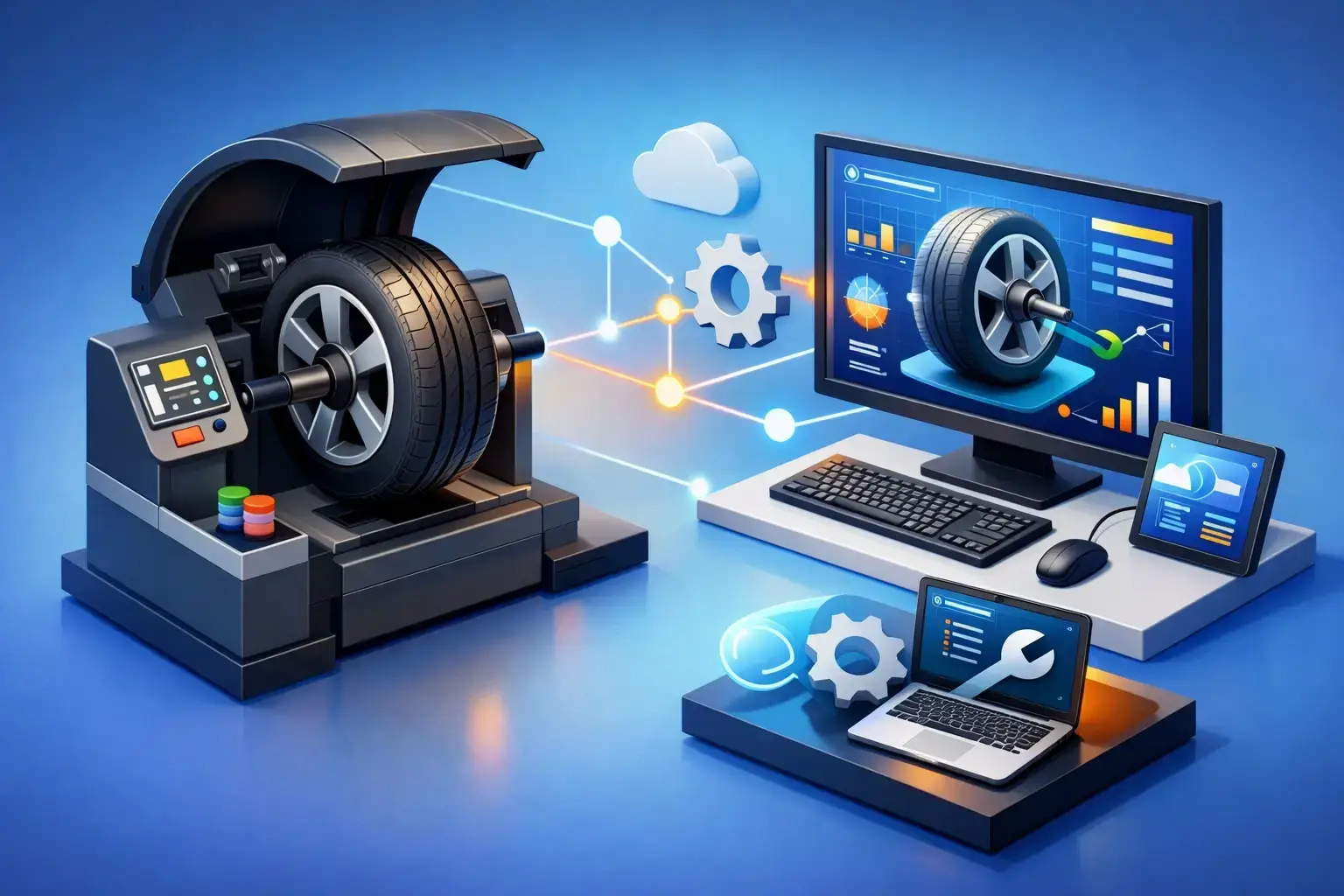
A rotor's balance value is not merely the number displayed on the measurement screen. That number must be calculated against the correct reference, presented clearly to the operator, and traceable throughout repetitive production. Therefore, balancing machine software support is one of the essential services that transforms the machine's measurement precision into daily production decisions.
Even if a balancing machine is mechanically sound, its sensors are functioning, and its calibration is up to date, a software-related problem may increase cycle time, lead to incorrect correction instructions, or make measurement results difficult to track. Particularly in facilities working with many different rotor types, the compatibility of the software with the process determines the actual efficiency of the machine investment.
What does balancing machine software support include?
Software support is not limited to launching the program or resolving display errors. It includes configuring measurement parameters according to the rotor's geometry, operating speed, balancing quality grade, and correction method. If data such as the component's center of mass, reference planes, tolerances, direction of rotation, and correction diameter are not correctly defined, even the most precise measurement system cannot produce reliable decisions.
During technical support, existing settings are examined, and the operator's working procedures are compared with the results produced by the machine. When necessary, programs specific to rotor families are created, tolerances are updated, and instructions on the operator screen are simplified. The objective is not only to ensure accurate measurement but also to make the process repeatable using the same method throughout production.
Software reporting, user authorization, data recording, and error message management are also included in this scope. The maintenance team's ability to access previous measurements, the quality department's ability to generate batch-based reports, and management's ability to identify deviations early all depend on a properly configured software infrastructure.
Software factors affecting measurement accuracy
Incorrect balancing measurements are not always caused by sensor failures. Selecting the wrong rotor type, entering incorrect tolerances, using outdated calibration coefficients, or defining an incorrect reference angle can directly affect measurement reliability. Therefore, software support should not be considered independently of mechanical and electronic inspections.
Rotor programs and tolerance definitions
Not every rotor operates under the same conditions. Acceptable residual unbalance levels may differ for electric motor armatures, fans, pump impellers, crankshafts, turbine components, or grinding spindles. Defining the correct balancing quality grade and appropriate tolerance in the software prevents both unnecessary corrections and the release of components with insufficient balancing.
For example, selecting an extremely low tolerance value in mass production may theoretically appear to improve quality. However, it can increase correction time, scrap rates, and cycle costs. Conversely, setting the tolerance too loosely creates risks of vibration, bearing wear, noise, and field failures. The correct value should be determined by evaluating the rotor's critical speed, application, and customer quality requirements together.
Correction guidance
The angle, weight amount, and correction plane information displayed to the operator are directly translated into practical actions. The software should provide appropriate instructions for correction methods such as drilling, milling, adding weights, welding, or using screws. An incorrect angular reference or plane assignment may worsen the balance instead of improving it.
At this point, the support service also includes making the interface user-friendly. Displaying only the necessary information and clearly presenting units, correction diameters, and tolerance indicators reduces the likelihood of errors. Standardized screens and program structures provide a critical advantage, particularly in shift-based production.
Rapid software intervention for production continuity
A balancing machine becoming unavailable due to a software problem may result in unexpected production line downtime. Problems such as failure to launch the program, database errors, communication interruptions, loss of part recipes, or user access issues can often be resolved more quickly than mechanical failures. However, this requires an accurate diagnosis by a technical team familiar with the machine's structure.
Remote preliminary assessment can save time for certain software problems. Nevertheless, symptoms related to sensor signals, encoder connections, drive systems, or computer hardware may require on-site inspection. Effective support does not automatically attribute the problem solely to software; it evaluates mechanical, electrical, and software-related data together.
MDBALANS adopts this comprehensive approach in its balancing machine services, evaluating software settings together with the machine's mechanical condition, calibration data, and application requirements. This approach focuses on the root causes of recurring failures rather than providing temporary solutions to display-related problems.
When is software modernization necessary in older systems?
A balancing machine that has been operating for many years may still be mechanically adequate; however, it may present an operational risk due to an outdated operating system, limited reporting capabilities, or computer hardware for which spare parts are no longer available. Longer program startup times, loss of measurement records, difficulty creating new part recipes, and unclear operator instructions are indicators that modernization may be necessary.
Software modernization does not always mean replacing the entire system. If the existing machine's sensors, mechanical structure, and drive system are in suitable condition, the control unit, user interface, and reporting system can be upgraded. This option may help maintain production capacity at a more controlled cost compared with investing in a new machine.
However, in systems with very old electronic infrastructure, a software update alone may not be sufficient. The stability of measurement boards, wiring, encoder accuracy, and safety circuits must also be evaluated. The correct decision is made by analyzing modernization costs alongside the targeted measurement accuracy and production capacity.
How does data recording benefit quality and maintenance teams?
Regular data recording through the software makes the balancing process more transparent. Changes in residual unbalance values over time within the same product group may provide early warnings about tool wear, rotor supply quality, assembly errors, or deviations in the manufacturing process. This information is valuable not only for quality control but also for predictive maintenance.
Traceability requirements vary by industry. In sectors such as defense, aerospace, energy, and automotive manufacturing, reporting by component or serial number is particularly important. In general manufacturing, monitoring shifts, product types, and result trends may be sufficient. The software structure should be configured according to the facility's actual reporting needs; unnecessary details slow down operators, while incomplete records make quality investigations more difficult.
What should you ask when obtaining software support?
The service provider must understand not only computer software but also the physics of balancing and rotor applications. During the support process, it should be clarified which rotor types require dedicated programs, how existing measurements will be verified, and how calibration will be integrated with software settings.
In addition, the benefits expected after support should be clearly defined: Shorter cycle times, lower repeated correction rates, new product recipes, improved reporting, or modernization of the old control system? When the objective is clear, the scope and priority of the intervention can be selected correctly.
If your balancing machine's measurement results are becoming inconsistent, operators use different settings for the same rotor, or historical records cannot be reviewed, do not consider the software merely an interface. A proper technical assessment will be the best starting point for adapting your measurement system to your production speed, quality requirements, and future rotor needs.