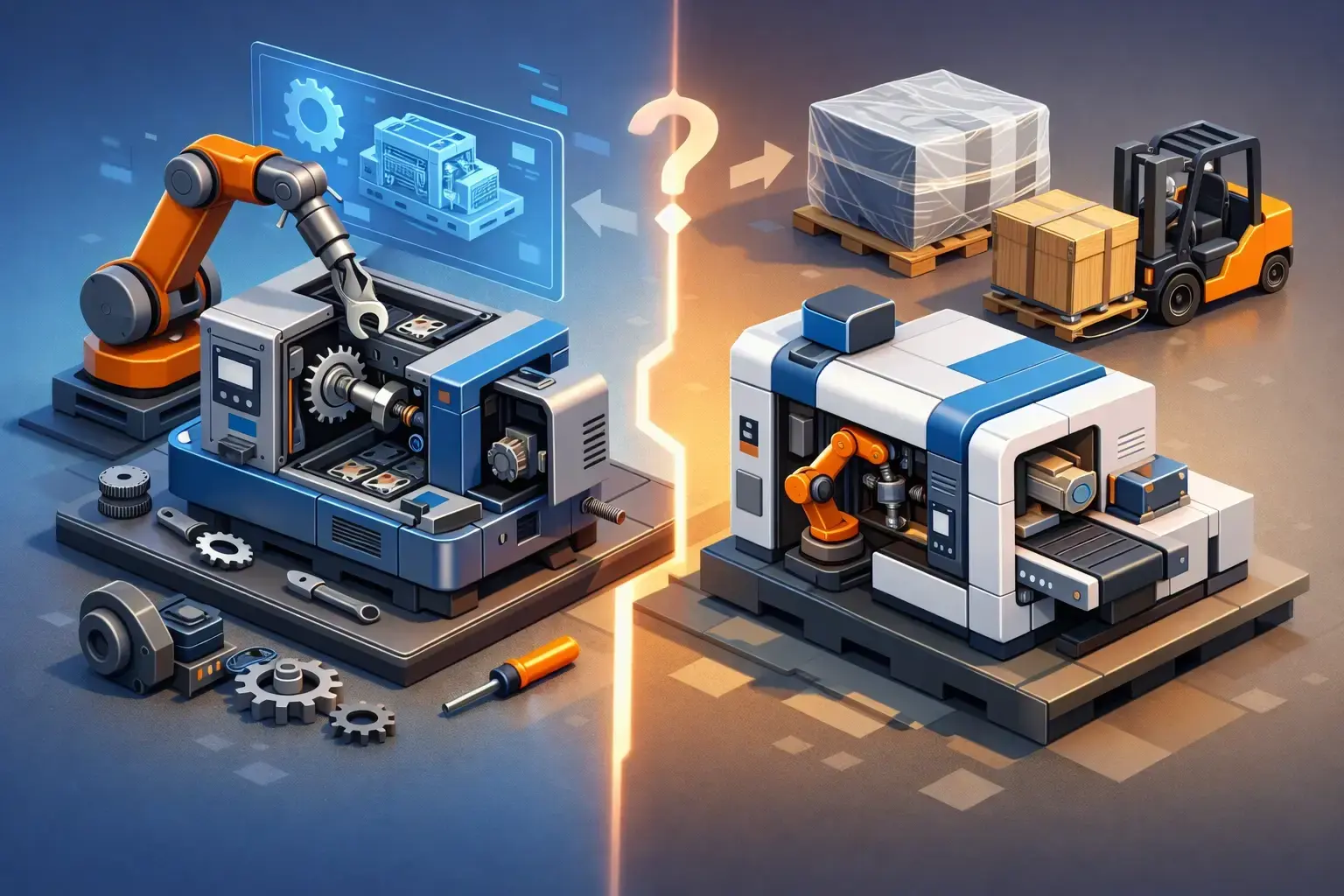
When a balancing machine operating on a production line loses measurement stability, the decision is not simply about replacing the faulty component. The choice between machine overhaul and machine replacement directly affects measurement accuracy, unplanned downtime, operator safety, and the investment budget. Especially in facilities where rotor geometries, production volumes, or quality expectations have changed, continuing to operate old equipment as it is can turn into a hidden production cost.
The age of a balancing machine alone is not a decision criterion. The condition of the bearing mechanics, performance of the drive system, reliability of the measurement electronics, software infrastructure, and availability of spare parts should be evaluated together. The correct approach is to consider not the production year on the machine's nameplate, but how safely and repeatably it meets today's process requirements.
Machine Overhaul or Machine Replacement?
Machine overhaul is the renewal of functional components while retaining the main body of the existing equipment and its mechanical infrastructure that remains in suitable condition. In a balancing machine, this process may include the renewal of the measurement unit, sensors, wiring, drive system, control panel, safety components, bearing assembly, and software according to requirements. The goal is not simply to make the machine operational again, but to bring measurement quality and operational safety in line with current production conditions.
Machine replacement, on the other hand, refers to investing in a new system when the existing equipment can no longer meet process requirements technically or economically. Higher rotor weight, a different diameter range, the need for automatic correction, shorter cycle times, or tighter balancing tolerances may require a new machine. In this case, the new equipment should be selected according to the future capacity and quality targets of production.
The fundamental difference between the two options is this: Overhaul provides improved performance and reliability on a sound infrastructure. Replacement provides new process capabilities that exceed the limits of the existing infrastructure. Therefore, the decision should be based not on the initial investment amount, but on the total operational impact.
Situations Where Overhaul Is Technically the Right Choice
If the machine frame, bearing pedestal structure, and basic mechanical geometry are sound, overhaul is often a strong option. Particularly in balancing machines that have been in service for many years but have outdated measurement electronics, the mechanical structure may still offer high rigidity and accuracy potential. In such systems, electronic upgrades, modern software, and proper calibration can significantly improve measurement repeatability.
Another situation where overhaul is appropriate is when the size and weight range of the rotors used in production has not changed. For example, if the facility is still balancing the same electric motor rotors, fans, shafts, or pump impellers, switching to a new machine with a wider capacity may be an unnecessary investment. If the load capacity, drive power, and safety structure of the existing machine are sufficient, a targeted overhaul can deliver results in a shorter period.
Spare parts availability is also a determining factor. If the machine frequently stops due to worn belts, bearing components, connection parts, or outdated control components, a systematic overhaul may be more efficient than component-based interventions. Fixing individual failures may initially appear less costly. However, interventions performed at different times continuously interrupt the production plan and do not improve the overall reliability of the machine.
The scope of the overhaul must be determined correctly. Simply replacing the control unit will not deliver the desired result if mechanical vibration sources or loose connections remain. Conversely, if the mechanical structure is in good condition, unnecessarily extensive disassembly may also extend the return on investment period. A technical inspection is the starting point for establishing this balance.
Critical Areas of Overhaul in Balancing Machines
Measurement quality in a balancing machine does not depend on a single component. The bearing assembly and mechanical rigidity directly affect rotor behavior. Sensors and measurement electronics accurately read this behavior and communicate it to the operator. The drive system ensures that the rotor rotates at a stable speed, while the software is at the center of measurement, tolerance evaluation, and correction guidance.
Therefore, mechanical inspection, electronic upgrades, and calibration should not be separated during an overhaul. After the overhaul, verification tests performed with reference rotors should demonstrate that the machine achieves the target accuracy under actual operating conditions. A process completed without a calibration report and measurement verification remains technically incomplete.
Signs That Machine Replacement Is Required
In some situations, an overhaul merely postpones the problem instead of solving it. If there is deformation in the machine frame, process-related limitations in bearing spacing, structural inadequacy in safety guards, or mechanical restrictions that limit capacity, a new machine should be considered. Particularly for rotors operating at high speeds, rigidity and safety systems are areas that can only be improved to a limited extent afterward.
A significant increase in production capacity is also a strong reason for machine replacement. An older manual balancing machine may be sufficient for low-volume production. However, if part mounting, measurement, correction, and re-verification times extend the total cycle in mass production, an automatic or semi-automatic system becomes a more appropriate investment. The benefit here is not only speed; reduced operator dependency and standardized quality are also important outcomes.
New rotor types can also change the direction of the decision. If the existing machine was designed for short and lightweight rotors while production has shifted to longer, heavier parts or parts with different mounting structures, adaptation solutions may be insufficient in terms of safety and accuracy. Likewise, in automotive, defense, energy, or aerospace applications requiring lower residual balancing tolerances, the measurement resolution and process capability of the old system should be reassessed.
Software and data requirements should not be overlooked either. If production tracking, part-specific records, tolerance management, operator authorization, or data transfer to the quality system is required, the limitations of the old control infrastructure may justify investment in a new machine. However, if some of these features can be provided through an overhaul, the decision still depends on technical feasibility.
Make the Decision Based on Total Impact, Not Cost
The purchase price is the most visible item when comparing machine overhaul and machine replacement, but it is not sufficient on its own. The cost of an overhaul may be lower, but the expected service life after overhaul, maintenance requirements, and capacity limits must be taken into account. A new machine may require a higher initial investment, but it can provide a return by reducing cycle times, minimizing scrap, and serving a wider product range.
At least five factors should be considered together in the overall decision:
- Planned and unplanned downtime
- Current and targeted production capacity
- Measurement repeatability and balancing tolerance
- Occupational safety and operator ease of use
- Five- to ten-year maintenance, spare parts, and service costs
For example, the direct maintenance bill of a machine that stops several times a year may appear low. However, each stoppage causes production delays, shipment delays, and additional workload for the quality control team, increasing the real cost. Similarly, purchasing a high-capacity machine when the current production volume is low may tie up capital inefficiently. A sound decision emerges from calculations based on actual production data.
How Should the Technical Inspection Process Be Conducted?
Before making a decision, the machine should not simply be checked to determine whether it operates. The technical inspection should cover mechanical condition, vibration behavior, measurement deviation, electrical safety, drive performance, and software functions. If possible, trial measurements should be performed using the facility's actual rotors, and the repeatability of the results should be observed.
The production target should then be clarified. Selecting a machine without determining the daily number of parts, rotor weight and size range, required residual imbalance value, shift arrangement, operator intervention, and quality recording requirements is risky. This information indicates whether the correct solution is the scope of an overhaul or a new horizontal, vertical, or automatic balancing machine.
MDBALANS conducts this evaluation by considering the technical condition of the existing machine together with process expectations. The objective is not to direct the customer toward investing in a new machine in every situation, but to determine the most appropriate, safe, and sustainable balancing solution for production.
If your machine maintains measurement reliability, its mechanical infrastructure is sound, and your process remains unchanged, a comprehensive overhaul can restore confidence in production. However, if capacity, safety, or accuracy limits have been reached, investing in a new machine should not be viewed as a deferred cost, but as a planned step toward production continuity. The best starting point is not to make a decision at the first failure, but to measure the actual performance of your machine and create a technical roadmap.