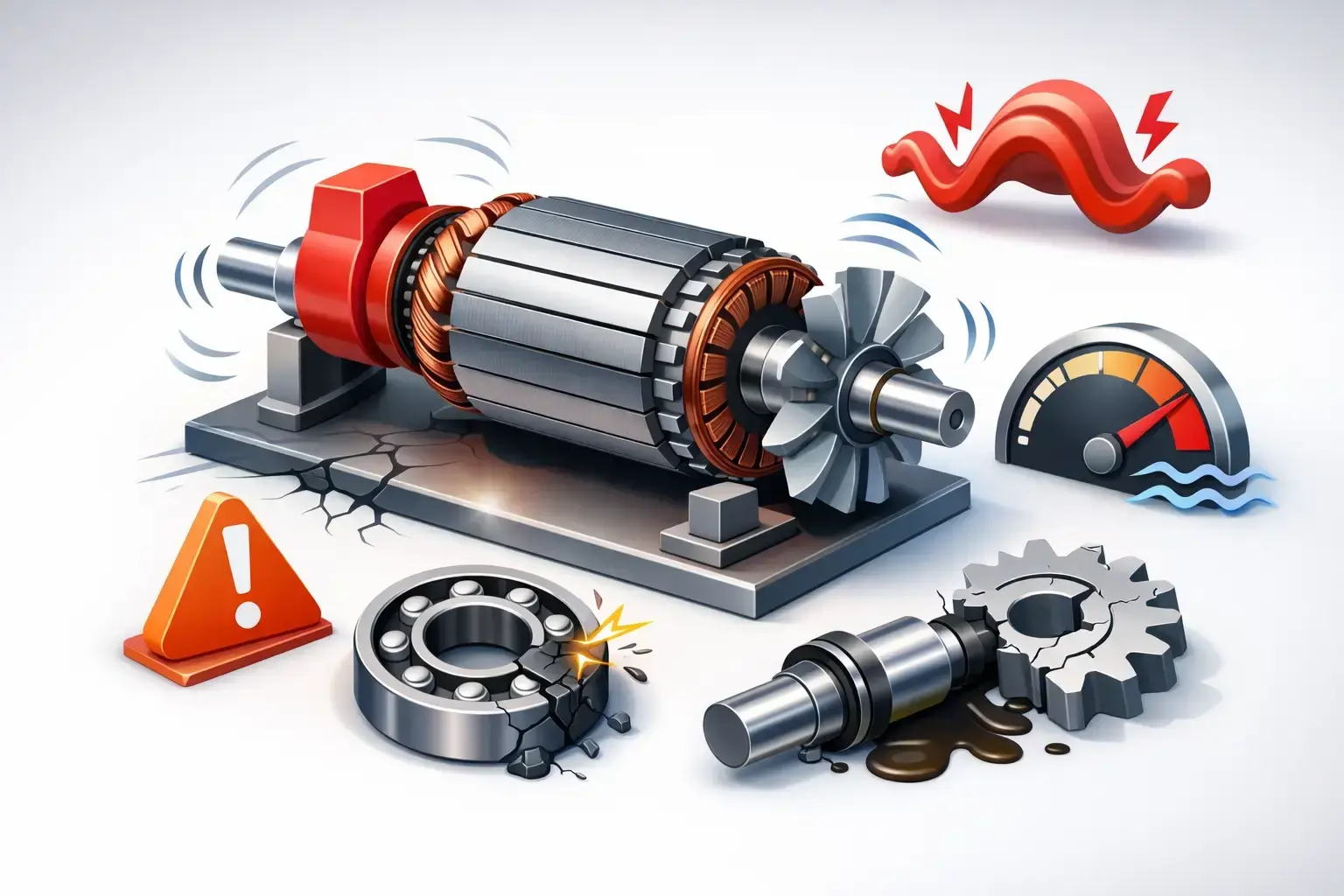
Excessive vibration in a motor or fan assembly on a production line is often not a fault by itself. The real issue is the root cause behind the vibration. At this point, rotor imbalance symptoms become critical because an imbalance that is not detected early can create a chain reaction throughout the rotating system, affecting bearings, shafts, couplings, and the machine structure.
In many facilities, the first noticeable signs are increased noise levels or bearing life that is shorter than expected. However, rotor imbalance is not merely a comfort or noise issue. It is a technical problem that directly affects production continuity, energy consumption, maintenance costs, and equipment reliability. Especially in high-speed machinery, even a small mass distribution error can generate significant dynamic forces.
Why is rotor imbalance so critical?
If a rotor cannot distribute its mass evenly around its axis of rotation, centrifugal force is generated. As the machine operates, this force increases, placing additional load on the bearings and supporting structure with every revolution. As a result, vibration levels rise, mechanical wear accelerates, and the equipment's service life is reduced.
The important point is that imbalance rarely exists alone. It is often accompanied by misalignment, looseness, bearing faults, or resonance. Therefore, the symptoms observed in the field must be interpreted correctly. Incorrect diagnosis leads to unnecessary component replacement and recurring failures.
How do rotor imbalance symptoms appear?
Rotor imbalance symptoms usually develop gradually. Initially, an operator may only notice slight vibration. Over time, vibration amplitude increases, machine noise changes, and maintenance records begin to show recurring bearing or fastener issues.
The most common symptom is increasing vibration. This vibration is generally related to rotational speed and is especially noticeable at bearing locations. In facilities performing vibration analysis, an increase at the 1x rotational frequency is a strong indication of imbalance. However, a single measurement is not enough for a definitive conclusion; operating conditions, rotor type, and support system must all be evaluated together.
A second symptom is abnormal noise. Fans, pumps, motors, and turbines may produce humming sounds, rhythmic knocking noises, or mechanical noise that increases with speed. Not every unusual sound indicates imbalance, but if it occurs together with vibration, a detailed inspection is required.
A third symptom is the increasing frequency of bearing problems. An unbalanced rotor continuously applies varying loads to the bearings. This leads to higher temperatures, reduced lubrication performance, and shorter bearing life. Many facilities believe replacing the bearing solves the issue, but if the root cause is rotor imbalance, the failure will return.
Another important sign is excessive stress on couplings, shafts, and fastening components. Loose bolts, cracked foundations, fatigue at connection points, and uneven loading on the shaft indicate that the imbalance has spread throughout the system. At this stage, the issue is no longer limited to the rotor itself but begins affecting the entire machine.
Does increased vibration always indicate imbalance?
No. This is one of the most common misconceptions in industrial environments. Increased vibration can be a strong indicator of imbalance, but it is not the only explanation. Misalignment, mechanical looseness, bearing damage, a bent shaft, electrical problems, or resonance can all produce similar symptoms.
For this reason, evaluation should rely on measurement rather than observation alone. Frequency analysis, phase measurements, operating speed analysis, and rotor geometry evaluation should all be considered together. If this distinction is not made correctly, rotor balancing may be performed without achieving the expected reduction in vibration, resulting in unnecessary time and cost.
How do the symptoms differ across different equipment?
Although rotor imbalance follows the same physical principles, the visible symptoms vary depending on the type of equipment. Electric motors commonly exhibit bearing vibration, increased temperature, and noise. Fans may show vibration together with reduced airflow and casing movement. Pumps often experience mechanical vibration accompanied by seal and bearing failures.
In high-speed rotor applications, even small imbalances can produce much more severe consequences. On the other hand, in larger-diameter and lower-speed systems, the problem may develop more slowly, although the potential for structural damage remains high. Therefore, symptom severity depends not only on the level of imbalance but also on rotor mass, rotational speed, bearing design, and system rigidity.
How do rotor imbalance symptoms affect production?
The most significant consequence in industrial operations is unplanned downtime. As the imbalance progresses, equipment becomes less capable of operating safely between maintenance intervals. Operators may begin running the machine under reduced load, process stability declines, and production capacity decreases.
Energy consumption should not be overlooked either. An unbalanced rotating rotor causes the system to operate less efficiently. While the difference may appear small in some applications, continuous-operation facilities can experience substantial long-term operating costs. This is particularly true for fans, motors, and pump systems where vibration-related inefficiency accumulates over time.
In addition, auxiliary components are also affected. Loose foundations, stress in piping systems, coupling wear, and seal damage are common secondary problems. Rotor imbalance is therefore not simply a component issue but a reliability problem affecting the entire machine system.
Which data should be monitored for early diagnosis?
Effective diagnosis combines operator observations with measurement data. If the equipment's normal operating behavior is known, changes in vibration trends can be identified quickly. Periodic vibration monitoring, bearing temperature tracking, and maintenance history provide valuable insight.
During an initial inspection, important questions include: Does vibration increase at a specific speed? Does machine behavior change with load? Has any work recently been performed on the rotor? Did the symptoms begin after a component replacement? Imbalance may result from wear, manufacturing tolerances, contamination buildup, mass distribution changes after repair, or blade damage.
For further verification, balancing inspection is required. The appropriate method depends on rotor size, weight, operating speed, and application. Some rotors are evaluated on balancing machines in workshop conditions, while others are better suited for on-site balancing. Selecting the correct balancing method is essential for achieving lasting results.
What should be done once the problem is detected?
The first step is to avoid continuing operation under excessive stress. If vibration levels have increased rapidly or are accompanied by rising temperatures, operating conditions should be brought under control. Rather than immediately replacing components, a root cause analysis should be performed.
The rotor should then be evaluated technically. Simply adding or removing weight is not a complete balancing solution. If contamination, material loss, weld repairs, blade deformation, or geometric distortion exists on the rotor, these issues should be addressed first. Otherwise, any balancing correction will only provide temporary results.
At this stage, an experienced team, a suitable balancing machine, accurate measurement software, and application expertise all become essential. For critical industrial rotors, tolerances become tighter and the margin for error decreases. Therefore, balancing must not only be fast but also performed with measurable accuracy.
What approach provides a permanent solution?
A permanent solution involves far more than a single corrective action. Rotor balance quality should be verified according to the appropriate balance grade, system behavior should be monitored after installation, and alignment and bearing conditions should also be evaluated where necessary. Even a perfectly balanced rotor can develop field problems if installation quality is poor.
For this reason, the most effective approach for industrial facilities is to integrate balancing services into the overall maintenance strategy. Periodic inspections, post-overhaul verification, calibrated equipment, and technical support significantly reduce repeat failures. Working with solution partners such as MDBALANS, specializing in both balancing machines and technical balancing services, provides considerable advantages for facilities where production downtime carries high costs.
Rotor imbalance symptoms usually appear at an early stage; the key is recognizing these warning signs correctly. Vibration, noise, and bearing failures are only symptoms. The real value lies in converting these signals into technical decisions before unplanned downtime occurs.