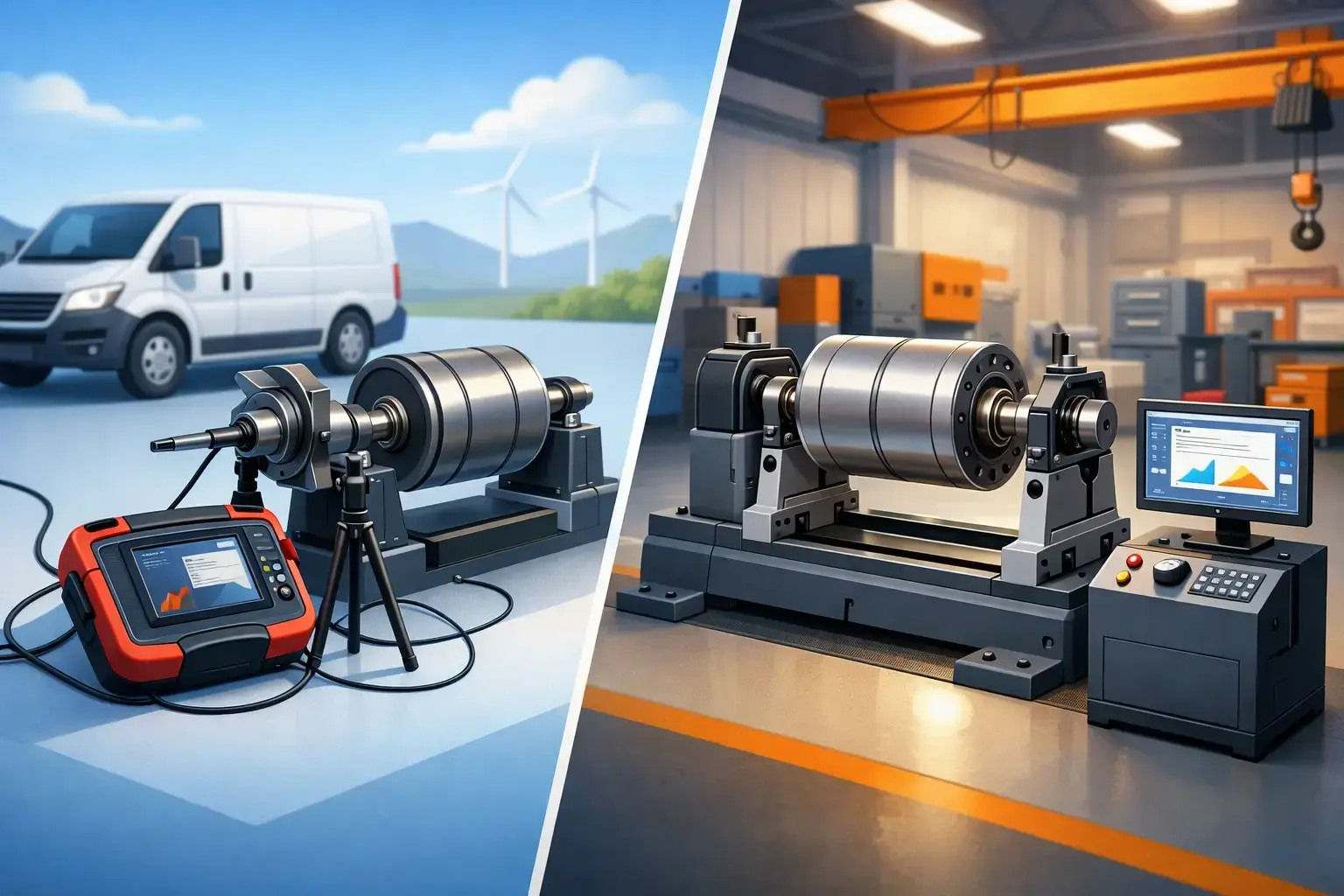
When an industrial fan line stops unexpectedly or turbine vibration reaches alarm levels, the decision is rarely theoretical—it is practical: will you dismantle the equipment and send it to the workshop, or perform an on-site intervention? The comparison of companies providing on-site and workshop balancing services becomes critical at this point. Because the correct method does not only reduce vibration; it directly affects maintenance time, production loss, labor load, and the remaining lifespan of the equipment.
Balancing is the process of reducing vibration to acceptable levels by correcting the mass distribution of a rotating part around its axis. However, not every rotor is the same. Likewise, every facility has different downtime costs, dismantling capabilities, tolerance expectations, and safety conditions. Therefore, there is no single correct choice between portable and in-shop balancing methods. The right decision is made by evaluating the equipment type together with operating conditions.
What is on-site and workshop balancing?
Portable balancing is the process of balancing the rotor in its operating position or directly on the machine in the field. Measurement equipment, sensors, and portable balancing devices are used. The aim is to detect imbalance without dismantling and apply the correction on-site. This method is especially preferred for large fans, blower systems, certain pump groups, coupled rotor systems, and equipment where dismantling would create high costs.
In-shop balancing, on the other hand, is the process of removing the rotor from the machine and correcting it on a balancing test bench. Performed on horizontal or vertical balancing machines, this method provides more detailed measurement and correction under controlled conditions. It is commonly used for electric motor rotors, armatures, shafts, impellers, roller rotor groups, and mass-produced components.
The fundamental difference is not only where the operation takes place. Measurement conditions, accessibility, precision level, correction methods, and total cycle time also differentiate these two approaches.
When does on-site portable balancing provide an advantage?
Portable balancing provides its biggest advantage by reducing downtime. Dismantling, transporting, reinstalling, and commissioning equipment is a complete operation in itself. For large fans, process-integrated rotor systems, or hard-to-reach machines, this process can take a long time. On-site balancing significantly shortens this duration under the right conditions.
Another key advantage is evaluating the rotor under real operating conditions. In some machines, vibration issues are not caused only by rotor mass imbalance. Mounting tolerances, coupling effects, foundation rigidity, thermal conditions, and process load can all affect vibration behavior. On-site measurements allow these real operating effects to be observed directly.
However, portable balancing is not always the ideal solution. If access to the rotor surface is limited, if applying correction weights is unsafe, or if there is suspicion of mechanical damage, field intervention may be insufficient. Likewise, in cases of severe misalignment, bearing failure, looseness, or resonance, the issue may not be only imbalance. In such cases, portable balancing alone cannot provide a permanent solution.
Typical use cases for portable balancing
Industrial fans, cooling fans, certain blower systems, large rotating equipment in cement and paper plants, and rotors where dismantling would significantly affect production are suitable for this method. As the physical size of the equipment increases and dismantling costs rise, on-site balancing becomes more valuable.
When is in-shop balancing the better choice?
In-shop balancing is a more comprehensive solution for many rotors due to its controlled measurement environment and higher intervention capability. Once the rotor is dismantled, not only imbalance but also bending, surface damage, connection tolerances, previous incorrect repairs, and geometric distortions can be evaluated. This turns the process into a technical validation rather than just a correction.
Balancing performed on a test bench is especially advantageous for high-precision components. Electric motor rotors, high-speed shafts, precision impellers, aerospace and defense rotors, or mass-produced parts achieve more reliable results under controlled workshop conditions. Repeatability is a critical factor here. For manufacturing companies, every part must be balanced to the same quality standard, and in-shop balancing provides the most consistent method.
The workshop method is also more suitable for operations such as material removal, weight addition, drilling, milling, or custom fastening corrections on the rotor. These operations are not always safe or practical in field conditions.
Key scenarios for in-shop balancing
Quality control of newly manufactured rotors, post-repair validation, high-speed rotor applications, and components requiring mechanical inspection beyond balancing are better suited for workshop processing. If the equipment is already dismantled for maintenance, in-shop balancing is often the more rational choice.
Differences in precision, cost, and time
The three most common criteria in choosing between on-site and workshop balancing are precision, cost, and time. However, these should not be evaluated independently.
From a precision perspective, controlled bench environments generally provide higher and more repeatable measurement accuracy. This is due to stable support conditions, precise speed control, defined reference conditions, and detailed correction capabilities. However, the idea that field balancing is insufficient is not always correct. With proper equipment, experienced personnel, and correct analysis, portable balancing can also deliver highly effective results in many industrial applications.
On the cost side, focusing only on service fees can be misleading. Dismantling, crane usage, transport, reassembly, alignment, testing, and production loss often make up the largest portion of total cost. Therefore, field service may appear more expensive at first, but total operating cost can be lower. The opposite is also possible. For small and easily removable rotors, workshop balancing may be both more economical and safer.
In terms of time, portable balancing often provides a faster solution. However, if the issue is not only imbalance, time spent on-site may eventually still lead to dismantling. Therefore, the expectation of a quick fix should not be confused with technical diagnosis. The more accurate the initial analysis, the better the overall time management.
What technical questions should be asked when deciding?
To choose the correct method, the role of the rotor in the system must first be clarified. Is the equipment part of a critical process line? What is the hourly downtime cost? Is dismantling safe and feasible? Can correction points be accessed on-site? Is the vibration truly caused by imbalance, or are there effects of bearing issues, misalignment, looseness, or resonance?
Another key factor is the required quality level. If the goal is to quickly bring vibration down to acceptable levels, portable balancing may be sufficient. However, if the goal is to validate the rotor according to production standards and document long-term reliability, in-shop balancing becomes more appropriate.
At this point, experience is crucial. Because choosing the wrong method often leads to double intervention: first a temporary field fix is attempted, then workshop intervention becomes necessary. Or the rotor is unnecessarily dismantled, causing avoidable downtime for a problem that could have been solved on-site. The value of a technical partner like MDBALANS, which provides both field service and balancing machine infrastructure, becomes clear here. Instead of selling a single method, recommending the correct method for the application produces more efficient results for the operation.
Correct approach for on-site and workshop balancing services
This comparison should not be reduced to a simple preference table. Portable balancing stands out for speed and on-site problem-solving capability. In-shop balancing provides advantages in control, precision, and comprehensive technical validation. One protects production quickly, the other ensures deeper rotor quality control.
The best decision is one that considers both the technical structure of the rotor and the operational realities of the facility. For a large and critical fan, on-site balancing may be the best solution. In the same plant, a high-speed motor rotor removed for maintenance may be better suited for workshop balancing. This is where engineering thinking begins: choosing the method based on the application, not habit.
Balancing is not just a maintenance task for reducing vibration. When applied correctly, it extends bearing life, reduces energy losses, minimizes unplanned downtime, and improves overall machine reliability. Therefore, decisions should be based not only on where the operation is performed, but on the desired operational outcome.