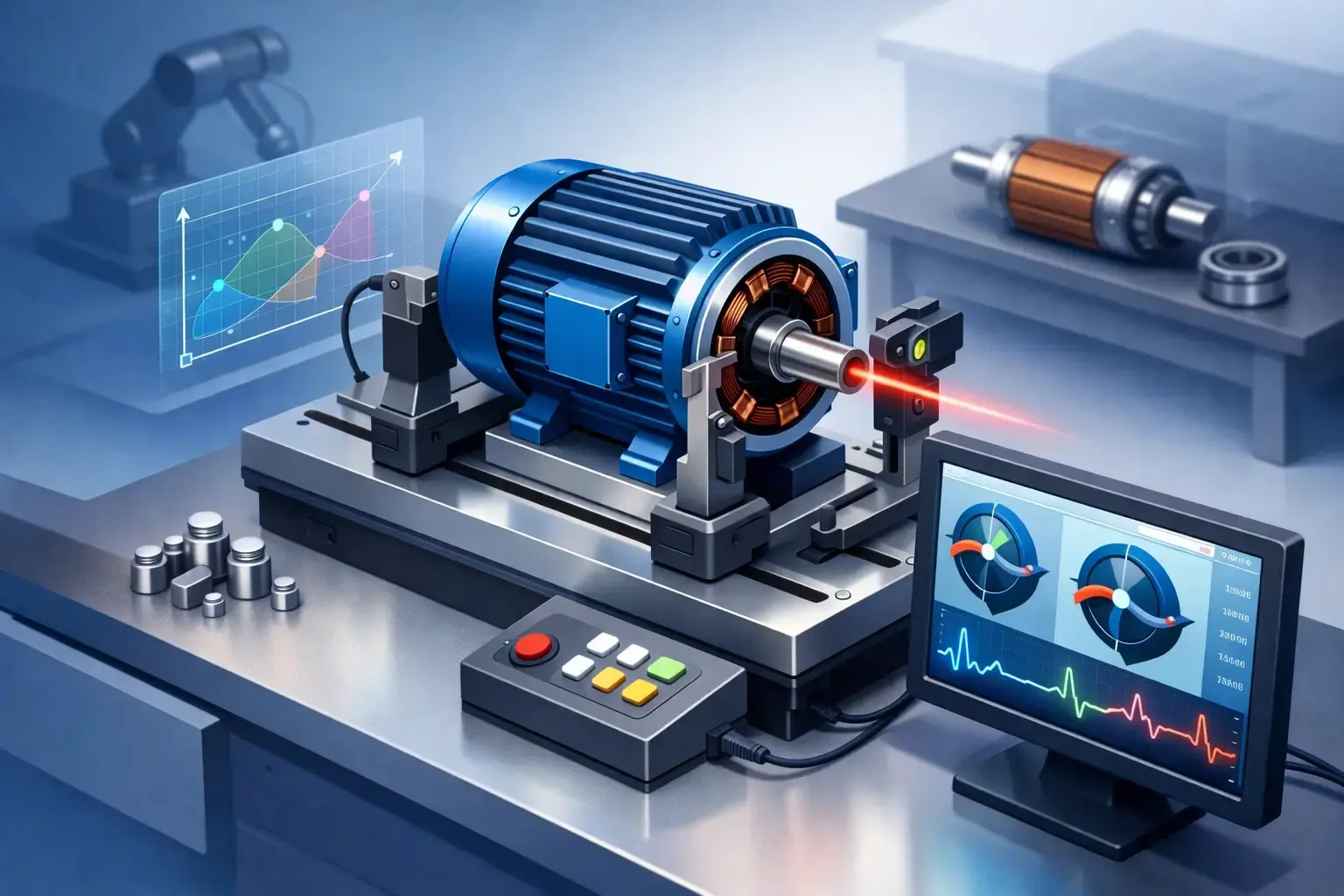
An electric motor can be one of the most critical components in a production line, but failure often starts not from the windings but from the rotor. This electric motor balancing case study explains, in a production process stopped due to increasing vibration complaints, how the source of imbalance was verified, which measurements were taken, and what results were achieved after balancing.
The examined application belonged to a continuously operating production facility and involved a 75 kW, 2-pole electric motor in the approximately 3000 rpm class. The motor was driving a fan group via a coupling. The maintenance team’s initial complaints were increased bearing temperature and rising housing vibration. The bearings had previously been replaced, coupling alignment had been checked, and even drive parameters had been reviewed for a short period. Despite this, the problem persisted.
In such cases, the most common mistake is attributing symptoms to a single cause. However, high vibration may result from unbalance, misalignment, mechanical looseness, resonance, bearing damage, or electrical issues, or a combination of several factors. Therefore, the work started not by adding mass, but by ensuring diagnostic accuracy first.
Electric motor balancing case study – initial findings
Initial field measurements compared vibration levels in horizontal and vertical directions of the motor. The most dominant component appeared at 1x rotational frequency. While this alone is not definitive proof, it strongly increases the likelihood of rotor imbalance.
Rotor imbalance became a primary suspect. The relatively low axial values ruled out classic misalignment scenarios. Bearing spectrum analysis did not show dominant defect frequencies, indicating that the root cause was unlikely to be bearing failure.
Maintenance history showed that the rotor had been disassembled and reassembled twice before. Dirt accumulation on the fan side and previous repair marks were also notable. Especially on one side of the rotor pack, surface corrosion cleaning had been performed, but no balancing verification had been recorded afterward. This is important because even a very small mass distribution change on the rotor can significantly increase vibration levels at high speed.
The motor was carefully taken out of service and the rotor was dismantled. Visual inspection showed no structural issue in the rotor bars. No clear bending was observed on the shaft surfaces. However, localized dirt buildup and surface irregularities from previous interventions were found near the fan side. These findings were consistent with a growing imbalance during operation.
Pre-balancing technical evaluation
Before the rotor was taken into balancing, two critical checks were performed. First, shaft geometry and bearing surfaces were measured to rule out mechanical misalignment. Second, the applicable standard and quality grade for the rotor were determined. Because not all rotors are balanced to the same tolerance level.
For a high-speed electric motor driving a process fan, acceptable residual imbalance is much tighter compared to low-speed, less sensitive applications.
The technical decision here was to use two-plane balancing instead of single-plane balancing. This was due to the rotor length not being short and the likelihood of uneven mass distribution across both ends. While single-plane balancing is sufficient in some cases, ignoring dynamic behavior in high-speed motors can lead to incomplete results. In particular, correcting one side while ignoring the moment effect on the other can result in only partial vibration reduction.
The rotor was mounted on a horizontal balancing machine. Before measurement, mounting surfaces were cleaned, reference points were defined, and rotation direction and correction planes were set. This preparation step is often rushed, but it directly affects balancing quality.
Balancing process and applied corrections
In the first measurement cycle, imbalance beyond tolerance was observed in both planes of the rotor. The fan side showed higher values. Stable phase angles indicated reliable measurement conditions. At this stage, two correction methods were considered: material removal and mass addition. Due to rotor geometry, service life, and safety considerations, controlled material removal was selected.
The correction was not performed aggressively in a single step. Instead, a gradual approach was adopted. After the first correction, the rotor was run again, residual imbalance values were measured, and the second correction was calculated accordingly. This approach saves time in practice because theoretical calculations may deviate due to manufacturing tolerances, surface conditions, and mounting variations.
After the second cycle, imbalance on the fan side decreased significantly, while only a smaller correction remained on the drive side. In the third measurement, the rotor was brought within the target quality grade. Repeatability was verified through multiple measurements.
An important technical note here: balancing does not always solve all vibration problems. If there are underlying issues such as soft foot, weak foundation, coupling misalignment, or resonance, overall vibration may not drop to expected levels even after proper balancing.
In this case, the value of prior diagnostic work became clear, as the maintenance team attributed the issue not only to imbalance but to the dominant verified root cause.
Electric motor balancing case study results
After the rotor balancing process was completed, the motor was reassembled, bearing conditions were checked, and coupling alignment was verified. During startup, vibration measurements were repeated under both no-load and load conditions. A significant reduction in the 1x rotational frequency component was observed. Overall vibration levels decreased by approximately 55% compared to the pre-intervention state. Bearing housing temperatures stabilized after a few hours of operation.
A more critical outcome was seen in maintenance planning. Before the intervention, the team had to monitor the motor frequently and keep standby equipment ready for potential unplanned downtime. After balancing, the monitoring interval returned to the normal maintenance schedule.
No dramatic reduction in energy consumption was expected, and measurements confirmed this. This is normal. The main effect of balancing is reduced vibration, lower bearing loads, mechanical stress, and extended equipment life.
Key lessons from this case
This study clearly demonstrated three key points. First, repeated bearing failures are not always bearing-related. If the root cause is rotor imbalance, replacing parts only delays the outcome. Second, balancing decisions must be based on rotor geometry and operating conditions. Third, balancing requires strict measurement discipline; without proper equipment, correct mounting, and validation cycles, results cannot be sustained.
A common situation in industry is assuming that because the manufacturer balanced the motor at the factory, no further balancing is needed. However, revisions, fan changes, shaft machining, contamination, local repairs, or surface wear during operation can change rotor mass distribution.
For maintenance teams, the correct approach is understanding the vibration signature first. When spectrum and mechanical checks are evaluated together, unnecessary interventions are reduced.
In high-speed motors, even a small imbalance can cause significant consequences. However, with the right equipment and experienced technical evaluation, the issue can usually be controlled.
If you observe a similar vibration pattern in your facility, start with the rotor, not the bearing.