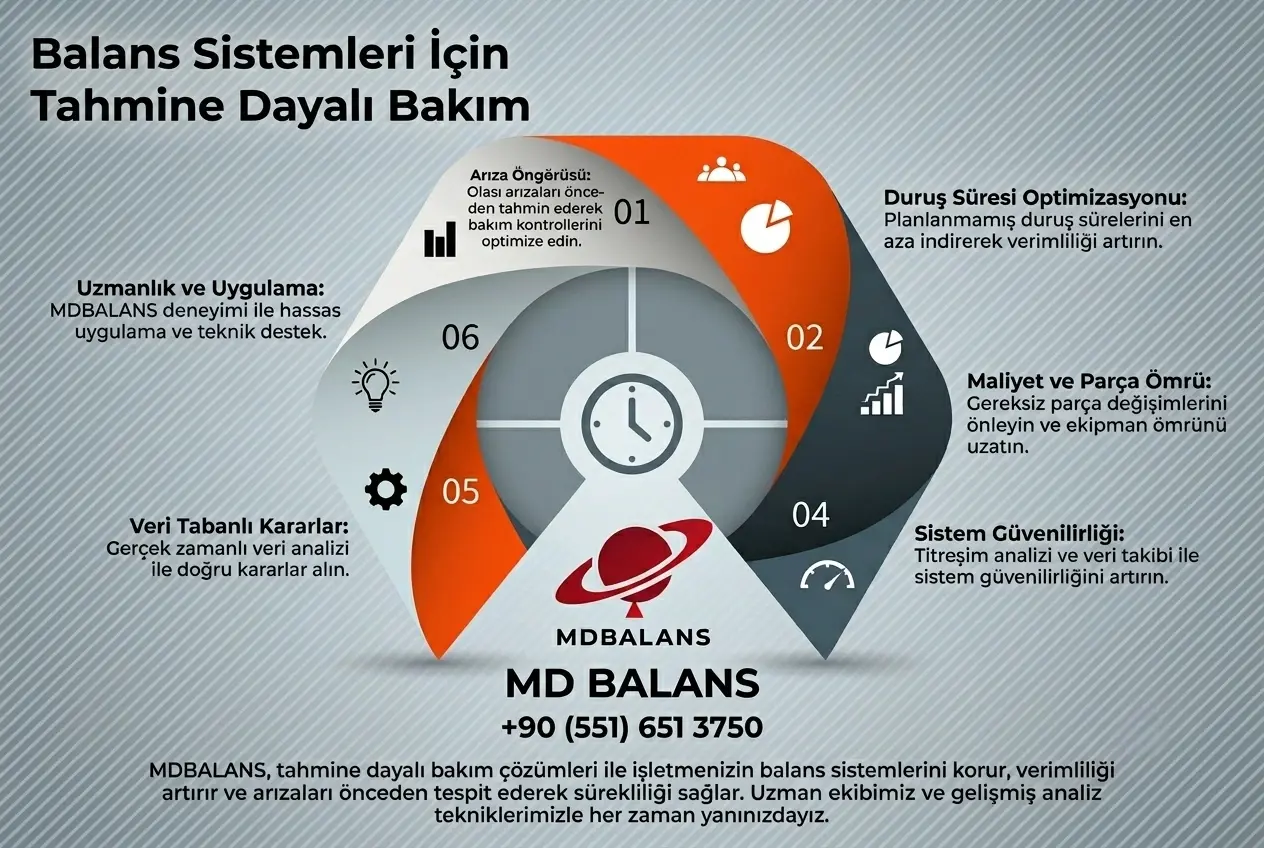
When the cost of an unplanned shutdown is evaluated, in most facilities it is not limited only to lost production hours. Bearing damage, rotor surface deterioration, quality deviations, and emergency service needs quickly turn into a larger operational problem. For this reason, the predictive maintenance for balancing systems approach treats balancing equipment not only as a running machine but as a critical production asset whose continuous performance must be managed.
Why is predictive maintenance for balancing systems necessary?
Balancing systems create value as long as they can accurately read the vibration behavior of rotating parts and make correct correction decisions. However, over time sensor drift, mechanical looseness, drive system wear, cabling problems, calibration deviations, and operator-related usage differences affect measurement reliability. As a result, even if the machine appears to be running, the data it produces may not maintain the same accuracy.
The main risk here is that failure does not always appear as a machine stop. A more common scenario is the gradual deterioration of balancing quality. This deterioration initially stays within acceptable tolerances, then increases rework rates, extends test times, and eventually returns as a quality problem on the customer side. This is where the value of predictive maintenance emerges. The goal is not post-failure intervention, but capturing performance deviation before failure occurs.
Which components should be monitored?
In balancing systems, maintenance prediction cannot be based only on bearing temperature. A proper approach requires evaluating the mechanical structure, measurement chain, and control software together.
On the mechanical side of the machine, bearings, belt-pulley groups, drive motors, couplings, support units, and frame rigidity stand out. Even a small looseness in these components can disrupt measurement repeatability. Especially in high-precision rotor applications, mechanical deviations on the machine may lead to incorrect correction weight decisions.
On the measurement side, vibration sensors, phase reference systems, cables, connectors, data acquisition cards, and calibration status play a critical role. If the sensor is not working correctly, the result cannot be reliable no matter how advanced the software is. Therefore, data quality itself becomes a maintenance parameter that must be monitored.
On the control and software layer, alarm history, measurement repetition rate, number of operator corrections, cycle time variation, and recipe deviations must be carefully tracked. Some issues arise not from mechanical faults but from incorrect parameter usage or outdated software configurations.
Which data provides early warning?
The success of predictive maintenance depends not only on collecting the right data but also on interpreting it correctly. One of the most valuable indicators for early warning in balancing systems is the change in measurement dispersion between cycles for identical rotor types. If similar parts previously produced results within a narrow band but now show wider deviations, a change in the machine or process may have started.
Vibration level is of course a primary indicator, but it is not sufficient alone. Phase stability, consistency of response to trial weights, residual imbalance levels after correction, and the need for retesting must also be monitored. Especially an increase in the ratio of parts requiring second or third corrections is a serious warning sign of maintenance needs.
Temperature trends, motor current, rotational speed stability, and sensor signal noise also provide important data. For example, a gradual increase in motor current does not only indicate a motor problem. Mechanical friction, bearing load, or alignment issues can produce the same symptom. Therefore, data must be interpreted not individually but in correlation.
How to implement predictive maintenance for balancing systems?
A good structure does not need to be expensive or complex. First, critical equipment is defined. The balancing machine with the highest production impact, the line without backup capacity, or the station with the highest quality risk is prioritized.
Next, a baseline is created. Data such as vibration, temperature, cycle time, measurement repeatability, and energy consumption are recorded over a period on a healthy machine. Defining alarm thresholds without this reference is often misleading because each machine has its own operating character.
The third step is setting the alarm logic. A single upper-limit approach is not sufficient. A more accurate method is to combine absolute limits with trend-based deviations. Even if a machine is still within limits, a consistently worsening indicator over the last three months should be included in the maintenance plan.
The fourth step is field validation. When data indicates a problem, the team must perform mechanical checks, calibration checks, and process validation. Otherwise, the system may generate excessive alarms and the team may eventually start ignoring warnings.
Finally, the entire structure must be linked to the maintenance plan. If a predictive maintenance report is generated but not converted into a work order, the system only produces data, not value.
Is the same model suitable for every facility?
No. A low-volume, high-precision rotor production facility and a high-volume serial production line do not have the same needs. In the first case, measurement accuracy and calibration discipline are much more critical. In the second case, cycle time, operator repeatability, and unplanned downtime rate are more decisive.
Similarly, manual balancing machines and automatic balancing systems also require different maintenance approaches. In automatic systems, software, sensor integration, and data recording discipline play a greater role. In manual systems, operator behavior and mechanical condition directly affect results.
For this reason, the correct method is not to copy a ready-made maintenance template, but to build a monitoring plan based on machine usage intensity, rotor type, tolerance class, and production targets.
Most common mistakes
One of the most common mistakes in the field is treating the balancing system only as equipment that requires service when it fails. However, small deviations in measurement accuracy can continue unnoticed for months. Another common mistake is checking only mechanical components while ignoring sensors and calibration. A third mistake is starting data collection without defining a proper interpretation method.
Another critical point is unplanned part replacement. For example, when vibration increases and bearings are replaced directly, the problem may temporarily reduce, but if the root cause is frame looseness, misalignment, or sensor failure, the issue will return quickly. Predictive maintenance requires not part replacement but correct cause-and-effect analysis.
Role of service and calibration
For predictive maintenance to work effectively in balancing systems, periodic technical inspection and calibration support are required. If the data produced by the system is not trusted, all analysis becomes questionable. Especially in precision rotor applications, reference verification, sensor testing, and software parameter checks must not be neglected.
At this point, cooperation between manufacturer and service provides a significant advantage. Expert teams who understand machine design, measurement architecture, and application limits can reach conclusions faster in data interpretation. Organizations such as MDBALANS, which provide machine manufacturing, technical service, and calibration support together, act not only as problem solvers but as partners ensuring performance continuity.
Where does measurable gain occur?
From a management perspective, the main question is: what does this approach deliver as an investment? In most facilities, the answer becomes clear in three areas. The first is the reduction of unplanned downtime. The second is the decrease in rebalancing, retesting, and scrap risk. The third is the extension of machine service life.
However, realism is necessary here. In the short term, not every alarm directly produces savings. At some stages, more inspections, more service planning, and more frequent validations may be required. But in critical lines, the real gain comes from preventing a single major shutdown or large-scale quality issue. This effect is especially significant in high-speed rotors, motor production, and fan, pump, turbine and precision rotating component lines.
Making balancing system maintenance data-driven is not only about protecting machines but also about making production decisions more reliable. A properly monitored system does not only tell you what has failed. It shows when you should intervene, which risk is growing, and which equipment has priority. This clarity means time for maintenance teams, continuity for production, and confidence for quality.