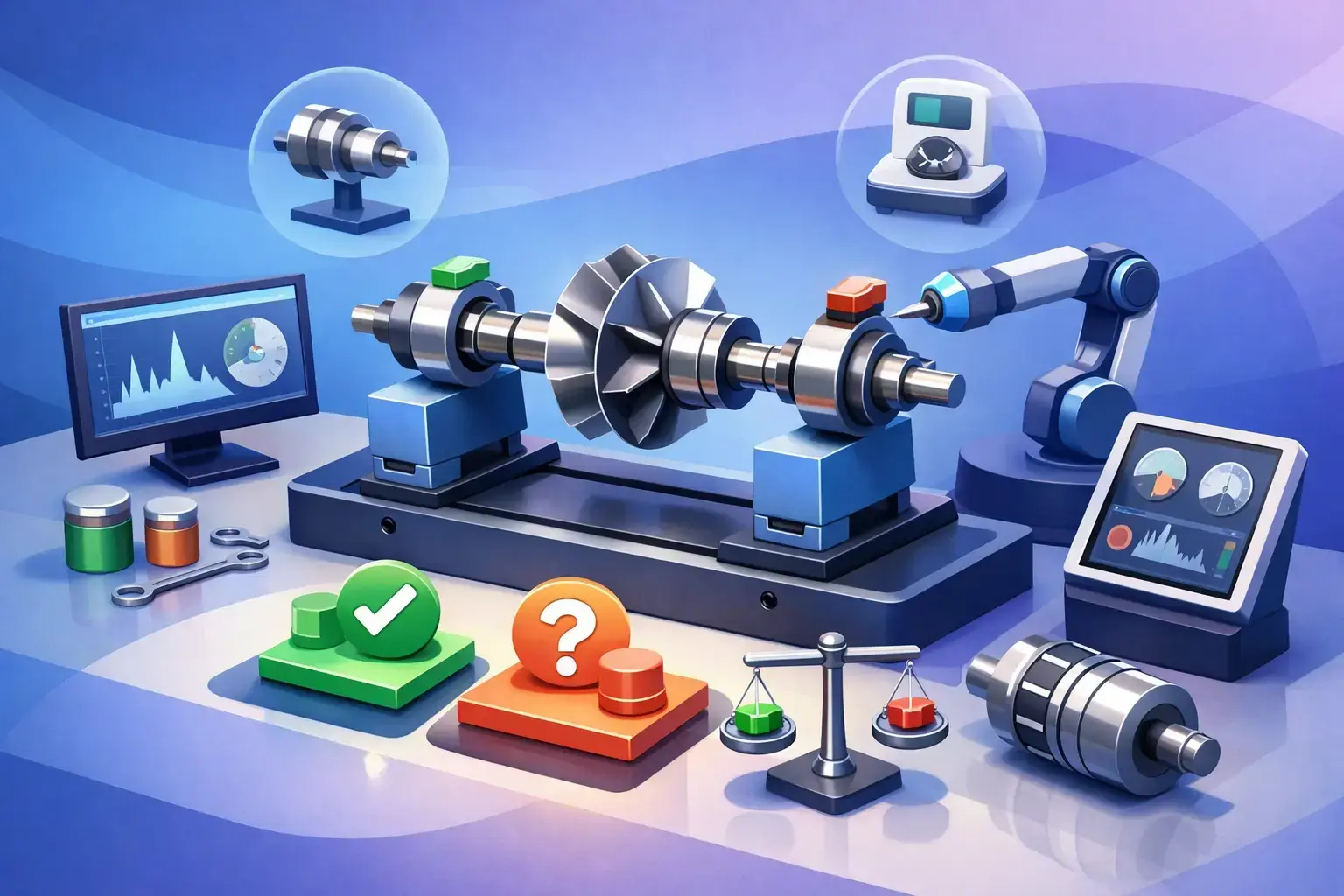
When a rotor starts generating vibration in the field, the problem is not only comfort or noise level. In most facilities, this situation means shortened bearing life, additional loads on couplings and housings, increased energy consumption, and a higher risk of unplanned downtime. For this reason, rotor balancing solutions are not a side topic of maintenance activities but a technical decision area that directly affects production reliability.
A wrong balancing approach may temporarily suppress the problem but may not eliminate the root cause. The correct approach evaluates the rotor type, operating speed, geometry, tolerance requirements, and process conditions together. Especially in high-speed, tight-tolerance, or continuously operating systems, balancing quality directly determines the service life of the equipment.
Why are rotor balancing solutions critical?
Imbalance occurs when the rotating mass is not evenly distributed around the axis of rotation. Although this problem seems simple in theory, in practice it manifests in many different ways. In electric motors it appears as efficiency loss and bearing load, while in fan and blower applications it creates vibration along with increased noise. In turbines, pumps, compressors, and special production shafts, it can lead to more severe dynamic consequences.
The main point here is that not every vibration originates from imbalance alone. Bending, misalignment, looseness, mounting errors, resonance, or surface defects can produce similar symptoms. Therefore, an accurate diagnosis must be made before selecting a balancing solution. A common mistake in the field is trying to solve every vibration problem directly with balancing.
A properly structured balancing process serves three goals. The first is reducing vibration to acceptable levels. The second is extending the rotor’s service life. The third is achieving reliability and repeatable quality in the production line. Especially in mass production facilities, this third point directly reflects on cost and delivery performance.
Which solution is required for which rotor?
When selecting rotor balancing solutions, the physical and operational structure of the rotor must first be examined. Short and disk-type components are not evaluated with the same method as long shafts. Similarly, the same tolerance approach is not used for a low-speed fan rotor and a high-precision armature or turbo component.
Single-plane balancing is often sufficient for short, disk-like rotors with limited width. This method delivers efficient results in grinding wheel flanges, certain fan impellers, and specific pulley types. However, as the rotor length increases and mass distribution varies along the axis, two-plane balancing becomes necessary. Because in this case, not only static imbalance but also moment-induced dynamic imbalance comes into play.
In industries requiring high precision, the issue becomes even more critical. In electric motor rotors, generator components, automotive sub-parts, aerospace parts, or defense industry applications, tolerances become much tighter. In such cases, measurement alone is not enough; machine precision, fixture quality, software accuracy, and operator experience together determine the final result.
When to prefer horizontal, vertical, and automatic systems?
Horizontal balancing machines are widely used for shaft-type rotors and parts supported between two bearings. They are a strong solution for electric motor rotors, crank-like parts, long shafts, and many industrial rotors. Especially well-calibrated horizontal machines that adapt to different rotor sizes offer broad advantages in both service and production environments.
Vertical balancing machines, on the other hand, may be more suitable for disk-type, wheel-type, or single-sided mounted parts. They provide easier setup and handling for brake discs, fan impellers, flywheels, and similar geometries. The key point is that the part must be held as close as possible to its real operating condition. Any mounting error directly affects measurement accuracy.
Automatic balancing systems stand out in high-volume production facilities. These systems perform measurement, angle detection, correction, and verification steps in a more controlled and faster way. However, automation does not always mean the best investment. In low-volume, high-mix production environments, flexible manual or semi-automatic solutions may be more reasonable. The decision should be based not only on technology level but also on production structure.
On-site balancing or workshop balancing?
This question is commonly faced by maintenance teams. If the rotor can be disassembled, measured in a workshop with suitable fixtures, and corrected in a controlled environment, workshop balancing provides higher accuracy. This approach is especially preferred for overhauled or reworked rotors.
On the other hand, in large fans, heavy industrial shafts, process equipment, or systems where disassembly causes significant downtime, on-site balancing service may be more efficient. The advantage of on-site balancing is reduced downtime. However, access conditions, operational safety, condition of reference surfaces, and the overall mechanical health of the machine must be carefully evaluated.
An on-site balancing operation should not mask another mechanical problem. For example, in a system with severe misalignment, loose base, or damaged bearings, only performing balancing correction may provide short-term improvement. For permanent results, diagnosis and application must be considered together.
What technical aspects should be considered in the right balancing solution?
A good rotor balancing solution is not just about machine supply. Measurement accuracy, calibration discipline, software reliability, fixture design, operator training, and service continuity are all determining factors. A machine may look sufficient on paper, but if proper clamping cannot be achieved under real production conditions, the expected result will not be obtained.
Therefore, the solution provider must not only sell equipment but also understand the application. As rotor types change, support elements, sensor placement, correction method, and tolerance calculations may also change. Flexibility is especially an advantage for facilities serving multiple industries.
Calibration and verification are also important. If the balancing machine is not regularly checked for accuracy, the reliability of the results becomes questionable. This affects quality records, customer acceptance processes, and production repeatability. For this reason, technical support and spare parts availability are not secondary but primary criteria in purchasing decisions.
How should rotor balancing solutions investment be evaluated?
Some businesses consider balancing only when a failure occurs. However, this approach often leads to higher total costs. When bearing failures caused by vibration, unplanned downtime, rework needs, and quality losses are combined, the balancing investment can pay back much faster than expected.
When evaluating investment, focusing only on machine cost is incomplete. Part variety, daily volume, target tolerance, operator ease of use, maintenance requirements, and service response time must all be considered together. In some facilities, a compact vertical machine is the best solution, while in others a horizontal system with automatic correction capability is more suitable.
Working with a solution partner that provides fast technical support, revision, calibration, software support, and field service across Türkiye makes a significant difference. Structures such as MDBALANS, which specialize in both machine production and technical service, provide sustainable one-stop support and therefore offer a strong advantage for production continuity-focused facilities.
Most common mistakes when making decisions
The first mistake is selecting a machine without considering the rotor’s real operating conditions. This is often why a part balanced in laboratory conditions does not deliver expected results in the field. The second mistake is defining tolerance requirements either too loosely or unnecessarily strictly. Too loose tolerances reduce quality, while overly strict tolerances increase time and cost.
Another mistake is treating service and training as post-purchase topics. Without proper operator training, even the best machine can perform inefficiently. Similarly, when fast technical support is not available, significant production losses may occur.
Rotor balancing is not just a measurement process; it is an engineering discipline combining machinery, method, fixture, software, and field experience. The right solution in this field is not the most expensive or most complex system, but the one that best matches your rotor structure and production flow.
Every rotating component that operates quietly, with low vibration and predictable performance in production, carries a well-made engineering decision behind it. Treating balancing needs as part of process quality rather than a failure response is the most robust long-term approach.