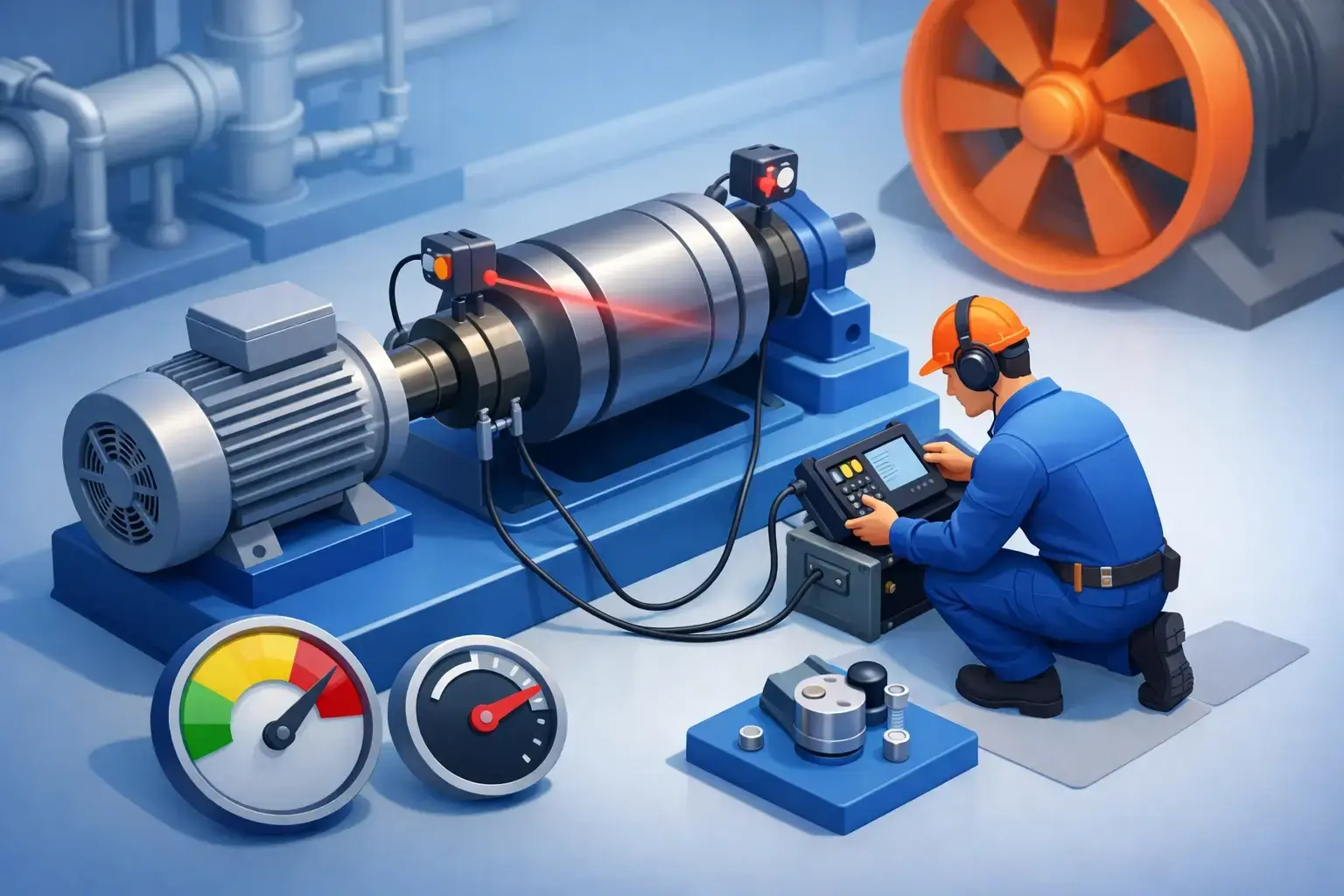
If vibration levels suddenly increase while a fan line is operating normally, bearing temperatures rise, or an unusual noise occurs on the coupling side, the question is clear: when is on-site balancing needed? The need for field balancing often reveals itself before an unplanned shutdown begins. Especially in large diameter, high inertia, difficult-to-disassemble rotor systems operating at the core of a process, the right decision may be not to move the equipment to the workshop but to perform measurement and correction on-site.
On-site balancing is the process of balancing the rotor under its actual operating conditions. This approach is preferred not only to reduce vibration but also to maintain production continuity, prevent downtime caused by disassembly and reassembly, and take the real operating characteristics of the system into account. However, not every vibration problem means imbalance. Correct diagnosis is therefore the first step.
Short answer to when on-site balancing is needed
On-site balancing is required when the rotor is difficult or costly to dismantle, when significant vibration is observed at operating speed, and when measurements indicate that the root cause is imbalance. Fans, blowers, large electric motors, pump rotors, turbines, mills, separators, and specially aligned process equipment are common examples in this category.
The critical point here is this: vibration does not automatically mean balancing is needed. First, it must be determined whether the issue is imbalance, misalignment, mechanical looseness, bearing failure, or resonance. The value of on-site balancing services emerges exactly here. Without proper equipment and experienced engineering analysis, intervention may mask the problem rather than solve it.
Typical signs requiring on-site balancing
The most common indicator is a high 1X vibration component related to operating speed. If a machine generates vibration at a certain speed range and this behavior becomes more pronounced as speed increases, imbalance becomes more likely. This may also be accompanied by increased bearing loads, reduced mechanical life, and surface degradation.
Another indicator is material buildup, dirt accumulation, or mass loss on the rotor. Especially in fan impellers, crusher rotors, textile and paper applications, uneven material accumulation on the rotor quickly creates new imbalance. Similarly, welding repairs, blade replacement, local wear, or part breakage can disturb mass distribution.
Sometimes the issue appears after maintenance. Bearing replacement, coupling removal and installation, rotor assembly, or small geometric differences during maintenance can change operating behavior. A rotor that appears balanced in the workshop may behave differently in the field due to housing conditions, foundation rigidity, or process load. In such cases, on-site balancing provides more accurate results because it reflects real operating conditions.
Which equipment is more suitable for on-site balancing?
Large fans are the most common equipment group for this service because removing and transporting them is time-consuming and affects production. Additionally, fans may exhibit different dynamic behavior when operating with their housing, bearings, coupling, and process airflow together.
For pump and motor systems, the decision depends more on conditions. For small and easily removable equipment, workshop balancing may be more practical. However, for high-power motors, critical process pumps, or systems requiring long downtime for disassembly, on-site balancing provides significant advantages.
Turbines and heavy industrial rotors and high-precision process equipment require not only accessibility considerations. In these machines, data must be collected under conditions close to operating speed because balancing quality is directly related to real dynamic response.
When should on-site balancing be chosen instead of workshop balancing?
If dismantling the rotor requires removing surrounding equipment as well, on-site balancing is often more economical. When crane planning, transportation, realignment, test runs, and production losses are combined, field service that initially seems expensive may actually result in lower total cost.
Another case is when imbalance occurs after assembly. The rotor may be balanced individually, but coupling halves, keys, process connections, or installation tolerances may cause system imbalance. In such cases, workshop results do not fully reflect field conditions.
Additionally, time is critical in plants requiring urgent intervention. Even hours matter in unplanned shutdowns. Rapid measurement, analysis, and correction to bring the machine to a safe operating level provides a major advantage in maintenance management.
When is on-site balancing needed in critical plants?
In critical facilities, the answer is clearer. Power plants, cement factories, steel production lines, HVAC infrastructure in large manufacturing plants, petrochemical processes, and all operations where downtime directly causes capacity loss often include on-site balancing as part of their maintenance strategy. Here, the issue is not only vibration but also downtime duration, equipment life, safety, and delivery performance.
Especially in systems without backup machines, removing the rotor and sending it to the workshop carries significant operational risk. In such cases, a proper field balancing application quickly reduces vibration levels and provides operational relief. More comprehensive maintenance planning can be done afterward.
What should be checked before on-site balancing?
A professional service approach does not start by directly adding weights. First, vibration measurement, phase analysis, operating speed evaluation, bearing condition, foundation integrity, looseness, and alignment effects must be assessed. The goal is to confirm that imbalance is truly the main issue.
For example, in a rotor with shaft bending or a system operating in resonance, balancing alone provides limited improvement. Similarly, if bearing damage is severe or there is mechanical looseness, added correction weights will not provide a permanent solution. Therefore, field balancing should always be carried out together with diagnostic discipline.
Proper correction plane selection is also important. Whether single-plane or two-plane balancing is required depends on rotor geometry, speed, and vibration mode. A thin disk-type rotor and a long shaft rotor cannot be treated with the same method.
Main advantages and limitations of on-site balancing
The biggest advantage is evaluating the machine under real operating conditions. This increases the chance of identifying the actual problem. The second advantage is speed. Especially in plants under production pressure, eliminating dismantling and transportation significantly reduces intervention time.
However, not every field application is ideal. If access is limited, there are no safe weight placement areas, the rotor surface is damaged, or deformation is severe, workshop intervention may be required. Therefore, on-site balancing is a powerful solution but not a universal one. Machine type, damage level, and plant conditions must all be considered when selecting the correct method.
What does correct application ultimately provide?
A successful on-site balancing operation reduces vibration levels, extends bearing and housing life, and reduces loads on couplings and connections. In practical terms, this means fewer unplanned shutdowns, lower maintenance costs, and more stable production. Especially in continuously operating lines, this gain directly improves operational performance.
At the same time, smoother machine operation becomes noticeable to operators. Noise decreases, overheating is controlled, and machine behavior becomes predictable. For technical teams, this is not just fault correction but an improvement in maintenance reliability.
When receiving on-site balancing services, measurement infrastructure, reporting quality, technical interpretation level, and post-intervention verification should be carefully evaluated. An experienced team does not only add weights; it analyzes the problem, clearly defines limits, and may provide additional maintenance recommendations. Technical service structures focused on this field, such as MDBALANS, act not only as service providers but also as decision-support partners.
If a rotor can be balanced without dismantling, vibration characteristics indicate imbalance, and downtime costs are high, delaying the decision often worsens the problem. A properly timed field balancing operation can be a small but critical intervention that prevents a major failure.