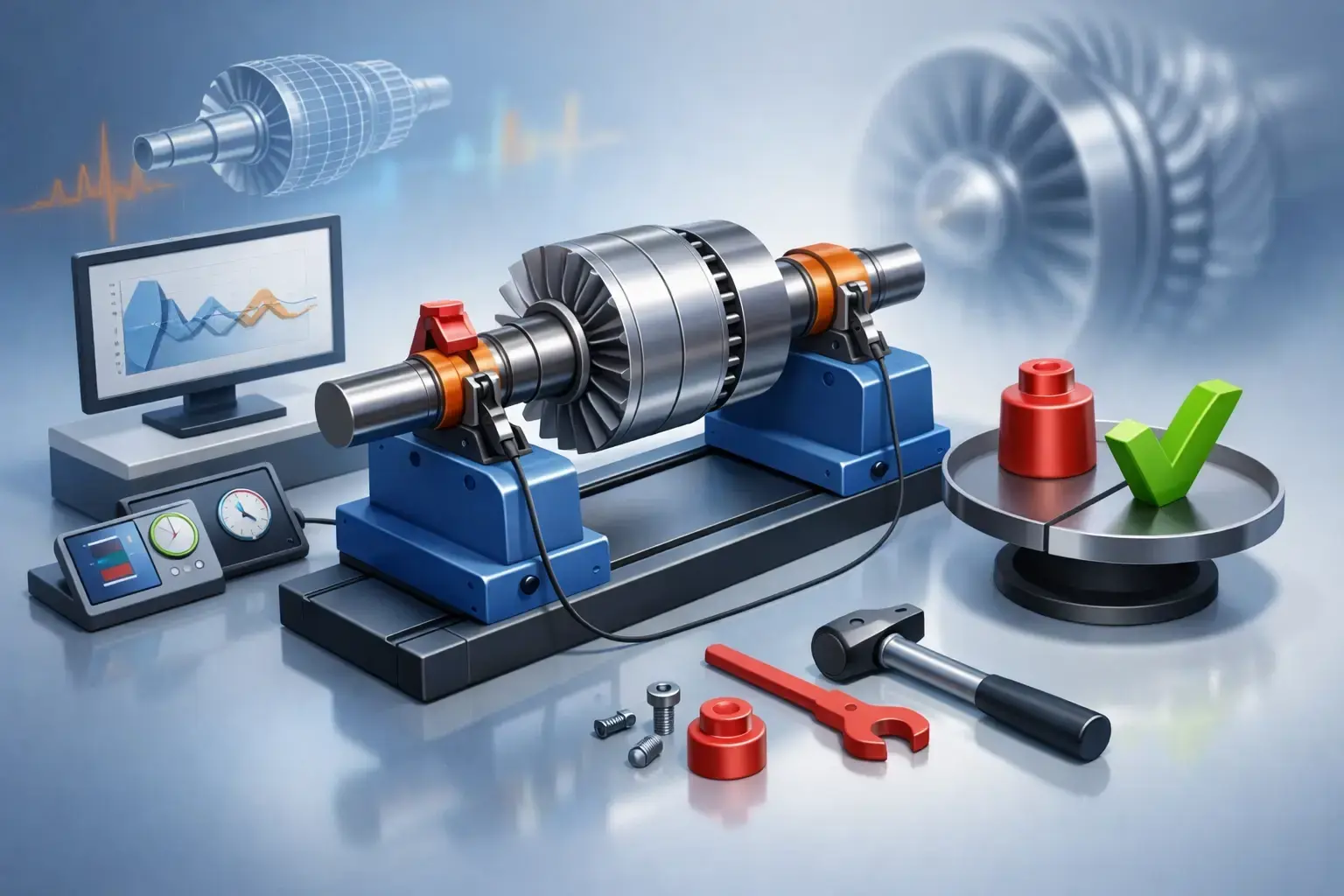
When imbalance begins in a rotor, the problem often reveals itself not through noise, but through cost. Increased vibration raises bearing and housing loads, stresses couplings, affects energy consumption, and ultimately leads to unplanned downtime. For this reason, rotor balancing services should be evaluated not as a maintenance task, but as a technical guarantee that protects production continuity.
Rotor imbalance is not limited to a single industry. From electric motors to fans, pumps to shafts, turbine components to custom manufactured rotating parts, every rotating element requires precise balancing depending on operating speed and mass distribution. The issue is not only the presence of vibration, but its level, the speed range at which it increases, and its impact on machine mechanical life. The correct service is not just about adding or removing weight, but correctly diagnosing the root cause.
What do rotor balancing services cover?
Rotor balancing services cover a much broader technical scope than most businesses assume. It is not only a workshop balancing operation, but also measurement, analysis, proper machine selection, tolerance evaluation, reporting, and on-site intervention when required.
The balancing process is generally planned according to rotor type, weight, geometry, operating speed, and application area. A short and rigid part may require single-plane balancing, while long and flexible structures may require two-plane or more advanced analysis. Applying the same method to all rotors does not produce correct results.
The process usually starts with a preliminary inspection. The physical condition of the rotor is evaluated, including surface damage, eccentricity, bending, loose mounting points, or previously incorrect corrections. Then measurements are taken using a suitable balancing machine to determine the amount and angular position of imbalance. In the next step, a correction method such as weight removal, addition, or repositioning is selected. The process is not considered complete without a final verification measurement.
Why is vibration alone not enough?
Vibration in equipment does not always directly indicate imbalance. Alignment errors, bearing failures, mechanical looseness, shaft bending, installation issues, or resonance can produce similar symptoms. Therefore, qualified rotor balancing services do not only aim to reduce vibration levels; they also isolate the root cause.
The key difference here is that the service provider treats balancing as part of a diagnostic process. If imbalance is truly the root cause, correction provides fast results. However, if the underlying issue is geometric deviation or mechanical damage, balancing alone provides only temporary improvement, and the problem returns shortly after. A significant portion of recurring vibration problems in industry originates from this.
Which equipment requires rotor balancing services?
Industrial applications are very wide. Electric motor rotors, fan impellers, blower units, pump rotors, compressor components, spindle parts, grinding shafts, turbine rotors, pulleys, flywheels, and custom rotating parts may all require regular balancing checks.
The frequency depends on the importance of the equipment. In high-speed machines, even a small mass imbalance can cause serious effects. In heavy rotors, imbalance creates significant mechanical load on the system. Some facilities apply balancing only after failures, while more mature maintenance systems prefer periodic inspection. The second approach generally results in lower total cost.
Workshop balancing or on-site balancing?
There is no single correct answer. If the rotor can be safely removed and balanced in a machine, a controlled workshop environment usually provides higher accuracy. This is especially advantageous for new production parts, post-repair verification, and quality control applications.
On-site balancing is preferred when dismantling is difficult, costly, or time-critical. It provides significant time savings in large fans, heavy equipment operating in place, or systems that cannot be shut down for long periods. However, field conditions, structural rigidity, and operating environment directly affect the results. On-site balancing is fast, but not always the first choice for every rotor.
The correct decision is made by evaluating rotor criticality, dismantling time, target accuracy, and operating conditions together. A technically strong service provider does not force a single method but selects the most appropriate solution.
How to recognize the right service provider?
When selecting rotor balancing services, price alone should not be the deciding factor. A low-cost service with insufficient measurement infrastructure may lead to the same problem recurring in a short time, eliminating any initial savings.
A competent provider should be evaluated on three main aspects: measurement and verification capability, suitable machinery and technical infrastructure for different rotor types, and post-service technical support continuity. Companies that combine manufacturing and service expertise often manage both equipment limitations and application risks more effectively.
Reporting is also important. Recording initial and final values of the correction provides valuable reference data for maintenance teams. Technical service should not only deliver results but also generate usable engineering data.
How balancing quality impacts the business
A properly performed balancing process should not only be seen as vibration reduction. Increased bearing life, reduced stress on shafts and couplings, more stable operation, improved consistency in surface-sensitive processes, and predictable maintenance planning are the real benefits.
In mass production environments, small vibration deviations can gradually lead to quality loss. Machining precision may be affected, motor heating behavior may change, and fatigue effects may appear in fans and blower systems. Therefore, balancing should be considered not only as failure prevention but also as a process stability factor.
In some cases, businesses demand very fast results. While understandable, speed must be balanced with technical accuracy. Random material removal or trial-and-error balancing may show short-term improvement but can compromise the integrity of the rotor. Engineering discipline is essential here.
Relation between revision, calibration, and balancing
For balancing to produce lasting results, surrounding technical factors must also be managed correctly. A rotor coming out of repair may not reach the desired balance class if its geometry is not within acceptable limits. Similarly, if the balancing machine calibration is not reliable, measurement results become questionable.
Therefore, in professional service structures, balancing is not treated as an isolated process. Machine accuracy, fixture suitability, mounting method, sensor condition, and operator experience collectively determine the outcome. Companies like MDBALANS, which combine machine manufacturing and service expertise, can better control this chain.
When should rotor balancing service be applied?
Waiting for symptoms is often the most costly approach. Increased vibration, noise changes, frequent bearing failures, coupling issues, looseness in mounting elements, and unexpected behavior after maintenance may indicate the need for balancing. New rotors should also be checked before commissioning, repaired parts before installation, and critical equipment during periodic maintenance plans.
Operating conditions determine priority. High speed, heavy load, continuous operation, and temperature variation increase the criticality of balancing. In industries such as defense, energy, automotive, rail systems, marine, and general manufacturing, acceptable tolerances vary depending on the application.
Proper rotor balancing services are not taken to silence machines, but to ensure safe and reliable operation. If rotating equipment is at the core of your operation, balancing should be considered not as a corrective action, but as a regular part of performance management.