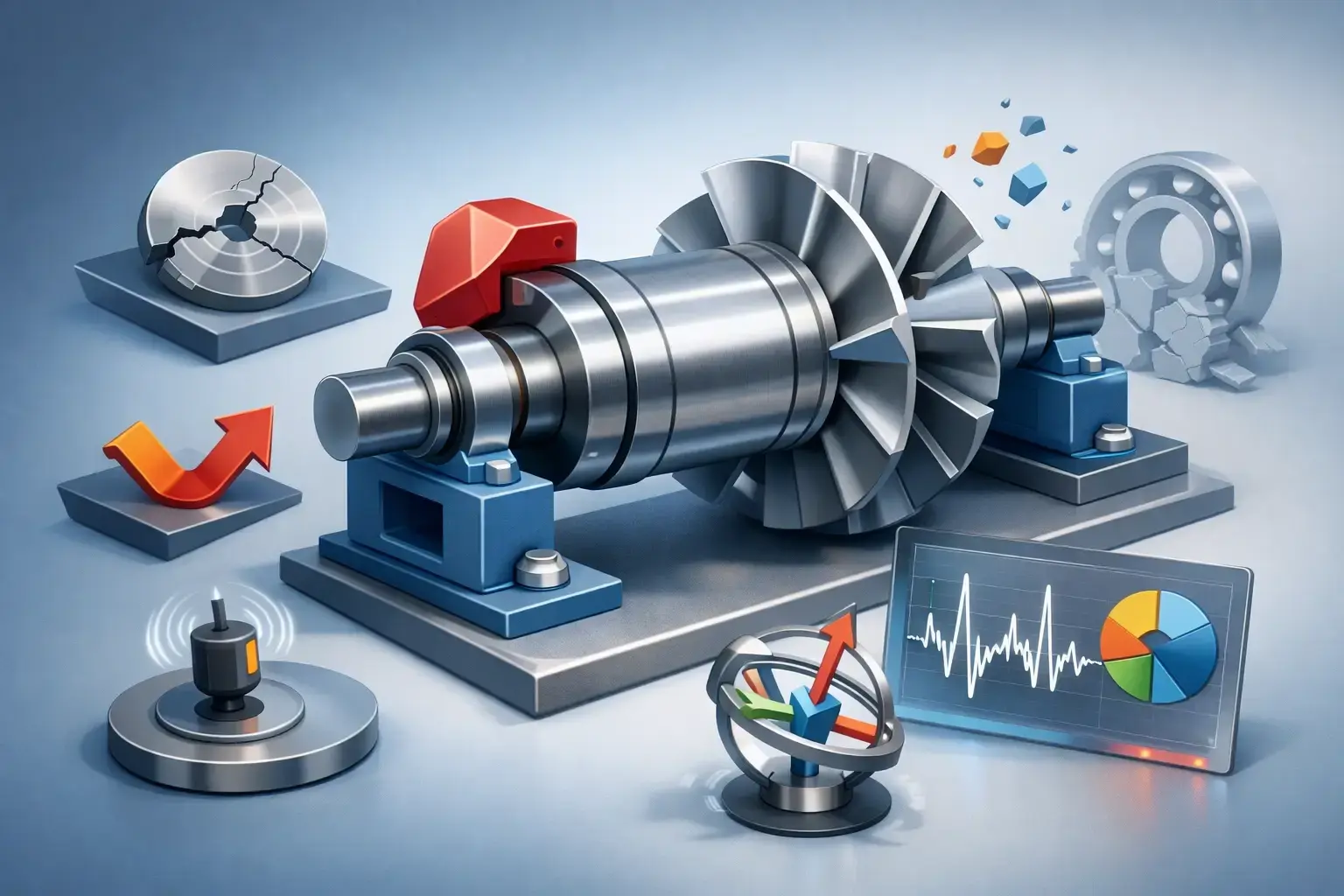
If a rotor that was operating smoothly in the field suddenly starts generating vibration, the issue is often not limited to bearings or couplings. In many facilities, the real question becomes: what causes rotor imbalance and why does this problem repeat? Rotor imbalance occurs when the mass center of a rotating part does not align with its rotational axis. The result is not only vibration. Bearing loads increase, energy consumption rises, component life decreases, and the risk of unplanned downtime grows.
Why does rotor imbalance occur?
Rotor imbalance does not originate from a single cause. From production to assembly, from operating conditions to maintenance practices, many factors can disturb mass distribution. Therefore, the correct approach is to evaluate root causes rather than symptoms alone. Detecting vibration does not always mean the issue can be solved only by adding balancing weights.
The basic principle is simple. If mass distribution around the axis is uneven, centrifugal force occurs. As speed increases, this force grows. A minor imbalance at low speed may turn into severe vibration at operating speed. For this reason, especially fans, electric motors, turbines, pumps, shafts, drums, and high-speed special rotors require balancing quality as a critical production and maintenance criterion.
Main answers to “what causes rotor imbalance”
One of the most common causes is manufacturing tolerances. Small mass variations from machining, casting, welding, pressing, or assembly can create imbalance. Even if a part looks geometrically correct, density differences, weld material distribution, or uneven material removal can change the real mass distribution.
Another important cause is assembly errors. Misalignment between rotor and shaft, coupling installation, fan blade mounting, or eccentric positioning of components directly affects balance behavior. Some rotors may be balanced individually but behave unbalanced in real assembly conditions. Therefore, it is critical to define balancing conditions according to the final operating configuration.
Contamination and material buildup are also very common in the field. Dust accumulation on fan blades, residue in pump impellers, or process material deposits gradually create uneven mass distribution. In harsh industrial environments, periodic cleaning becomes as important as balancing itself.
Wear has the opposite effect. Uneven wear, erosion, corrosion, friction, or particle impact can remove material asymmetrically, leading to imbalance. This is frequently seen in pumps, blower systems, turbine components, and mining equipment.
How do production and repair processes create imbalance?
Repaired rotors carry higher risk than newly manufactured ones. Welding, localized grinding, part replacement, shaft straightening, or blade refurbishment all alter mass distribution. Even if the repair is technically correct, balancing verification after the process is essential before commissioning.
The same applies to post-maintenance assemblies. Bearing replacement, coupling disassembly/assembly, pulley changes, or auxiliary component replacements may affect axial and radial behavior. A common mistake is to skip balancing after mechanical maintenance. In many systems, post-repair balancing should be a standard procedure.
Thermal effects are also important. In high-temperature applications, uneven thermal expansion can occur. Welded structures may deform over time due to stress redistribution. A rotor that is balanced at room temperature may behave differently under operating conditions. Therefore, real operating conditions should always be considered: on-site balancing.
Is every vibration problem caused by imbalance?
No. This distinction is critical. Rotor imbalance is one of the most common causes of vibration, but not the only one. Misalignment, looseness, bearing defects, resonance, shaft bending, mechanical rubbing, and foundation issues can produce similar symptoms.
Correct diagnosis requires evaluating vibration data together with speed, phase measurement, operating history, and rotor geometry. If imbalance is the real cause, frequency patterns and measurement points typically confirm it. Otherwise, mechanical integrity must be checked before performing balancing, or the correction may only provide a temporary effect.
What is the impact of rotor imbalance on operations?
An unbalanced rotor does not only create vibration; it stresses the entire system. Bearing loads increase, temperatures rise, and the life of couplings and seals decreases. Over time, fatigue occurs in shafts, housings, and connections, increasing maintenance costs and causing unplanned shutdowns.
Energy efficiency is also affected. Unbalanced equipment generates higher mechanical losses. In high-speed or continuously operating machines, even small imbalance levels can significantly increase total energy and maintenance costs. In production lines, quality deviations and process instability may also appear.
Which conditions increase the risk?
High speed, frequent start-stop cycles, dirty environments, abrasive fluids, and insufficient maintenance increase the likelihood of imbalance. Fans and impellers exposed to material buildup may quickly become unbalanced even after being initially stable.
Balancing should not be treated as a one-time operation. Some rotors remain stable for long periods after manufacturing balancing, while others require periodic inspection depending on operating conditions. Maintenance planning should therefore be based on rotor type and application.
What is required for a permanent solution?
A permanent solution depends on identifying the root cause correctly. If the issue is manufacturing-related, process improvement and correct balancing standards are required. If contamination is the cause, cleaning cycles and process conditions must be improved. If wear is involved, rotor geometry loss should be evaluated and repaired or replaced if necessary.
The choice of balancing method is also important: dynamic balancing methods. Single-plane or two-plane balancing should be selected based on rotor length, diameter, speed, and mass distribution. Workshop balancing and field balancing may differ in application. Incorrect method selection limits the result.
Measurement quality is also critical. Sensor accuracy, reference methods, operating speed, and operator experience all influence results. Rotor balancing is therefore not just equipment usage but a true engineering interpretation process. Companies specializing in this field, such as MDBALANS, provide value through both equipment and field expertise.
When is professional evaluation required?
Professional analysis is required when vibration repeats, balancing corrections fail quickly, or behavior changes after overhaul. For critical equipment, trial-and-error approaches can be costly due to downtime, safety risks, and potential damage.
For components such as electric motor rotors, fan impellers, pump impellers, armatures, turbine parts, and custom rotating equipment, balancing quality is part of operational reliability. The goal is not only to reduce vibration but to ensure stable behavior under real working conditions.
Rotor imbalance often starts with a small mass difference but affects the entire machine. The real question is not only “what causes rotor imbalance,” but which process creates it in your system and how to prevent recurrence. When this perspective is adopted, balancing becomes not just a corrective action, but a foundation of reliable production.