When a rotor is placed on the wrong balancing machine, the problem is not limited to inaccurate measurement. Time loss, repeat operations, false acceptance risks, and ongoing vibration issues in the field can quickly escalate. For this reason, comparing horizontal and vertical balancing machines is not simply a preference about machine form; it is a technical decision that directly affects production efficiency and maintenance performance.
One of the most common mistakes in balancing machine selection is evaluating the rotor only by its dimensions. In reality, the correct decision requires analyzing the part geometry, center of gravity, clamping method, production volume, balancing tolerance, and operator workflow together. Both horizontal and vertical systems serve the same fundamental purpose: detecting imbalance accurately and making the correction process reliable. However, the way they achieve this, the rotor groups they are suitable for, and the operational advantages they provide are significantly different.
What Is the Difference Between Horizontal and Vertical Balancing Machines?
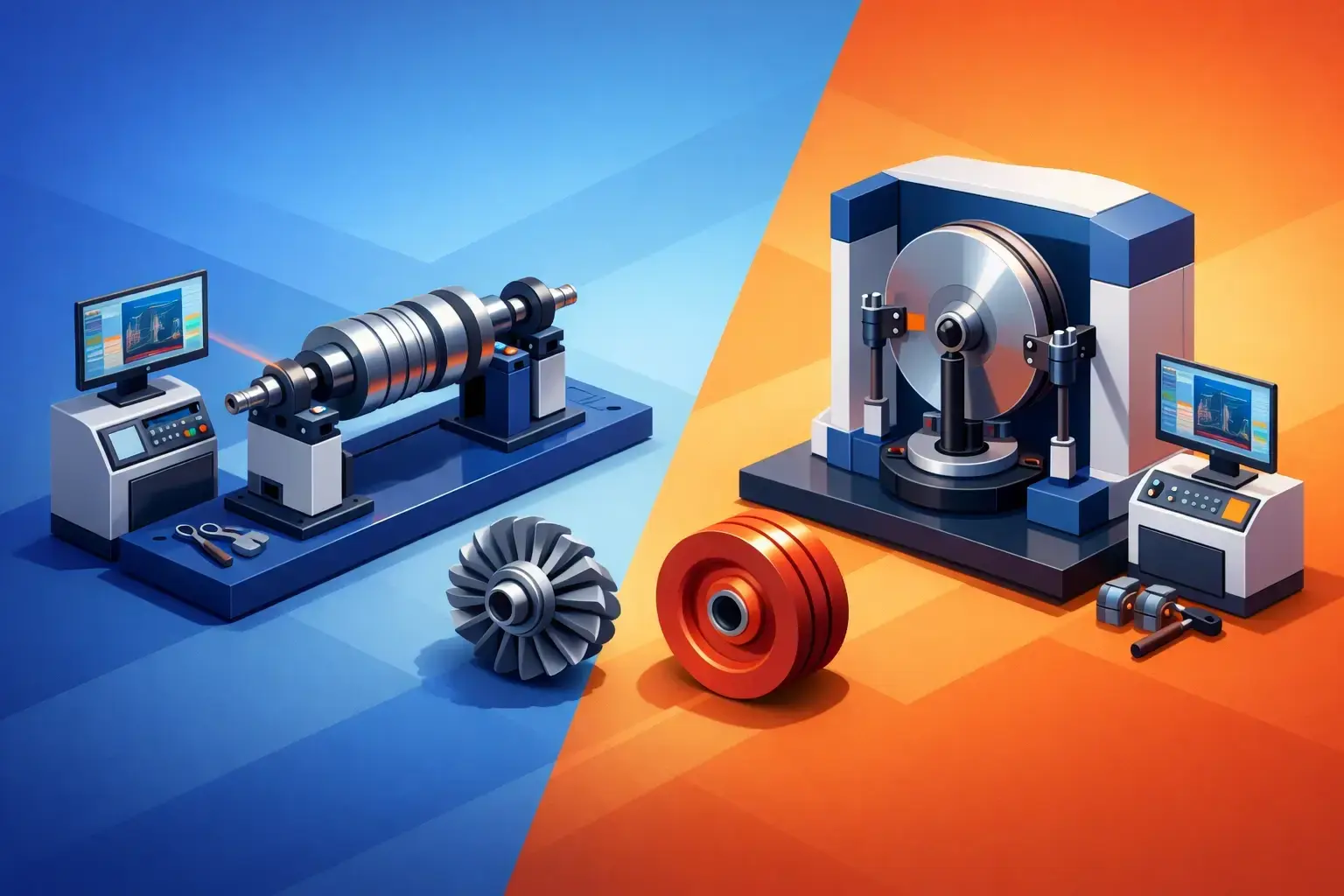
The primary difference lies in how the rotor is positioned on the machine. In horizontal balancing machine systems, the rotor is carried on a horizontal axis, generally between two support points. In vertical balancing machine systems, the rotor is mounted vertically, usually through a flange or table connection.
This distinction affects not only the machine structure but also the measurement behavior itself. Horizontal machines are particularly effective for shaft-type rotors, long and slender parts, fan shafts, armatures, compressor rotors, and components operating between two bearings. Vertical machines are generally more practical and efficient for disc-shaped parts, flywheels, brake discs, pulleys, pump impellers, and rotors that can be clamped from a single surface.
The critical point is this: every rotor rotates around an axis, but not every rotor can be measured accurately using the same clamping principle. The correct machine is the one that creates a test environment closest to the rotor’s actual operating condition and mass distribution.
When Do Horizontal Balancing Machines Stand Out?
Horizontal balancing machines become the preferred solution especially for long rotors and applications requiring two-plane balancing. Since these parts operate between bearings during real working conditions, horizontal systems represent their dynamic behavior more accurately. This significantly improves measurement reliability.
Electric motor rotors, generator rotors, paper machine cylinders, drive shafts, and similar components are commonly balanced using horizontal systems. The rotor is supported in a way that closely simulates real operation, allowing imbalance in different planes to be separated clearly. This distinction becomes extremely important in high-precision manufacturing environments.
Another major advantage is flexibility across a wide range of rotor types. Horizontal machines can be configured for different bearing distances, rotor lengths, and weight classes. This flexibility creates substantial benefits in maintenance and repair operations as well.
However, horizontal systems are not always simpler to use. Long rotor alignment, centering, and selecting proper support elements require operator experience. Handling heavy rotors may also require additional lifting equipment. In other words, while horizontal machines provide broader capability, process discipline and correct fixture usage become more critical.
Why Is Technical Decision-Making More Sensitive in Horizontal Systems?
Bearing type, belt drive configuration, hard-bearing or soft-bearing structure, measurement speed, and calibration strategy directly affect the result. The same rotor may receive an incorrect correction recommendation if the support characteristics are not properly matched. Therefore, horizontal balancing machine selection should never be based solely on capacity tables.
In real industrial applications, the important factor is compatibility between the machine and the rotor family. Instead of purchasing one oversized universal machine, a solution optimized for a specific production group may provide much better efficiency.
When Are Vertical Balancing Machines the Better Choice?
Vertical balancing machines provide a fast and efficient solution for parts whose center of gravity can be safely supported on a table structure. Disc-type rotors are typical examples of this category. Since the component can often be clamped from the top or center, loading times become shorter and operator workflow speeds up significantly.
This is one of the main reasons vertical systems are widely preferred in automotive, pump, fan, white goods, and mass-production industries. The part is mounted quickly, measured, corrected, and moved to the next cycle with minimal downtime. In high-volume production environments, this operational flow translates directly into higher productivity.
Vertical systems are highly effective in single-plane balancing or disc-character two-plane balancing applications. Flywheels, brake drums, clutch components, turbine wheels, fan impellers, and pump impellers can all achieve excellent repeatability with vertical balancing systems. When centering fixtures are properly designed, the process becomes extremely stable.
However, vertical systems also have limitations. Long shaft-type rotors or parts whose behavior must be analyzed between bearings may not be suitable for vertical balancing. If the clamping arrangement on the table does not represent real operating conditions, measurement results may appear technically correct while vibration performance in the field remains unsatisfactory.
Why Are Vertical Machines Highly Efficient?
Because loading and unloading are generally much more practical. Heavy yet compact parts can be quickly placed on the table using a crane. If the fixture system is standardized, operator dependency decreases significantly. This reduces cycle time, keeps error rates under control, and supports production consistency in serial manufacturing environments.
Which Criteria Matter Most When Choosing Between Horizontal and Vertical Balancing Machines?
The correct approach is to focus on the application rather than the machine itself. The first evaluation should be based on rotor geometry. Long, shaft-type components operating between bearings are generally better suited for horizontal systems. Compact disc-shaped parts that can be mounted from a central point are usually more suitable for vertical systems.
The second important factor is the number of balancing planes. In some single-plane balancing applications, vertical machines provide both fast and economical solutions. For two-plane balancing and rotors with significant mass distribution along the axis, horizontal systems offer greater control and accuracy.
The third factor is the production model. In prototype manufacturing, low-volume production, or environments with frequent product changes, flexibility becomes extremely important. In mass production, cycle time, fixture standardization, and operator repeatability become the priority. Vertical systems can offer major advantages here, but only if the rotor family is compatible. Faster does not always mean more accurate.
The fourth criterion is tolerance level. For high-precision balancing requirements, the machine’s mechanical rigidity, sensor quality, software accuracy, and calibration discipline become decisive factors. Machine orientation alone does not guarantee precision. A properly designed horizontal or vertical system can deliver excellent accuracy within its intended application range.
The fifth and often overlooked factor is service continuity. Purchasing a balancing machine is not just an equipment investment. Calibration support, spare parts availability, software support, operator training, and on-site technical service determine the real long-term performance of the system. This should never be ignored, especially in facilities where downtime costs are high.
There Is No Universal Best Choice — Only the Right Application
A common question in industry is: which is better, horizontal or vertical? Technically, there is no single universal answer. The better machine is the one that best matches your rotor and process requirements.
If your rotor operates on a shaft, shows imbalance behavior across multiple planes, and its dynamic behavior depends on bearing support, a horizontal balancing machine will usually be the correct choice. If your component has a disc form, requires high production speed, and can be safely centered from a single point, a vertical balancing machine becomes the more efficient investment.
In some facilities, the most effective decision is not choosing a single machine type at all, but planning two separate solutions according to different product families. While this approach requires more careful evaluation during initial investment, it can significantly reduce quality losses, cycle delays, and clamping-related errors in the long term.
At MDBALANS, the main focus is not simply choosing a machine type, but correctly defining the application requirement. Because the right balancing solution is not the one that only performs well in measurement results; it is the one that reduces vibration in real operation, protects bearing life, and supports production continuity.
Before making your investment decision, evaluate your rotor characteristics, process flow, and service expectations before looking at catalog values. In most cases, the correct machine selection becomes clear at that stage — and a properly configured system becomes a silent but critical guarantee of stable production for many years.