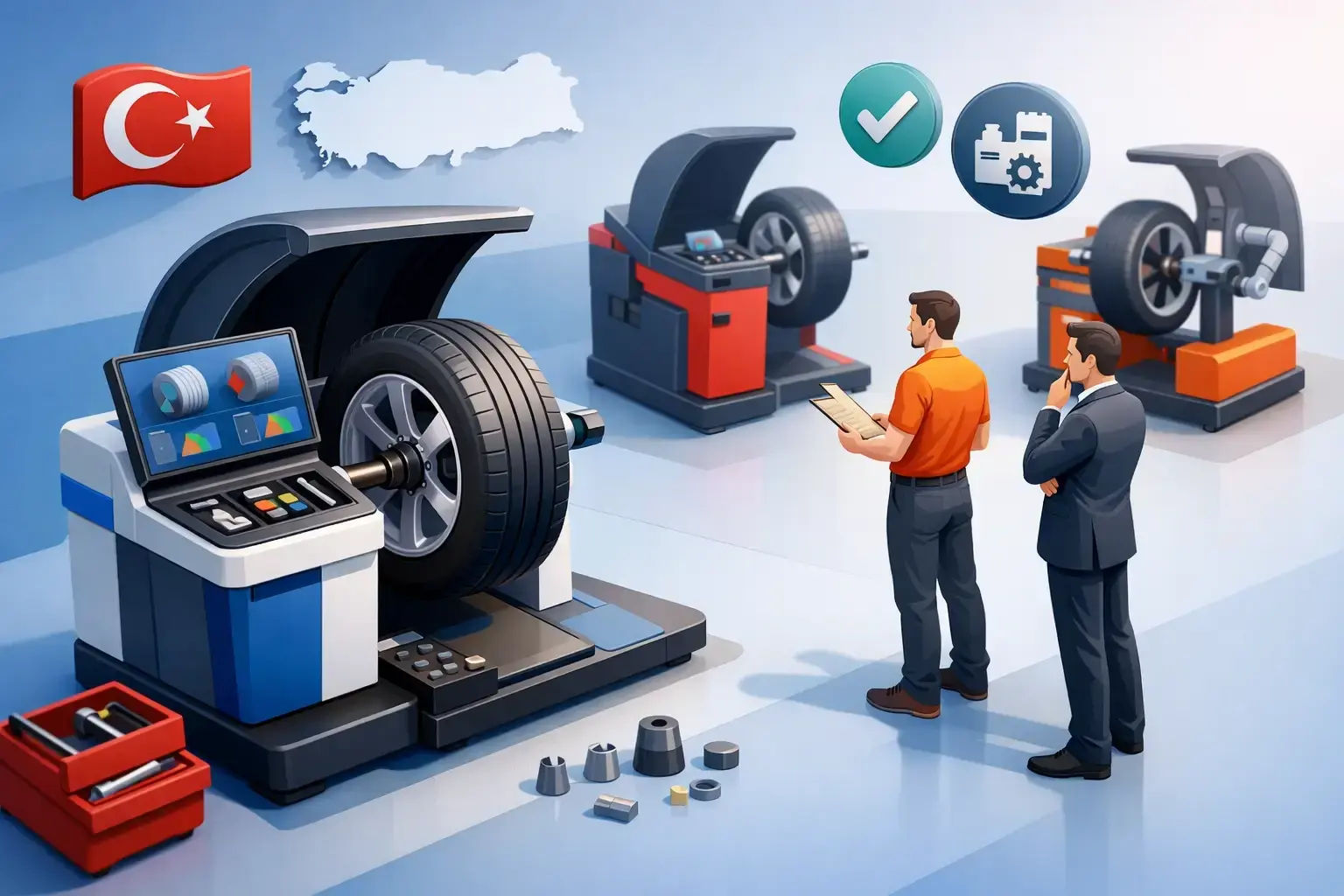
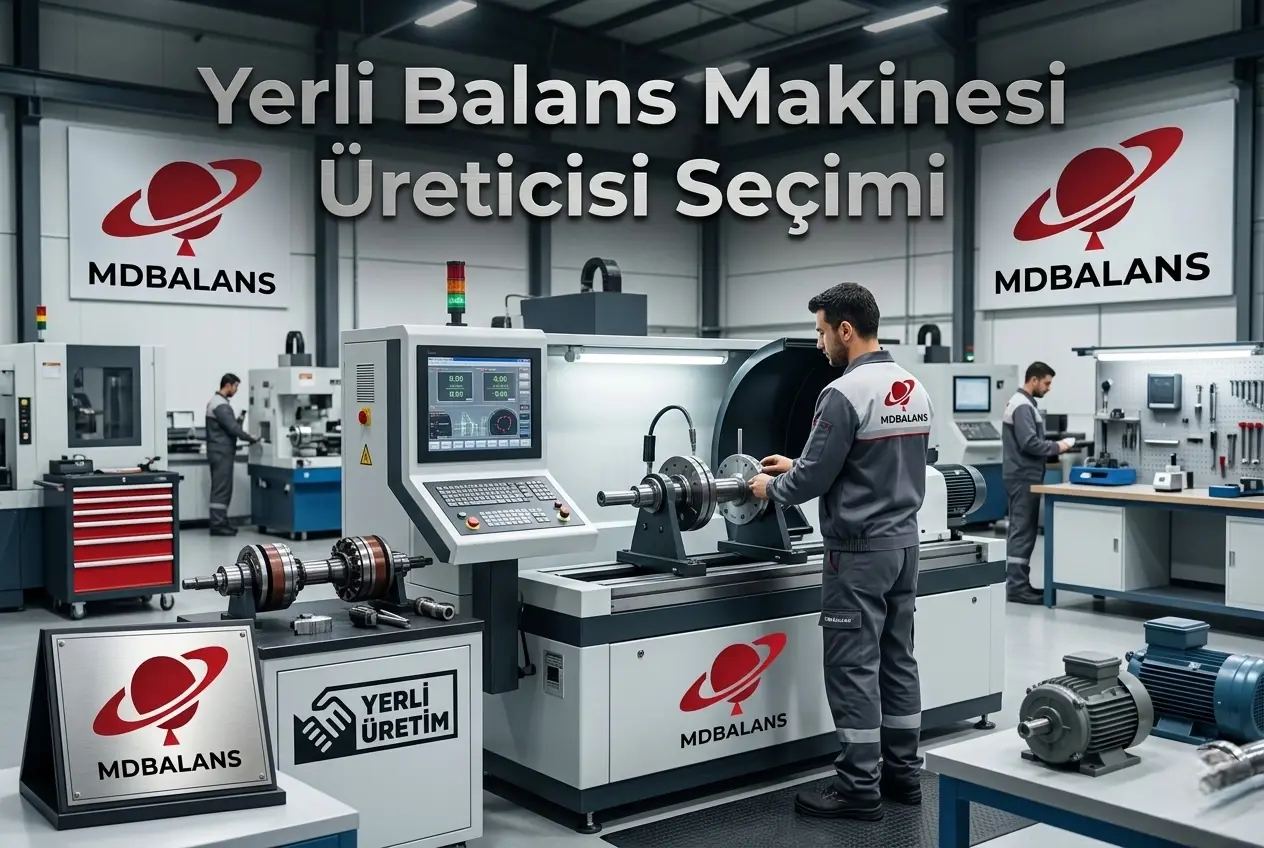
When a vibration-related shutdown occurs in a production line, the issue is rarely just a rotor imbalance. The real problem lies in how quickly the imbalance is detected, how accurately it is corrected, and how the process is managed without disrupting production. Therefore, choosing a domestic balancing machine manufacturer is not merely a purchasing decision; it is a strategic investment that directly impacts maintenance reliability, production continuity, and total operating cost.
Why is choosing a domestic balancing machine manufacturer critical?
Balancing machines are essential equipment in the quality control and service processes of rotating parts. From electric motors to fans, pumps to automotive components, balancing quality has a direct impact on vibration levels, bearing life, energy consumption, and overall product reliability. At this point, it is not enough for the manufacturer to simply deliver a machine. They must also correctly define the measurement logic required by the application, rotor geometry, clamping method, and tolerance management.
The strongest advantage of working with a domestic manufacturer emerges here. Field requirements can be addressed more quickly, service waiting times are reduced, spare parts supply is better controlled, and technical communication is more direct. Especially in facilities where production loss is measured in hours, the decisive factor for decision-makers is often not catalog data, but response speed.
Of course, not every domestic manufacturer operates at the same level. The determining factors are the manufacturer’s engineering infrastructure, measurement accuracy, calibration discipline, and after-sales service organization. Being local provides an advantage, but sustainable value is only achieved with technical competence.
What capabilities should be considered in a domestic balancing machine manufacturer?
The first aspect to evaluate is application experience. Manufacturers working across different industries can better interpret varying requirements depending on rotor types. Standard approaches are not sufficient for slender and long rotors, disc-type parts, high-speed components, or applications requiring special fixtures. In addition to the machine’s mechanical structure, the measurement system, sensor quality, and software algorithms directly affect the result.
The second aspect is technical support capacity. The process does not end after purchasing a balancing machine. Installation, operator training, validation with reference parts, periodic calibration, software updates, and revision services when needed are all required. If the manufacturer can manage this entire chain, a more predictable operational structure is established within the facility.
The third aspect is customization capability. Every production flow is different. In some facilities, manual loading is sufficient, while others require automated balancing systems. In some applications, single-plane measurement is enough, while others require two-plane balancing with tighter tolerances. A good manufacturer does not force the customer to adapt to a standard machine; instead, the machine is adapted to the process requirements.
Machine selection is not just about horizontal vs vertical
One of the most common mistakes in balancing machine investments is reducing the selection to machine type alone. Horizontal balancing machines are widely used solutions for many rotor types and are particularly suitable for shaft-type components. Vertical balancing machines, on the other hand, can be more efficient for disc-type components, fan impellers, and certain geometries. However, the right choice depends not only on the rotor shape but also on its weight, length, rotational speed, production volume, and required precision level.
In addition, clamping fixtures, drive systems, sensor positioning, and operator usability also affect production performance. A theoretically correct machine selection can become inefficient in practice due to improper fixtures or inadequate software interfaces. Therefore, technical pre-consultation with the manufacturer is one of the most critical steps in the quotation process.
Service and spare parts advantages in domestic production
One of the most expensive cost factors for industrial facilities is unplanned downtime. A failure in a balancing machine can directly impact the quality control line or maintenance department. With imported equipment, service scheduling, spare part lead times, and foreign-based technical coordination can extend this downtime. Domestic manufacturers provide a significant advantage in this regard.
The ability of service teams to quickly reach the site, diagnose issues remotely, and supply critical components from stock creates a major operational advantage. Especially in high-volume production facilities, the speed of support can be as decisive as price in purchasing decisions.
Additionally, it is important that the domestic manufacturer provides software support. Improving the user interface, adapting reporting requirements, optimizing measurement screens for the process, and enhancing data tracking all increase the real usability of the machine. Sustainable support for both hardware and software is essential.
Why price-focused selection creates long-term risks
Focusing solely on the initial purchase cost of a balancing machine can be misleading. A lower-cost system may generate additional costs in a short time if its measurement stability is weak, service accessibility is limited, or calibration discipline is insufficient. Incorrect balancing corrections, rework, increased vibration, bearing failures, and product returns can significantly raise the total cost.
For this reason, technical purchasing teams should focus on total cost of ownership. The machine’s lifespan, maintenance requirements, spare part accessibility, training support, and service continuity should all be evaluated together. Especially in mass production environments, even a few seconds of cycle time difference can lead to significant annual efficiency gains.
Balance is key. Not every application requires high-level automation. For low-volume production or diverse product ranges, semi-automatic or manual solutions may be more appropriate. The goal is to avoid systems that are either over-engineered or insufficient for the need.
Key questions to ask when working with a domestic manufacturer
During the quotation phase, technical details must be clearly defined. It is essential to ask whether the manufacturer has experience with similar rotors, what tolerance levels they can achieve, and how their calibration approach works. In addition, commissioning time, operator training, warranty scope, and after-sales response time should be clearly specified.
The machine should be suitable not only for current needs but also for future requirements. If new rotor types will be introduced, it should be evaluated whether the fixture system allows for this flexibility. Software capabilities such as creating new recipes, data archiving, and user authorization should also be reviewed. For technical decision-makers, the most effective approach is to consider the machine not just as equipment, but as part of the production process.
Why sector-specific experience makes a difference
Although balancing requirements may seem similar across industries such as automotive, home appliances, energy, defense, railways, or electric motor manufacturing, application details vary significantly. In some sectors, high production volume and short cycle times are critical, while in others, traceability and detailed reporting are more important. A manufacturer who understands these differences ensures that the solution works not only on paper but also in real production conditions.
For example, the expectations of a maintenance-focused operation differ greatly from those of a mass production line. One requires flexibility, while the other prioritizes standardization and speed. An experienced manufacturer recognizes this distinction from the beginning and designs the solution accordingly.
The right manufacturer means a more stable operation
Balancing is often only considered when problems arise, but with the right equipment and technical partner, many hidden losses can be prevented from the start. Lower vibration levels, longer equipment life, less rework, more consistent quality output, and a safer production environment are the direct results.
When selecting a domestic balancing machine manufacturer, it is essential to look beyond technical specifications and evaluate the manufacturer’s responsiveness, engineering approach, and service continuity. Because good balancing is not only about measurement accuracy, but also about delivering the right technical support at the right time.
When making the final decision, it is useful to focus on one key question: Is this manufacturer simply selling a machine, or are they truly contributing to the sustainable performance management of your rotating equipment?