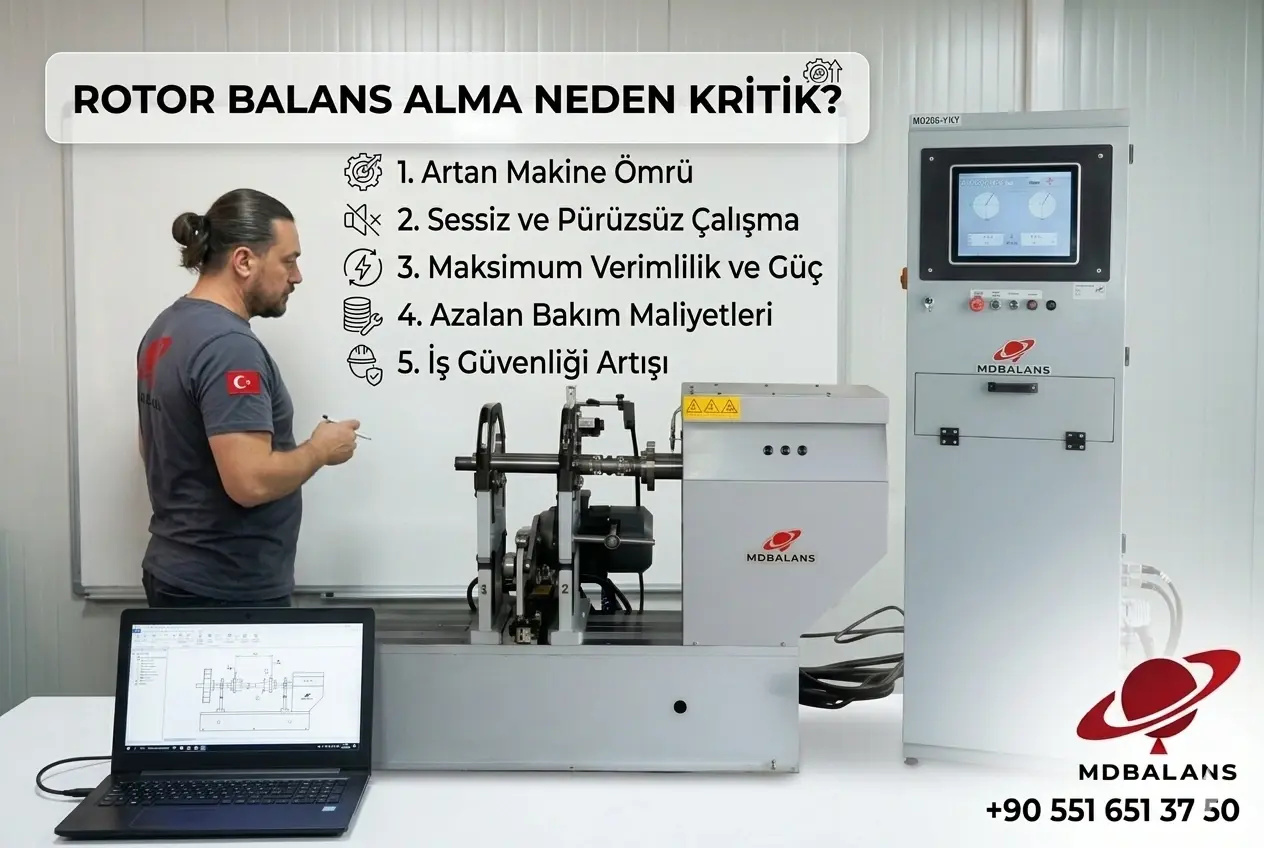
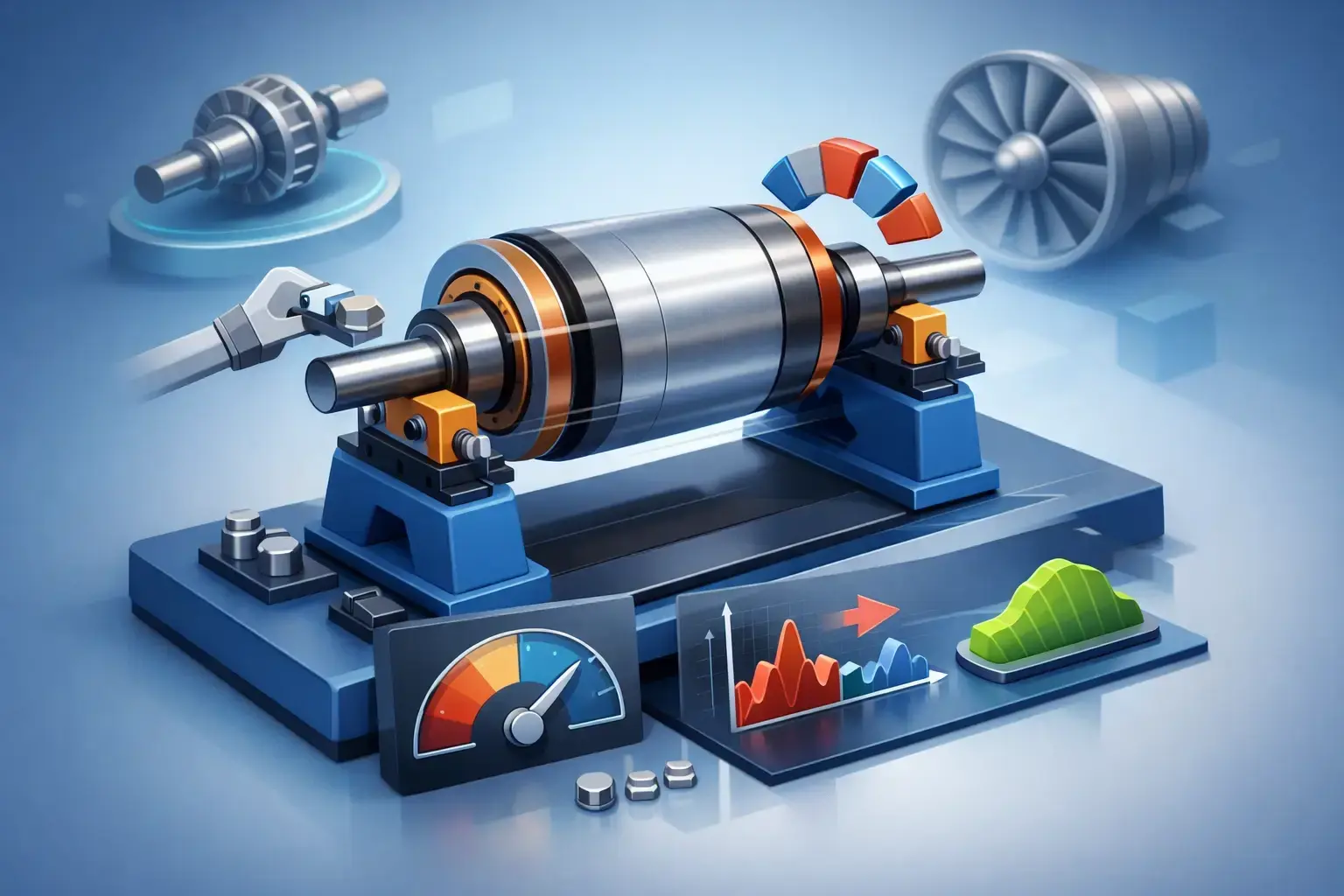
Just because a rotor is manufactured to the correct dimensions on paper does not mean it will operate vibration-free in the field. Whether it is a shaft, fan, armature, drum, turbine component, or electric motor rotor, even a small mass imbalance can create serious consequences at high speed. For this reason, rotor balancing is not simply a quality step but a technical necessity that directly affects equipment life, process stability, and operational safety.
An unbalanced rotor first generates vibration, then increases bearing loads, stresses support elements, affects couplings, and over time creates destructive fatigue effects on the housing. This situation turns directly into cost, especially in serial production facilities, power plants, fan applications, pump systems, and electric motor manufacturing. The issue is not limited to breakdowns alone. Increased noise, surface quality loss, dimensional deviation, and more frequent unplanned maintenance often originate from the same source.
What does rotor balancing solve?
Rotor balancing is the process of optimizing the mass distribution of a rotating component relative to its axis of rotation. The goal is to reduce the centrifugal forces generated during operating speed to acceptable limits. The critical point here is that balancing is not performed only to reduce vibration. It also ensures more stable rotational behavior, balances mechanical loads, and extends the service life of the machine.
Not every rotor is evaluated the same way. In short and rigid rotors, single-plane balancing may be sufficient, while long or geometrically complex parts require two-plane balancing. The application area also affects the method. For example, a fan impeller and a high-speed spindle rotor are not handled with the same tolerance philosophy. The rotor mass, geometry, operating speed, bearing type, and working conditions must all be evaluated together.
Most common causes of imbalance
A significant portion of balancing problems encountered in the field are caused not by manufacturing defects but by process-related effects. Minor eccentricities in machining, weld distribution in fabricated parts, density differences in castings, and misalignment during assembly can all create the need for balancing. In addition, dirt accumulation, wear, blade damage, thermal deformation, and local repairs during service can also shift the rotor’s center of mass.
One frequently overlooked issue is the need for balancing after maintenance. When a rotor is disassembled for bearing replacement, coupling revision, or fan blade repair by welding, the system no longer maintains its previous balance values. For this reason, maintenance quality and balancing quality should never be considered separately.
The correct approach in rotor balancing
The balancing process is not simply about adding weight or removing material from a rotor. To achieve reliable results, measurement accuracy must first be ensured. At this point, the calibration of the balancing machine, sensor sensitivity, the suitability of mounting fixtures, and operator experience become decisive. Even a small error in the measurement chain can lead to unnecessary correction on the rotor.
The second stage is operating the rotor with the correct references. The component should be supported as closely as possible to its actual working conditions. The bearing arrangement, drive method, and speed level should reflect the real application whenever possible. Otherwise, a good result on the machine may fail to deliver the expected performance in the field.
The third stage is selecting the correction method. In some rotors, material is removed by drilling, milling, or grinding. In others, weight addition, welding, or screw-mounted correction is preferred. The main criterion is reaching the target tolerance without compromising the structural integrity of the rotor. A quick solution is not always the correct solution.
Single-plane or two-plane?
This is one of the most common technical decisions in practical applications. For disc-shaped and narrow-width rotors, single-plane balancing is usually sufficient. However, as rotor length increases and mass distribution changes along the axis, two-plane balancing becomes necessary. The two-plane method controls both static and moment-related imbalance.
If the wrong method is selected, the component may appear acceptable at one speed but continue to generate vibration in different speed ranges. For this reason, balancing should not be planned only according to an instant measurement result, but according to rotor dynamics principles.
Why does tolerance vary by application?
The same balancing quality is not targeted for every rotor. The acceptable limit for an electric motor rotor differs from that expected in aerospace, defense, or high-precision process equipment. The reason is the difference in operating speed and system sensitivity. Residual imbalance that is manageable in a low-speed drum can become critical in a high-speed rotor.
For this reason, tolerance should be determined not only by rotor dimensions but also by the intended use scenario. Excessively loose tolerance increases operational risk. Excessively tight tolerance can create time and cost pressure. The correct target is the balance between technical necessity and economic practicality.
Effects of an unbalanced rotor on operations
Imbalance rarely creates just one failure symptom. First, an increase in bearing temperatures is observed, then bearing life becomes shorter than expected. Coupling alignment deteriorates, bolt loosening increases, and cracks may begin to form in the housing. From the operator’s perspective, rising noise levels and unstable operation are usually the first visible signs.
For production facilities, the more critical issue is the chain reaction of these effects. A balancing problem does not remain limited to one component. It can also affect the connected drive system, base structure, line equipment, and measurement accuracy. Especially in continuously operating processes, a small vibration problem can eventually become a major downtime cost.
The same applies to quality. In machines that use rotors, increased oscillation can reduce machining precision, damage surface quality, and harm product standardization. This moves balancing from being a maintenance task into a direct production performance issue.
When is rotor balancing service necessary?
Balance control is required for newly manufactured rotors, overhauled components, and equipment showing vibration complaints in the field. In addition, any intervention involving blade replacement, welded repair, shaft grinding, rewinding, coating, or material removal should be followed by a new balancing evaluation.
Some companies only consider balancing after a failure occurs. This is often a delayed intervention. Performing balance checks during scheduled maintenance helps manage bearing replacement intervals more effectively and reduces unplanned downtime. Especially in critical equipment, evaluating field data together with workshop balancing results provides a safer approach.
Why machine selection determines the result
The quality of rotor balancing is directly related to the capability of the machine used. Rotor weight range, diameter, length, bearing type, and required sensitivity level are all decisive in machine selection. Horizontal balancing machines generally provide advantages for shaft-type and long rotors, while vertical balancing machines may be more suitable for disc-type components.
In serial production facilities, cycle time and repeatability become more important. At this point, automatic measurement, user-friendly software, quick clamping solutions, and process integration gain importance. In maintenance-focused facilities, flexible use, compatibility with different rotor types, and technical support may be more critical.
This is where working with a specialized company such as MDBALANS, which provides both machines and technical service, makes a difference. Because the need is not only equipment supply. Proper machine configuration, calibration, operator training, software support, and fast after-sales technical response all determine total efficiency.
Should balancing be done in the field or in the workshop?
There is no single correct answer to this question. If the rotor belongs to a large system that must be measured without disassembly, field balancing offers a major advantage. It can reduce downtime, especially for large fans, turbine-like equipment, and difficult-to-remove rotating components. However, field conditions are not always controlled. Accessibility challenges, environmental vibration, and safety limitations can affect measurement accuracy.
Workshop balancing offers a more controlled environment. Precise mounting, repeatable measurement, and detailed correction are easier to achieve. On the other hand, disassembly, reinstallation, and logistics may create additional workload. The correct decision should depend on rotor criticality, size, tolerance requirements, and downtime planning.
What does the right balancing approach provide?
A well-performed balancing process improves more than vibration levels. Bearing and support life are extended, energy losses may be reduced, operator complaints decrease, and equipment reliability increases. More importantly, the root cause of many mechanical issues that appear unclear can finally be identified.
For technical teams, the main value here is measurability. When balancing is performed with the correct machine, correct method, and correct tolerance, results become traceable in the field. This makes maintenance decisions more predictable and production performance more stable.
Rotor balancing is often seen as a process remembered only when a problem becomes serious. In reality, the greatest benefit is achieved not after a failure occurs, but while the system is still operating in healthy condition.